

“One lesson and you'll never slice again.”
You've seen that promise on a range sign or a website, and you've been rightly skeptical. But the opposite claim — that fixing a slice takes a full lesson package and six months of rebuilding — is also a sales pitch, just a more expensive one.
The truthful answer sits in between, and it depends almost entirely on which kind of slice you have. Some slices genuinely resolve in a single 45-minute session. Others can't. Knowing which one you own before you book saves you money, and knowing what to ask for makes the difference between a lesson that changes your golf and a lesson that gives you a swing thought you've forgotten by Thursday.
The Honest Answer: It Depends on Face vs. Path
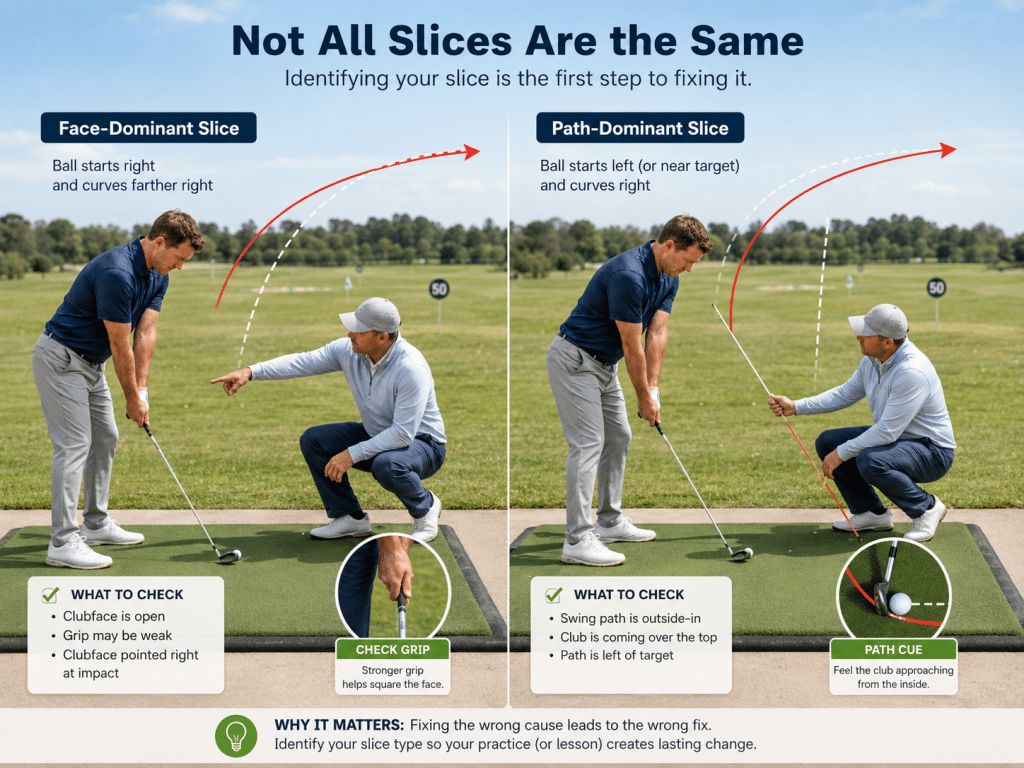
A face-dominant slice can often be fixed in one lesson. If your ball starts right of the target and curves farther right, your problem lives in your grip and setup — the pre-swing stuff. A competent instructor can diagnose it in five swings, rebuild your grip, and send you home with a ball flight that's dramatically better before you leave the property. The follow-up work is repetition, not further instruction.
A path-dominant slice usually cannot. If your ball starts at or left of the target and curves right, you have an out-to-in swing path. The setup portion (alignment, ball position, stance) is fixable in one session, but if the root cause is sequencing — your upper body starting the downswing ahead of your lower body — that's a motor pattern. Motor patterns take repetitions, and one lesson gives you the drill, not the change.
So the useful reframe: one lesson can always fix your diagnosis. It can only sometimes fix your swing. And an accurate diagnosis is worth the money by itself, because it tells you what to practice for the next three months instead of guessing.
Run the start-line test before you book. It costs nothing and it'll tell you what you're buying.
What a Good Slice Lesson Actually Looks Like
Here's the sequence a competent instructor follows. If your lesson skips these steps, that's information about the instructor.
They watch you hit before they say anything. Five to ten shots minimum, with no coaching. An instructor who starts fixing before they've seen a pattern is fixing a stereotype, not you.
They ask about your history and goals. How long you've played, what you've already tried, whether you want to break 90 or just stop losing balls. A 54-year-old who plays twice a month needs a different plan than a 30-year-old who practices weekly, and a good pro adjusts the prescription accordingly.
They check grip and setup before touching the swing. This is the single biggest tell of quality. Grip, aim, ball position, posture — these explain the majority of amateur slices and take ten minutes to correct. An instructor who goes straight to swing plane while your grip shows one knuckle is skipping the free fix to sell you the hard one.
They give you one thing, not five. You can hold one swing thought. A lesson that ends with a list of six corrections is a lesson you can't use.
They send you away with a drill and a checkpoint. Something you can do at home or the range, plus a way to know if it's working — usually a ball-flight reading, which is the free feedback system you already have.
The Questions to Ask (Before and During)
Before booking:
“Do you use a launch monitor, and is it included in the lesson price?” — For a slice, seeing actual face angle and path numbers removes all guesswork. Some ranges charge extra; know before you go.
“Do you record video I can keep?” — A face-on and down-the-line clip you can review at home makes the lesson last longer than the hour.
“What's your approach with players who mainly want a playable ball flight rather than a rebuilt swing?” — This question separates instructors who fit the fix to the golfer from instructors who teach one method to everyone. There's no wrong answer, but the answer tells you if you're compatible.
During the lesson:
“Is my slice face-dominant or path-dominant?” — Ask it directly. A good instructor will answer immediately and show you the numbers or the ball flight that proves it.
“What's the one thing I should work on before I see you again — and how will I know it's working?” — Forces the specificity you need.
“How long should this take to feel normal?” — Sets your expectations so you don't abandon the change in week one, which is the standard failure.
One Lesson vs. a Package: Which to Buy
The case for one lesson first: you get a diagnosis, you find out whether you and the instructor communicate well, and — if you're face-dominant — you might genuinely be done. Spending $80–120 to discover you need a package is smarter than spending $400 to discover you don't like the instructor.
The case for a package: if you already know you're path-dominant, or your first lesson revealed a sequencing issue, motor-pattern changes need check-ins. Practicing a drill wrong for three weeks is worse than not practicing it. Most packages also come out cheaper per session.
The middle path most recreational golfers should take: buy one lesson, ask the questions above, and decide at the end of it. A trustworthy instructor will tell you honestly whether you need to come back. If they push a package before watching you swing, that's your answer.
What to Do in the Two Weeks After
Lessons fail more often in the follow-up than in the session. Three rules:
Don't add YouTube. The most common way golfers waste a lesson is by supplementing it with online tips that contradict what they were just taught. Give your instructor's change two weeks of exclusive attention.
Expect it to feel wrong. A grip change feels wrong for roughly two weeks; a setup change for a few rounds. Discomfort is the change working, not failing.
Track your start line, not your score. Your score will probably get slightly worse before it gets better, because you're thinking instead of playing. Start line is the honest metric during a change — it tells you whether the face is squaring up regardless of how the round is going.
When a Lesson Isn't the Right Purchase Yet
Honest counsel: if you've never checked your grip, tried moving your ball position, or verified your shoulder alignment, you can test all three this week for free — and roughly 70% of slicers find meaningful improvement there. Do the free work first. Then, if the slice persists, you'll walk into that lesson with real information (“I strengthened my grip to two knuckles and the ball still starts left and slices”), and the instructor can skip the basics and get to the actual cause. That's a far better use of $100 than paying someone to tell you your grip is weak.
The Bottom Line
A face-dominant slice — ball starts right, curves right — can genuinely be fixed in one lesson, because the fix is grip and setup. A path-dominant slice — ball starts left, curves right — gets diagnosed in one lesson and fixed over months, because sequencing is a motor pattern.
Either way, one lesson is almost always the right first purchase. Ask whether you're face- or path-dominant, ask for one thing to work on and a way to measure it, and protect the change for two weeks without adding outside tips.
And do the free stuff first. The best lesson is the one where the instructor doesn't have to spend twenty minutes on things you could have fixed in your garage.
FAQ
Can a slice be fixed in one lesson? Sometimes. A face-dominant slice — where the ball starts right of target and curves farther right — often can be, because the cause is grip and setup and both are correctable within a single session. A path-dominant slice, where the ball starts at or left of target, usually can't be fully fixed in one lesson because the root cause is often a sequencing motor pattern that takes weeks of repetition.
Should I buy one lesson or a package for my slice? Buy one lesson first. It gives you a diagnosis, reveals whether you communicate well with the instructor, and may be all you need if your slice is face-dominant. Decide on a package at the end of that session based on what the instructor finds — and be cautious of anyone pushing a package before watching you swing.
What should I ask a golf pro about my slice? Ask directly whether your slice is face-dominant or path-dominant, what one thing you should work on before the next session, how you'll know it's working, and how long the change should take to feel normal. Before booking, ask whether a launch monitor is included and whether you'll get video you can keep.
What should I do in the two weeks after a golf lesson? Work only on what your instructor gave you — don't supplement with YouTube tips that may contradict it. Expect the change to feel wrong for about two weeks. Track your ball's start line rather than your score, since scores often dip temporarily during a swing change.