

Every golf grip debate eventually comes down to one question you can answer in five seconds without a lesson, a launch monitor, or a training aid: look down at your lead hand and count your knuckles.
The knuckle test is the oldest checkpoint in golf instruction, and it survives because it works. Your grip is the only connection between your body and the clubface, and the way your lead hand sits on the handle largely predetermines where that face points at impact. Get the knuckle count right and a whole family of ball-flight problems — especially the slice — starts to shrink before you change anything else.
Here's how to run the test, what your number means, and the two mistakes that ruin the fix for most golfers.
How to Do the Knuckle Test (Correctly)
Take your normal grip on any club — driver is fine — and hold it out in front of you at address, arms relaxed. Now, without moving your hands, tilt only your eyes down at your lead hand (left hand for right-handed golfers, right hand for lefties).
Count the knuckles you can clearly see on that hand.
Two details make or break the test:
Keep your head in its normal address position. If you rotate your whole head to peer over your hand, you'll see extra knuckles and misread your grip as stronger than it is. Eyes down, head still.
Take your real grip, not your “test” grip. Most golfers subconsciously neaten their grip when they know they're checking it. Grip the club like you're about to hit a drive on the 18th with money on the line, then look.
What Your Knuckle Count Means
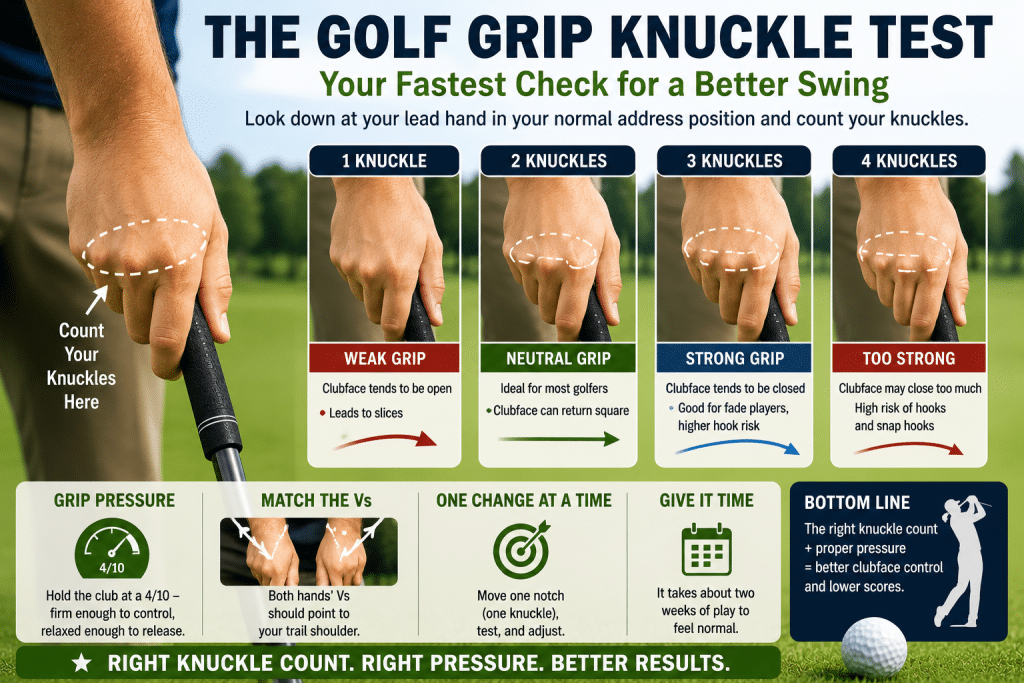
One knuckle or less — weak grip. Your lead hand is rotated too far toward the target. This is the classic slicer's grip: it leaves the clubface open at impact unless you make a perfectly timed compensation with your hands, which almost nobody does consistently at driver speed. If you slice and you see one knuckle, you've very likely found your primary cause.
Two to two-and-a-half knuckles — neutral to slightly strong. This is the zone. The face can return to square without manipulation, and the “V” formed by your thumb and index finger points at your trail shoulder. Most tour players live here. If you're in this range and still slicing, your problem is elsewhere — ball position, alignment, or path.
Three knuckles — strong grip. Playable, and genuinely useful for golfers who fight a fade or lack hand speed. Plenty of good players use it. But it narrows your margin: strong-grip players who also get “handsy” through impact start hooking, and a strong grip with soft grip pressure is a snap-hook recipe.
Four knuckles — too much. The face wants to slam shut. Unless you're deliberately building a low-hook specialty shot, back it off.
The Slicer's Fix: Move One Notch at a Time
If you see one knuckle and you slice, the fix is simple but the dosage matters. Rotate your lead hand away from the target — clockwise for a right-hander — until a second knuckle appears. Regrip, don't just twist your hand on the handle; take the hand off and place it back on in the new position so the club sits correctly in your fingers.
Then hit balls before you change anything else.
The single biggest grip-change mistake is jumping from one knuckle straight to three or four because “more must be better.” It isn't. Over-strengthening trades your slice for a hook, and now you have two misses instead of one. (If that's already happened to you, the next article in this series — I Strengthened My Grip and Now I Hook It — walks through the recovery.)
One notch. Test. Read the ball flight. Adjust again only if the ball still starts right and curves right.
The Hidden Half of the Test: Grip Pressure
Here's what the knuckle count alone won't tell you, and why some golfers strengthen their grip and see no change at all: pressure.
When golfers move to a stronger grip, they almost always squeeze harder at the same time — the new position feels unfamiliar, so the hands clamp down. Tension in the hands and forearms prevents the clubface from rotating back to square naturally, which cancels out exactly what the stronger grip was supposed to give you.
On a 1-to-10 scale, hold the club at about a 4 — firm enough that the club can't twist in your fingers, relaxed enough that someone could slide the club out of your hands with a good tug. Check your pressure at address and at the top of the backswing, because pressure that starts at 4 often creeps to 8 by the transition.
Knuckle count controls where the face points. Pressure controls whether the face is free to square up. You need both.
Lead Hand vs. Trail Hand: Does the Bottom Hand Matter?
The knuckle test is a lead-hand test, and the lead hand does most of the face-control work. But the trail hand can quietly undo a good lead-hand grip.
Quick check: the “V” of your trail hand's thumb and index finger should also point toward your trail shoulder, roughly parallel with your lead hand's V. If your trail hand slides under the handle (V pointing outside your trail shoulder), you've strengthened the bottom hand independently — a common cause of hooks and blocks even when the lead hand is neutral. If it rides on top (V at your chin or lead shoulder), it weakens the whole grip and reopens the slice door.
Match the Vs. That's the whole rule.
How Long Does a Grip Change Take to Feel Normal?
Honest answer: about two weeks of regular play or practice, and it will feel genuinely wrong for the first three or four sessions. A grip change is the most awkward-feeling adjustment in golf precisely because your hands are the only thing touching the club — every swing reminds you something's different.
Expect a short adjustment window where contact gets slightly worse before ball flight gets better. Most golfers who abandon a grip change quit inside the first week, right before the change would have paid off. If the knuckle test told you your grip was the problem, commit for two weeks before you judge the result.
The Bottom Line
Look down. Count your knuckles. One knuckle and a slice means you've found your fix; move one notch to two knuckles, soften your pressure to a 4, match your trail-hand V, and give it two weeks. It's the cheapest equipment change in golf — it costs nothing, and it's installed before your next round.
FAQ
How many knuckles should I see on my golf grip? Two to two-and-a-half knuckles on your lead hand is the neutral-to-slightly-strong zone that suits most golfers. One knuckle or fewer is a weak grip that commonly causes slices; three is a strong grip that suits fade-fighters but risks hooks; four is too strong for most players.
Can you fix a slice with grip alone? Often, yes — an open clubface is the leading cause of amateur slices, and the lead-hand grip largely controls face angle at impact. Strengthen a weak grip one knuckle at a time and soften grip pressure. If the slice persists after the grip is neutral, ball position, alignment, or swing path is the remaining cause.
Why did strengthening my grip make me hook the ball? You likely over-corrected — moving from one knuckle to three or four instead of two — or kept high grip pressure that suddenly released. Weaken the grip back a half-notch and hold the club at about a 4-out-of-10 pressure.
How long does a golf grip change take to feel normal? Roughly two weeks of regular play. Expect the new grip to feel wrong for the first several sessions; most golfers who abandon the change quit before it pays off.