

Article At A Glance
- A slice is caused by a clubface that is open relative to your swing path at impact — it is a geometry problem, not a mystery.
- Strengthening your grip is the single fastest fix most golfers can make without changing anything else about their swing.
- Aiming left to “play the slice” actually makes the problem worse by reinforcing the out-to-in path that creates it.
- GOLFTEC analyzed 14 million swings and identified three biomechanical causes behind most slices — and all three are fixable with setup changes alone.
- Two specific drills — the Headcover Gate Drill and the Staggered Stance Drill — can train an inside-out path in a single practice session.
Most golfers spend years trying to fix a slice by changing their swing, when the real culprits are hiding in their setup before they even take the club back.
If your ball starts reasonably straight and then curves hard to the right (for a right-handed golfer), you are not alone. The slice is the most common miss in recreational golf, and it is especially punishing with a driver. The good news is that the majority of slices share the same root causes — an open clubface, a weak grip, and a swing path cutting across the ball from outside to in. Fix those three things and the curve disappears, often without a single swing change.
GOLFTEC, which has analyzed over 14 million recorded swings, consistently points to these same biomechanical patterns as the source of most slices. Understanding what is actually happening at impact is the first step toward fixing it permanently. If you want a structured path to better ball striking, GOLFTEC's Swing Evaluation gives you video-backed data on exactly where your slice is coming from.
A Slice Is a Math Problem, Not a Swing Problem
The ball does not lie. Every curve your ball makes is a direct result of physics — specifically, the relationship between your clubface angle and your swing path at the moment of impact. Once you understand that, fixing a slice becomes a process of eliminating specific problems rather than guessing at swing feelings.
What an Open Clubface Actually Does at Impact
When the clubface is open relative to your swing path at impact, it imparts clockwise sidespin on the ball. That spin is what makes the ball curve to the right. The greater the difference between the face angle and the path direction, the more the ball curves. A face that is just a few degrees open can send a driver shot 30 to 40 yards offline by the time it lands.
This is why the slice feels so severe with a driver and barely noticeable with a 7-iron. The driver has the lowest loft of any club in the bag, which means it generates very little backspin. Backspin stabilizes flight and masks the sidespin. A 7-iron has enough loft to create backspin that partially overrides the sidespin. The driver has almost none of that forgiveness, so a slightly open face becomes a dramatic curve.
Why the Driver Makes a Slice Worse
Three things combine to make the driver the worst club in the bag for slicers. First, the club is the longest, which amplifies any timing error in the swing. Second, the ball sits forward in the stance, which tempts you to reach for it at impact and leave the face open. Third, the low loft means every degree of open face is punished more severely than with any other club. If you're struggling with a slice, here's the swing fix that actually works.
Most beginners make this worse by teeing the ball too high, which encourages an upward strike path that also leaves the face open. A simple tee height adjustment — which we will cover shortly — can reduce the severity of the slice without a single change to the swing itself.
How to Read Your Ball Flight to Diagnose the Cause
Before you try to fix anything, read what your ball is actually telling you. Ball flight gives you immediate feedback on two variables: where the face is pointing and where the path is going. For more insights on correcting your slice, check out quick fixes for beginners.
- Ball starts left, curves hard right: Classic over-the-top slice. Face is open to both path and target. Path is out-to-in, face is open.
- Ball starts at target, fades right: Path is closer to neutral, but face is still slightly open. A grip fix alone will often solve this.
- Ball starts right, keeps going right: Face is pointing right at impact. A weak grip and open alignment are the most likely culprits.
- Ball starts straight, then suddenly curves late: You are catching the toe of the club. Strike location is the problem, not the swing path.
Fix Your Grip First — It Closes the Face Without Touching Your Swing
The grip is the only connection between your hands and the club. If it is in the wrong position, the face will be open at impact no matter what the rest of your body does. The fastest slice fix available to most recreational golfers is a stronger grip — and it takes about 30 seconds to change.
What a Weak Grip Looks Like and Why It Keeps the Face Open
A weak grip is not about how tightly you hold the club — it refers to hand position. In a weak grip, both hands are rotated too far toward the target (counterclockwise for a right-hander). This naturally returns the face to an open position at impact because the hands follow their most comfortable rotational path through the swing. You can make a perfect swing and still slice the ball with a weak grip.
You can spot a weak grip instantly: look down at your lead hand (left hand for right-handers). If you can only see one knuckle, or none at all, your grip is too weak. The face will be open when the club returns to the ball, and no amount of swing adjustments will completely overcome it.
How to Strengthen Your Grip in 30 Seconds
Set the club down and pick it up again with intention. Place the grip across the fingers of your lead hand, not across the palm. Rotate that hand clockwise (for right-handers) until you can see two to three knuckles when you look straight down. Then place your trail hand (right hand) on the club so the palm faces the target — again, slightly rotated clockwise relative to where it probably sits now. The V formed between your thumb and forefinger on each hand should point toward your trail shoulder.
That is it. Do not grip tighter. Do not change your stance. Just rotate both hands slightly and re-grip. Hit five balls and watch the curve reduce immediately for most players.
The Knuckle Check: How to Know Your Grip Is Strong Enough
At address, look straight down at your lead hand. Two to three knuckles visible is the target for most recreational golfers fighting a slice. If you only see one, rotate the hand clockwise until you hit two. If you see four, you have gone too far and will likely start hooking the ball. The knuckle count is the fastest self-check you can do and requires no equipment, no video, and no lesson.
Stop Aiming Left — It Makes the Slice Worse
Here is one of the most counterproductive habits in recreational golf: aiming left to compensate for the slice. It feels logical — if the ball goes right, point yourself left. But all it does is make the underlying problem significantly worse.
When you aim left, your swing path follows your body. Your shoulders, hips, and feet are all aligned left of the target, which pulls the club across the ball from outside to in — the exact path that creates the slice in the first place. You are not compensating for the slice. You are training it deeper into your swing every single time you hit a ball.
Why Playing the Slice Trains the Wrong Path
The out-to-in swing path is the engine behind the slice. Every time you aim left and swing left to keep the ball in play, you are reinforcing that path. Over time, it becomes the only path your body knows. Your muscles memorize the movement, your timing adjusts to it, and the slice becomes permanent. What started as a quick fix becomes a swing fault that is genuinely hard to undo.
Most golfers who have been slicing for years are not fighting a bad swing — they are fighting years of muscle memory built around compensating for the slice. Breaking that loop starts with standing square to the target, even when it feels like the ball is going to go 40 yards right. Trust the grip change first. The path will follow.
How to Set Up Square in Three Steps
- Aim the clubface first. Stand behind the ball, pick an intermediate target a foot or two in front of the ball on your target line, and set the face pointing directly at that spot.
- Build your stance around the face. Place your feet, hips, and shoulders parallel to the target line — not aimed at the target itself, but parallel left of it (for right-handers). Use the intermediate target as your guide, not a feeling.
- Check your shoulders specifically. Most slicers align their feet reasonably well but leave their shoulders open. An open shoulder line is enough to pull the club outside and create an out-to-in path even with good foot alignment. A quick check: after you address the ball, hold your club across your shoulders and see where it points. It should run parallel to your target line, not left of it.

Ball Position and Tee Height Are Hidden Slice Causes
Once your grip is stronger and your alignment is square, two setup variables can still quietly keep the slice alive: where the ball sits in your stance and how high you tee it. Both are fast fixes that require zero swing change.
Where Most Beginners Place the Ball (And Why It's Wrong)
Most recreational golfers play the driver too far forward in their stance — sometimes as far as off the big toe of the lead foot. The intention is to catch the ball on the upswing, which is correct in theory. But when the ball is too far forward, the hips and shoulders have already rotated past square by the time the club arrives, leaving the face pointing right of the path. Moving the ball back by just half a ball width — so it sits inside the lead heel rather than off the toe — gives the face more time to square up before impact. Try it for a full bucket before deciding it does not work. Most slicers see an immediate reduction in curve.
How Tee Height Affects the Face Angle at Impact
Tee height changes your attack angle, and your attack angle changes how the face behaves through impact. When the tee is too high, you instinctively hang back to hit up on the ball, which tilts the shoulders dramatically and leaves the face open through the hitting zone. A tee that is excessively low forces a downward strike, which delofts the face and increases sidespin. The sweet spot for most recreational golfers is having roughly half the ball sitting above the top edge of the driver at address.
If you are unsure whether your tee height is contributing to your slice, use foot spray or impact tape on the face for a session. Strike location tells you immediately. Strikes clustered toward the toe almost always accompany a slice, and tee height is frequently the reason. Lowering the tee by a quarter inch and moving the ball back slightly can shift strikes toward the center of the face and take significant curve off the shot — without changing a single thing about your actual swing.
Two Drills That Train an Inside-Out Path Fast
Grip, alignment, and ball position will reduce the severity of your slice significantly. But if your swing path is still cutting across the ball from outside to in, some curve will remain. These two drills train the correct path using feel and feedback, not complicated swing thoughts.
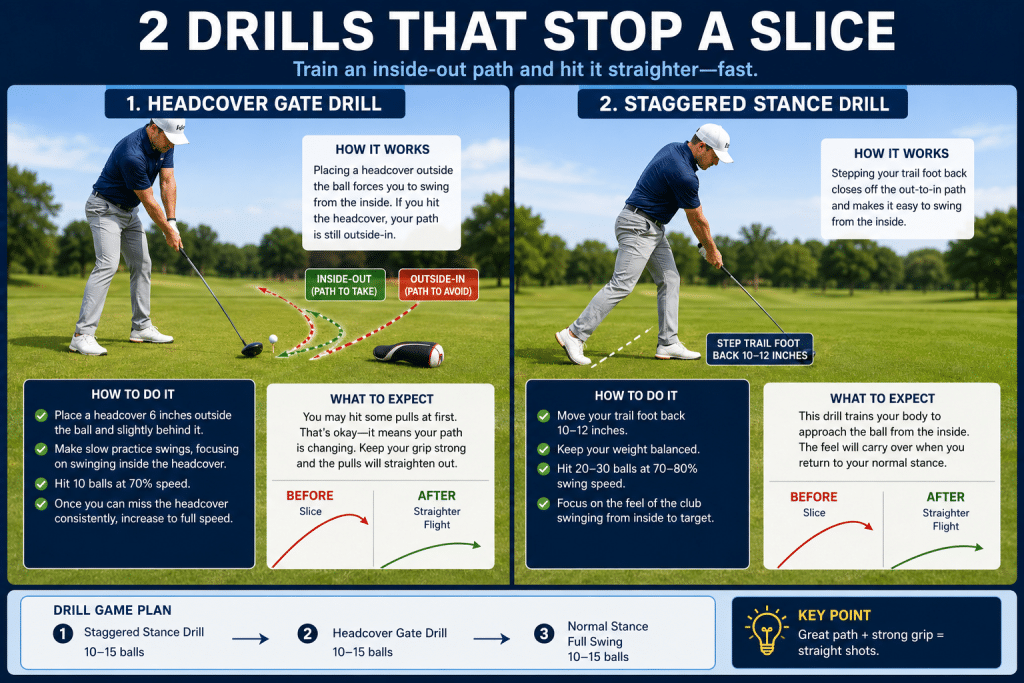
1. The Headcover Gate Drill
Place a headcover or an empty water bottle about six inches outside the ball and slightly behind it — on the far side of the target line relative to where you are standing. The goal is to swing the club down without hitting the headcover. If your path is out-to-in, you will clip it on almost every swing. When you start missing it consistently, your path is coming from the inside.
How to Run the Headcover Gate Drill:
• Set a headcover six inches outside the ball line, level with or just behind the ball.
• Take your normal address position and make slow practice swings first, feeling the club approach from the inside.
• Hit 10 balls at 70% speed, focused only on missing the headcover.
• If you are consistently hitting it, your path is still outside-in — slow down and exaggerate the inside approach.
• Once you can clear the headcover 8 out of 10 times, increase to full speed.
The drill works because it gives you immediate, physical feedback. You do not need to think about swing plane or path angles. You just need to not hit the headcover. The body figures out the rest faster than any swing thought ever could.
One important note: many slicers who try this drill for the first time start hitting pulls or pull-hooks. That is actually a sign of progress. It means the path has changed and now the face needs to catch up. Go back to the knuckle check, confirm your grip is strong enough, and the pulls will straighten out within a session or two.
2. The Staggered Stance Drill
Drop your trail foot back about 12 inches from its normal position, creating a staggered stance with the trail foot well behind the lead foot. Now hit balls from this position. The staggered stance physically closes off the downswing and makes it almost impossible to swing outside-in. Your body has no choice but to approach the ball from the inside, because the trail foot is blocking the out-to-in motion.
Hit 20 to 30 balls from the staggered stance at 70 to 80 percent swing speed, focusing on the feel of the club tracking from inside the target line through impact. Then return to a normal stance and try to recreate that same feeling. Most golfers notice the path improvement carries over immediately. If the slice returns after a few swings, go back to the staggered stance for another 10 balls and reset the feeling before continuing.
How to Use These Drills in a Single Practice Bucket
Structure your practice bucket so the drills build on each other rather than competing for your attention. Start with 10 balls using the Staggered Stance Drill at 70% speed — no score keeping, no target, just path feel. Then move to the Headcover Gate Drill for another 10 balls, again at reduced speed. By the time you hit your third set of 10 balls with a normal stance at full speed, your body has already rehearsed the correct motion twice. The slice, if it reappears, will be noticeably less severe.
Do not mix drills mid-bucket. Pick one, complete 10 to 15 swings, then transition. Switching between drills every two or three balls gives your nervous system no time to learn the pattern. Repetition in blocks is how motor skills get stored — your golf swing is no different than learning any other physical skill. One focused 30-minute bucket using this structure will do more for your slice than three buckets of unfocused full swings.
Strike Location on the Face Is a Slice Fix Most Golfers Ignore
Every fix covered so far — grip, alignment, ball position, path drills — targets the causes of an open face and an out-to-in path. But there is a third contributor that almost no recreational golfer thinks about: where the ball is actually making contact on the clubface. Toe strikes are one of the most overlooked slice causes in the game. For more insights on addressing this issue, check out swing fixes that actually work.
When you strike the ball toward the toe of the driver, the gear effect imparts additional clockwise spin on the ball — the same direction as a slice. Even with a neutral path and a reasonably square face, a consistent toe strike will curve the ball to the right. You can fix your grip, square your alignment, and train a better path, and still be fighting a slice if you are catching the toe on every swing. Impact tape or foot spray applied to the face will show you exactly where you are striking the ball after just five swings.
If your strikes cluster toward the toe, the most common fix is simple: stand slightly closer to the ball at address. Most toe strikers are standing too far from the ball, which forces them to reach at impact and catch the outer edge of the face. Move an inch closer, check that the ball is positioned inside the lead heel rather than off the toe, and re-test. Strike location moving toward the center of the face typically reduces curve immediately, without any other changes.
Run This Checklist Before Your Next Round
Before you step onto the first tee, run through this quick five-point check. It takes less than two minutes and covers every major slice cause discussed in this article:
- Grip: Two to three knuckles visible on the lead hand. V's pointing toward the trail shoulder.
- Alignment: Clubface aimed at the target first. Feet, hips, and shoulders parallel to the target line — not aimed at it. Shoulders checked specifically.
- Ball position: Inside the lead heel, not off the toe. Half a ball width back from where you usually play it if the slice is severe.
- Tee height: Half the ball above the top edge of the driver. Not higher.
- Strike location: If you have impact tape, put it on for the first three drives of the round. Confirm you are hitting the center, not the toe.
If you do all five and the ball still curves, the path drill work needs more time on the range. But for the majority of recreational golfers, this checklist alone will produce a noticeably straighter ball flight within the first few holes.
Frequently Asked Questions
These are the most common questions golfers ask when trying to stop slicing — answered directly, without the usual runaround.
Can I fix a slice without taking a lesson?
Yes — and most recreational golfers can fix the majority of their slice with setup changes alone before a lesson is ever necessary. Grip, alignment, ball position, and tee height are all self-diagnosable and self-correctable. The two drills in this article require no instructor and no equipment beyond a headcover you already own.
That said, if your slice persists after honest work on all five checklist items, a single lesson with video feedback — the kind GOLFTEC provides with every Swing Evaluation — will identify what the setup fixes could not. Some slices do have a deeper swing path cause that is easier to see on video than to feel from the inside.
Why do I only slice with my driver and not my irons?
The driver is uniquely punishing for three reasons that do not apply to irons in the same way:
- Low loft: Less backspin means sidespin dominates the ball flight instead of being partially masked.
- Ball position: The driver is played further forward, which increases the chance of the face being open when the club arrives.
- Club length: A longer shaft amplifies any timing error. Even a small face angle mistake creates a large curve.
Your irons may have a slightly open face too — you just do not notice it because the loft creates enough backspin to straighten the flight. A 7-iron with a mildly open face will fly slightly right of target. That same open face on a driver will slice 40 yards offline.
If you want to confirm this, pay attention to your iron shots for a full round. If they are consistently landing 10 to 15 yards right of where you aimed, the open face is present there too — it is just hidden by loft. Strengthening your grip will improve both your driver and your iron consistency at the same time.
What is the fastest single fix to stop slicing?
Strengthen your grip. Rotating both hands slightly clockwise at address (for right-handers) so that two to three knuckles are visible on the lead hand is the single change that produces the fastest, most consistent improvement for the widest range of slicers. It directly addresses the open face at impact without requiring any change to swing mechanics, timing, or path. Most golfers who make this change correctly see a reduction in curve within the first five balls.
If you make the grip change and the ball still slices, check alignment next. Aiming left compounds the grip problem by creating an out-to-in path that keeps the face open relative to the swing direction. Fix the grip first, then square the alignment, and the two changes together eliminate the slice for the majority of recreational golfers without any additional work.
Does swinging harder make a slice worse?
Almost always, yes. Swinging harder increases clubhead speed, which amplifies any existing spin on the ball. If the face is already slightly open and the path is slightly out-to-in, a harder swing does not fix either of those — it just spins the ball faster and produces a more dramatic curve. This is why many slicers notice their worst shots happen when they are trying to hit the ball the hardest.
The instinct to swing harder when you need distance is natural, but for a slicer it is almost always counterproductive. A controlled swing at 80 to 85 percent with a stronger grip and square alignment will produce a straighter, longer drive than a full-effort swing with an open face. Accuracy creates distance in golf — a straight ball that rolls out on the fairway covers more effective ground than a sliced ball that lands in the rough 40 yards right of the target.
How long does it take to fix a slice?
The timeline depends on how long the slice has been ingrained and how consistently you practice the fixes. Here is a realistic breakdown:
- Setup-only slices (grip, alignment, ball position): Noticeable improvement within one to two practice sessions. Consistent improvement within two to three rounds.
- Path-based slices (out-to-in swing): The drills typically show results within two to three focused range sessions. Full muscle memory change takes four to six weeks of regular practice.
- Long-term compensated slices (years of aiming left): These take longer because the body has deeply encoded the out-to-in path. Expect four to eight weeks of deliberate drill work with a square setup before the new path feels natural on the course.
The most important factor is not how long it takes — it is whether you are practicing the right things. Hitting 200 balls a week at the range with a weak grip and open alignment will not fix a slice. It will make it more permanent. Twenty focused balls with a strong grip, square alignment, and a path drill will outperform that session every time.
Be patient with the process, especially during the first few rounds after making grip and alignment changes. The ball will feel like it is going left. That is not a mistake — it means the face is finally closing. Stay with the changes through at least three rounds before evaluating whether they are working.
One final thought worth remembering: the slice is self-reinforcing when you leave it alone, and self-correcting when you address the actual causes. Grip, alignment, ball position, strike location, and path — fix those five things in that order and the curve will disappear. The swing you have right now is good enough to hit straight golf shots. You just need to stop fighting it with a setup that makes a slice inevitable.
If you want a data-driven look at exactly what your swing is doing, GOLFTEC's video-based Swing Evaluation gives you a clear picture of your face angle, path, and strike pattern so you know precisely which fix to prioritize first.
Related Articles:
- The Golf Grip Knuckle Test
- I Strengthened My Grip and Now I Hook It
- The Traffic Light Method: Diagnose Your Slice
- Do Draw-Bias Drivers Actually Work? –coming soon
- How Many Strokes Does Fixing Your Slice Save? –coming soon