

The Short Answer
A root swing flaw is the single fault in your swing that causes the other faults. Fix it, and three or four of your other problems quiet down on their own. Ignore it, and every drill you do is treating a symptom — which is why you can practice for a year and not get better.
That's the whole idea. It's not complicated. But it runs directly against how most golfers actually practice, which is why so few people improve.
Why You Can Practice for a Year and Not Improve
Here's a pattern almost every mid-handicapper will recognize.
You slice your driver. You look it up. You find that a slice comes from an open clubface, so you work on closing the face. It helps for two range sessions. Then you start hooking, so you back off. Then the slice comes back, but now you're also hitting it fat. So you look that up, and now you're working on weight shift. And on it goes.
You're not lazy and you're not untalented. You're doing something more specific than that: you're treating each miss as its own separate problem, in the order you happened to notice them.
The trouble is that golf swing faults are not independent of each other. They're a chain. A grip problem at address creates a face-control problem at impact. A face-control problem creates a compensating path. A compensating path creates a contact problem. By the time you notice the miss, you're looking at the last link in a chain that started somewhere upstream — usually before the club ever moves.
So you fix the last link. And the chain regenerates it, because everything upstream is still there.
This Idea Is Older Than the Marketing Around It
You'll see “root swing flaw” branded as if it were invented recently. It wasn't. Good instructors have worked cause-first for as long as golf instruction has existed — the standard teaching sequence of grip, then posture and alignment, then swing shape exists precisely because each stage constrains the one after it. Ben Hogan's Five Lessons, published in 1957, is organized this way on purpose.
What is new is the attempt to automate the diagnosis, which we'll get to. But the underlying principle is old, sound, and free. You don't need to buy anything to use it. That matters, and any honest discussion of this should say so up front.
The Chain, In Order
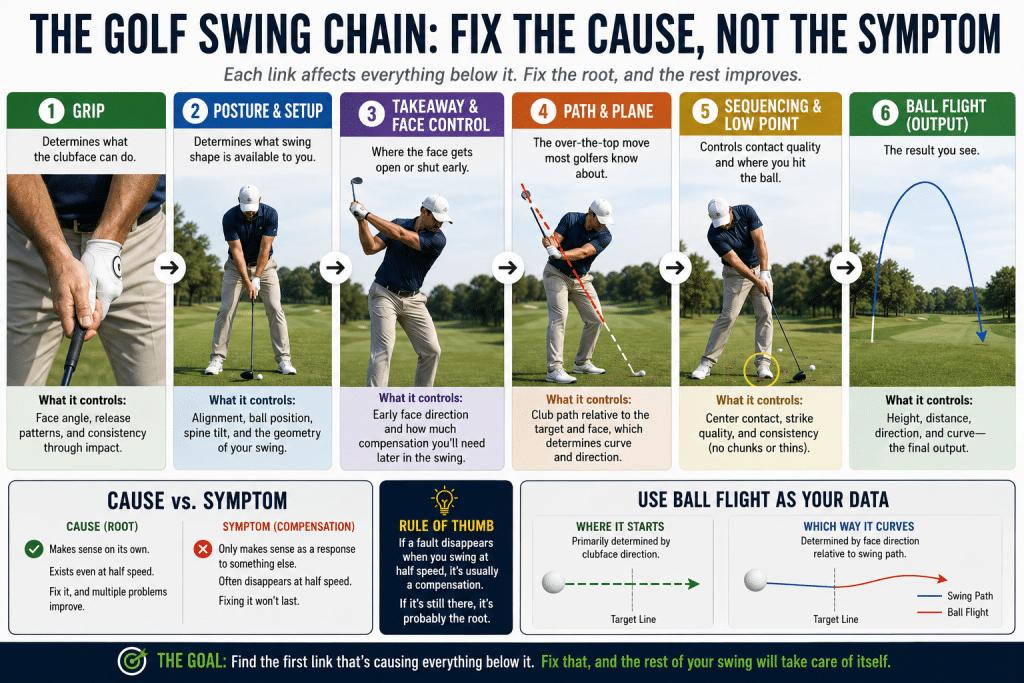
If you want to find your own root flaw, it helps to know what the chain actually looks like. Each of these constrains everything below it:
1. Grip. Determines what the clubface can do. A weak grip makes a square face at impact require active hand manipulation — a timing move you have to repeat perfectly, forever. Most chronic slicers have a grip problem underneath the slice.
2. Posture and setup. Determines what swing shape is available to you. Ball position, spine tilt, and alignment set the geometry. If you're aimed 15 yards left and the ball starts left, that's not a swing fault, that's an aim fault.
3. Takeaway and face control. Where the face gets open or shut early, requiring compensation later.
4. Path and plane. The over-the-top move most golfers know about. Very often a compensation for an open face, not a primary fault — the body senses the ball is going right and the arms throw out to try to steer it back.
5. Sequencing and low point. Early extension, hanging back, casting. These control contact quality and are where chunks and thins live.
6. Ball flight. The output. Everything you actually see.
You experience the swing bottom-up — you see the ball flight and work backwards. But the swing is built top-down. This is why fixing what you see rarely holds.
The Practical Test: What's a Cause and What's a Symptom?
Here's a diagnostic you can run yourself without an app, a coach, or a launch monitor.
Ask: does this fault make sense on its own, or does it only make sense as a response to something else?
An over-the-top move is the classic example. On its own it's irrational — nobody's body chooses a less efficient path for fun. But as a response to a face that's already open at the top, it's completely rational: your body is trying to save the shot. Fix the face and the path often relaxes without you working on it directly.
The same logic applies elsewhere. Hanging back on your trail side is usually a response to the low point being too far back already. Gripping the club tighter is usually a response to not trusting the face.
Rule of thumb: if a fault disappears when you slow down to half speed, it's probably a compensation. If it's still there at half speed, it's probably primary.
That single test will get most golfers closer to their actual root flaw than another twenty YouTube videos will.
Use Ball Flight as Your Data
Your ball flight tells you more than your feel does, because feel is unreliable and the ball doesn't lie.
Two pieces of information matter most:
- Where the ball starts is governed primarily by clubface direction at impact.
- Which way it curves is governed by face direction relative to swing path.
So a ball that starts left and curves hard right tells you the face was closed to target but open to path — a genuinely different problem from a ball that starts right and curves right, which is an open face with a path chasing it.
Most golfers describe both as “my slice” and try the same fix on both. They need opposite corrections.
If you want the full version of this diagnostic, we covered it in detail in the traffic light ball flight method article.
Why “One Thing at a Time” Isn't Just a Slogan
There's a real reason the diagnosis-first approach pairs with working on a single change.
Motor learning research is consistent on this point: conscious attention is a narrow channel. You can hold roughly one swing thought during a motion happening in under two seconds. Golfers who try to manage three or four end up managing none of them and swinging worse than their untrained baseline — which is the “I'm overthinking it” feeling everyone knows.
So the practical sequence is: find the fault furthest upstream, work on that one alone until it's automatic, and only then reassess. The reassessment matters, because once the root is fixed, half your list often isn't there anymore.
Where Apps and Tools Fit In
The bottleneck for most golfers isn't willingness to practice. It's that self-diagnosis is genuinely hard — you can't see your own swing, and your sense of what you're doing is frequently wrong by a wide margin.
That's a real gap, and it's the gap a good instructor fills. It's also the gap several AI swing-analysis products are now trying to fill at lower cost.
Performance Golf's PG1 system is the most aggressive entry in this space, and it's built explicitly on the root-flaw idea — the marketing language above is largely theirs. Since readers are going to encounter it, here's a straight account of what it is and what to watch.
What it does: You film your swing on your phone, and their SwingScan AI identifies what it calls your root swing flaw. The company says the system is trained on over two million swings across 47-plus flaw patterns. It then gives you one drill or focus at a time (a “Smart Step”) and matches you with a coach who specializes in that fault type. Their coaching roster includes Hank Haney, Martin Chuck, Erika Larkin, Eric Cogorno, Andrew Rice, and JT Thomas — genuinely well-regarded instructors.
What it costs: This is where you need to pay attention, because the price you see depends on which page you land on.
- On the public product page: $29/month with a 7-day free trial, $199/year, or $399 for a “Founders” lifetime tier advertised as limited to 1,000 units.
- Through their video sales funnel: the monthly option isn't offered at all. It's $199/year or $399 lifetime.
To be fair about it, the ladder is honest arithmetic. Monthly at $29 is $348 a year, so the annual tier is genuinely cheaper and lifetime is only $200 more than a single year. If the product works for you, lifetime is the rational choice. That's not a squeeze.
What to watch: Performance Golf has a documented history of billing friction. Better Business Bureau complaint records include a case where a trial converted to a $399 charge that the company refunded in full after the complaint, and Trustpilot reviews describe customers being enrolled in multiple programs — including a separately-named “PG1 Champions Pass” at $299 — following phone conversations they understood as informational. The company's responses generally characterize these as trial access rather than completed subscriptions.
That naming overlap is worth understanding: the $299/$399 “Champions Pass” sold by phone is not the same thing as the current in-app subscription tiers, even though the numbers are similar enough to cause confusion on a bank statement.
Practical advice if you buy: Screenshot your order confirmation. Note the exact date any trial period ends and set a calendar alarm two days before. Check your statement 30 and 60 days out. Their stated guarantee is 365 days with a full refund by email — hold them to it in writing, not by phone.
One more thing about “lifetime.” It means the company's lifetime, not yours. Performance Golf reports over $125 million in annual revenue and has operated since 2016, so this isn't a fly-by-night risk. But it's a cloud service with ongoing costs, and “all future upgrades forever” is a promise against an open-ended expense. Worth a moment's thought before you pick lifetime over annual.
You Don't Have to Buy Anything to Start
Before you spend money, spend one range session doing this:
- Film your swing down-the-line with your phone on the ground, propped against your bag. Free.
- Check your grip against a neutral reference — two to two and a half knuckles visible on your lead hand at address.
- Hit ten balls at half speed. Note which faults survive and which disappear.
- Note where the ball starts separately from which way it curves.
The faults that survive at half speed, plus a grip check, plus honest start-direction data will point most golfers at their root flaw. If it does, you've saved yourself $399. If you genuinely can't tell after doing that work, then paying for diagnosis — whether that's an app or an hour with a local pro — is a reasonable purchase rather than a hopeful one.
An hour with a good local instructor, incidentally, typically runs $75–$150 and gets you a human being looking at your actual swing. That's the honest comparison, and it's the one the marketing tends to skip.
Frequently Asked Questions
What is a root swing flaw? A root swing flaw is the single fault in your golf swing that causes your other faults. Because swing faults form a chain — grip affects face control, face control affects path, path affects contact — fixing a downstream symptom rarely holds while the upstream cause is still there. Fixing the root often resolves several other problems at once.
How do I find my own root swing flaw? Swing at half speed and see which faults survive. Faults that disappear when you slow down are usually compensations for something else. Faults that persist are usually primary. Combine this with a grip check and with noting where your ball starts separately from which way it curves.
Is “root swing flaw” a real instructional concept or just marketing? The underlying principle is genuine and long-established — teaching grip before posture before swing shape exists because each stage constrains the next. The specific branded terminology, including “root swing flaw” and “47 flaw patterns,” comes from Performance Golf's PG1 marketing. The idea is real; the branding is theirs.
Is the over-the-top move a root flaw? Usually not. An over-the-top path is most often a compensation for a clubface that is already open at the top of the backswing — your body sensing the ball will go right and throwing the arms out to steer it back. In those cases, fixing face control first will relax the path without direct work on it.
How much does the PG1 app cost? The public product page lists $29 per month with a 7-day free trial, $199 per year, or $399 for a lifetime “Founders” tier. Performance Golf's video sales funnel does not offer the monthly option, showing only the $199 annual and $399 lifetime tiers. Prices should be verified on their site before purchase. You can see current PG1 pricing here.
Should I buy a swing analysis app or take a lesson? An hour with a local PGA instructor typically costs $75–$150 and involves a person watching your actual swing in person. An app costs less per use over time and is available whenever you practice. If you have never had your swing looked at by a qualified person, one in-person lesson is usually the higher-value first purchase.