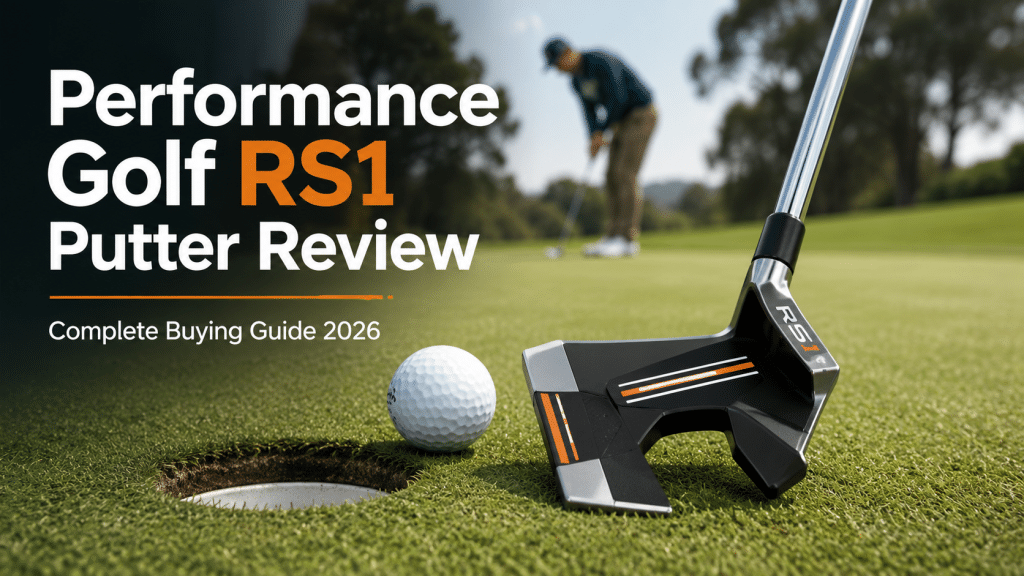
Performance Golf RS1 Putter: The Complete Buying Guide (2026)
The Performance Golf RS1 putter launched in spring 2026 and immediately generated more pre-purchase research traffic than almost any direct-to-consumer golf product in recent memory. The reason isn't just clever marketing — it's because the RS1 uses a genuinely unconventional engineering approach that raises real questions before you commit $399 or more to something that looks and feels nothing like a conventional putter.
This guide answers every one of those questions honestly. We cover the technology, the configurations, the feel, the legitimate concerns about Performance Golf's subscription model, and how the RS1 stacks up against its closest competitors. By the time you finish reading, you'll know exactly whether this putter belongs in your bag — or whether a different club is the smarter choice for your game.
Quick Navigation:
- What Is the RS1 Putter and How Does It Work?
- RS1 vs RS1 Plus vs Founder's Edition: Which Should You Buy?
- Who Is the RS1 Actually For?
- How Does It Feel? Sound, Touch, and Acoustics
- RS1 vs the Competition
- The Subscription and Billing Issue: What You Need to Know
- The 365-Day Return Policy Explained
- Frequently Asked Questions
What Is the Performance Golf RS1 Putter and How Does It Work?
Most putters are designed around one of two philosophies. Traditional mallets and blades concentrate mass behind the shaft axis, which can allow the face to drift open or closed during the stroke. Zero-torque designs like the LAB Golf DF3 attempt to solve this by neutralizing all rotational forces, leaving the face completely passive throughout the swing.

The RS1 takes a third approach called Forward Axis Weighting, also referred to by Performance Golf as Face Down Balance.
Here is what that means in practice: instead of positioning weight behind the shaft or neutralizing it around the shaft axis, the RS1 places over 75% of its 360-gram head mass within the front 25% of the clubhead. This pushes the center of gravity (CG) significantly forward of the shaft entry point.
During your putting stroke, that forward CG works with gravity to actively pull the face back toward square. It isn't a spring mechanism, a gyroscope, or anything artificial — it's pure physics. The forward mass creates a constant, gentle corrective torque that operates throughout the entire stroke arc, reducing the effect of any involuntary face rotation your hands introduce.
The practical result: the RS1 actively assists your stroke rather than staying neutral or passively resisting rotation. For golfers who consistently deliver the face open or closed at impact — even slightly, even without realizing it — this active correction is the core value proposition.
The RS1 was designed by Chris McGinley, a veteran club designer whose work includes equipment developed for eleven world number-one-ranked players. It conforms fully to USGA rules and is legal for all competitive play.
The club sits at 74 degrees lie angle, which is approximately 4 degrees more upright than a standard putter. This positions your eyes directly over the ball at address and encourages a straighter, more compact back-and-through stroke path with less rotational arc.
RS1 vs RS1 Plus vs Founder's Edition: Which Configuration Should You Buy?
Performance Golf offers the RS1 in three configurations. All three share the same 360-gram head, 74-degree lie angle, 3-degree loft, and Forward Axis Weighting geometry. The differences are in shaft material, grip construction, finish, and price.
Performance Golf RS1 Standard — $399
The base model pairs a CNC-machined steel front face with a stepless steel shaft (0.370 tip) and a Dual Pistol Rubber grip.
Who it's for: Golfers who are primarily performance-focused and less sensitive to acoustic feedback. The steel shaft and steel face combination produces a bright, high-pitched sound at impact that some players love and others find jarring. If you're coming from a soft insert putter like an Odyssey White Hot, be aware that the feel profile is dramatically different — firm and crisp rather than soft and muted.
The honest caveat: if feel and sound quality matter to you at all, read the RS1 Plus section below before deciding. The $30 price difference buys a genuinely meaningful upgrade in the tactile experience.
Performance Golf RS1 Plus — $429
The RS1 Plus replaces the steel shaft with a 15mm low-torque graphite shaft and upgrades the grip to a Dual Pistol Polyurethane construction.
The key difference: the graphite shaft acts as a vibration dampening system, absorbing the high-frequency energy generated at the steel face before it reaches your hands. The acoustic profile shifts from the bright “ting” of the base model to a deeper, more controlled “tock” at impact — comparable to premium dampening shafts like the Fujikura MC Smooth.
Who it's for: Golfers who have refined feel sensitivity, those coming from soft-insert putters, senior golfers who prefer a quieter feedback profile, and anyone who has read about the base model's acoustics and already knows that sound matters to them. For most buyers, the RS1 Plus is the version worth buying. The $30 differential is genuinely justified by the feel improvement alone.
Performance Golf RS1 Founder's Edition — $449
The Founder's Edition was a limited production run of exactly 500 units worldwide, produced to generate brand prestige and reward early adopters. It features a CNC-machined 303 stainless steel face, carbon composite crown, aluminum T-wing tail, custom Founders graphite shaft, and a premium all-black finish.
What 303 stainless steel actually means: 303 is a specific alloy chosen by premium putter manufacturers — including Titleist for their Scotty Cameron studio select line — specifically for its softer, more dampened impact feel compared to harder stainless variants. Combined with the custom graphite shaft, the Founder's Edition produces the warmest, most refined feel profile in the RS1 lineup. The all-black finish is also considerably more understated and premium-looking than the standard silver and carbon colorway.
The availability reality: with only 500 units produced globally, Founder's Edition availability at retail pricing is extremely limited at this stage. Units that do surface on the secondary market are already trading above the $449 retail price.
Who it's for: Serious gear enthusiasts who want the best-performing version of the club, collectors who understand limited production run dynamics, and golfers for whom the premium black aesthetic genuinely matters.
RS1 Configuration Comparison Table
| Feature | RS1 Standard | RS1 Plus | Founder's Edition |
|---|---|---|---|
| Price | $399 | $429 | $449 |
| Face Material | Steel | Steel | 303 Stainless Steel |
| Shaft | Stepless Steel | 15mm Low-Torque Graphite | Custom Founders Graphite |
| Grip | Dual Pistol Rubber | Dual Pistol Polyurethane | Custom |
| Finish | Silver / Carbon / Black | Silver / Carbon / Black | All Black |
| Sound Profile | Bright / Crisp | Muted / Deep | Warm / Refined |
| Production | Open | Open | 500 Units Only |
| Best For | Value-focused buyers | Most buyers | Enthusiasts / Collectors |
Who Is the RS1 Putter Actually For?
This is the most important question to answer honestly, because the RS1 is not the right putter for every golfer — and understanding who benefits most will save you from an expensive mistake in either direction.
Golfers Who Benefit Most
Mid-handicappers with a reasonably consistent stroke: Counterintuitively, the RS1 often shows the most measurable improvement for golfers who already putt reasonably well. If you're a 10 to 18 handicapper who makes most of your short putts but consistently leaks 8 to 15 footers, you're likely losing strokes to micro-face-rotation you cannot feel or consciously correct. The RS1's active gravitational correction removes that invisible variable.
Golfers with a documented open or closed face tendency: If you've been SAM LAB tested or had your putting stroke analyzed and you know you consistently deliver the face open at impact, the RS1 was literally engineered for your problem. The corrective torque works directly against a systematic directional bias in a way that passive zero-torque designs cannot.
High-handicappers and newer golfers struggling with short putts: Missed putts inside six feet are almost always a face angle problem, not a distance control problem. The RS1's gravitational squaring mechanism has its maximum effect on short, compact strokes — meaning the four to eight foot range where recreational golfers lose the most shots is precisely where the RS1 delivers its most immediate improvement.
Golfers who want a straight back straight through stroke path: The 74-degree upright lie angle naturally promotes a straighter stroke arc with less face rotation throughout the motion, complementing the Forward Axis Weighting mechanism.
Golfers Who Should Think Carefully
Players with genuinely elite stroke mechanics: If you're a low single-digit handicap with a well-grooved stroke that consistently delivers the face square, the RS1's active correction mechanism may produce a slight overcorrection. In that scenario, the LAB Golf DF3's passive zero-torque design — which expresses your stroke without interference in either direction — is arguably the more appropriate technology.
Golfers who prioritize lag putting distance control above everything else: The forward-weighted head requires a calibration period on longer putts. Most golfers adapt within three to five practice sessions, but if your primary putting weakness is distance control rather than face angle, the adjustment period is worth factoring into your decision.
Golfers with strong acoustic preferences for soft insert putters: If the pillowy feel of a White Hot insert or a soft polymer face is non-negotiable for you, the base RS1 Standard will feel dramatically different. The RS1 Plus mitigates this significantly, but even with the graphite shaft upgrade, the steel face produces a firmer, crisper contact sensation than insert putters.
How Does the RS1 Feel? Sound, Acoustics, and Touch
Feel is subjective, but the RS1's feel profile is distinctive enough that it deserves specific attention rather than vague generalities.
The Base RS1 Standard
The combination of the steel face and steel shaft produces a high-pitched, bright sound at impact. Reviewers consistently describe it as a “ting” or “ping” — not unpleasant in an absolute sense, but distinctly different from the muted, soft feedback of insert putters or high-end milled aluminum designs. If you've spent years with an Odyssey White Hot, a Scotty Cameron, or any putter with a polymer or urethane insert, the base RS1's acoustic profile will require adjustment.
The firm feel does provide excellent feedback on off-center strikes — you know immediately when you've missed the sweet spot, which has practice value. But for golfers who use sound and feel primarily as a comfort mechanism during the stroke, the brightness of the base model can increase rather than decrease tension.
The RS1 Plus
The graphite shaft transforms the feel profile meaningfully. By absorbing high-frequency vibration before it travels up the shaft, the Plus shifts the acoustic feedback from bright to muted — most reviewers describe the impact sound as a solid, controlled “tock.” This is the version of the RS1 that sits closest to the feel profile of premium milled steel putters from traditional manufacturers.
The Dual Pistol Grip
Both the rubber and polyurethane versions of the Dual Pistol grip are designed around the natural creases of the hands to reduce grip pressure during the stroke. Lower grip pressure is directly correlated with reduced wrist rotation, which complements the face-squaring technology built into the head.
The grip accommodates multiple putting styles without modification:
- Conventional grip: The dual-sided profile maintains a square grip reference throughout the stroke
- Cross-handed grip: The long, flat-sided shape provides a stable platform for lead hand placement lower on the grip
- Claw grip: The flat-topped profile offers a consistent guide for the trailing hand
Related Reading: RS1 vs RS1 Plus: Is the Graphite Shaft Upgrade Worth the Extra $30?
How the RS1 Compares to Its Closest Competitors
RS1 vs LAB Golf DF3
This is the comparison that generates the most search traffic and the most genuine confusion because both putters are marketed as solutions to the same problem — face angle inconsistency — but they use fundamentally different engineering philosophies to address it.
LAB Golf DF3: Uses Lie Angle Balancing to position the center of gravity directly on the shaft axis, eliminating all rotational torque. The face has no tendency to open or close — it stays wherever the golfer places it throughout the entire stroke. This is a passive system.
Performance Golf RS1: Uses Forward Axis Weighting to position the CG forward of the shaft axis, creating an active gravitational pull toward square. This is an active corrective system.
The practical difference comes down to what your stroke actually does. If you have elite mechanics that consistently deliver the face square and you want a putter that expresses that stroke with perfect neutrality — LAB Golf is the argument. If you have any systematic face rotation tendency that you cannot eliminate through technique alone, the RS1's active correction directly addresses your specific problem in a way that passive neutrality cannot.
Price is also a meaningful differentiator. The LAB Golf DF3 runs approximately $600 to $800 or more depending on configuration and customization. The RS1 starts at $399 with a 365-day return guarantee.
Related Reading: RS1 vs LAB Golf DF3: Active vs Passive Face Squaring — Full Technical Comparison
RS1 vs S7K Stand Alone Putter
The S7K Stand Alone putter — targets a similar demographic of recreational golfers looking for technology-assisted alignment solutions. The S7K's primary feature is a weighted head design that allows the putter to stand upright on the green, assisting with alignment at address.
Where the RS1 wins this comparison decisively is in feel and build quality. The S7K is widely reported to produce a harsh, hollow acoustic profile at impact — frequently compared to hitting a ball with an aluminum softball bat. The RS1, even in base configuration, produces a noticeably more premium contact sensation with a more solid, multi-material construction.
The S7K addresses alignment at setup. The RS1 addresses face angle throughout the stroke. These are different problems, and most golfers who miss putts are losing them mid-stroke rather than at address.
RS1 vs TaylorMade Spider
The TaylorMade Spider series uses high moment of inertia (MOI) through rear perimeter weighting to resist twisting on off-center hits. It is a stability-focused design that does not actively address face rotation during the stroke.
The RS1's forward mass concentration does create a modest MOI tradeoff compared to extreme perimeter-weighted designs like the Spider — the aluminum T-wing tail compensates for some of this, but a traditional rear-weighted mallet will offer marginally higher twist resistance on significant heel-and-toe mishits from long distance.
For most recreational golfers putting inside 40 feet, this MOI difference is not perceptible in practice. The RS1's active face-squaring benefit outweighs the marginal MOI advantage of rear-weighted mallets for players with any face rotation tendency.
RS1 vs Kirkland Signature KS1
The Kirkland KS1 — is a traditional heel-toe weighted blade putter made from fully milled 303 stainless steel, available from Costco for approximately $100. It is a genuinely excellent putter for its price point.
The honest comparison: the KS1 is a well-made traditional blade that expresses your stroke with no corrective assistance. If your stroke is already technically sound and you're primarily looking for quality milled steel construction at a low price, the KS1 is a legitimate choice.
The RS1 at $399 makes sense when your stroke has a measurable face angle problem that practice and technique have not resolved. The 365-day return policy effectively converts the price differential into a risk-free technology trial — if the RS1 doesn't improve your putting measurably within a year, you return it.
The Performance Golf Subscription Issue: What You Need to Know Before Buying
This section is the most important thing to read if you're planning to purchase directly from Performance Golf's website. It's also the reason many golfers choose to buy through authorized retailers instead.
Performance Golf operates primarily as a direct-to-consumer digital marketing company. Alongside their physical equipment, they sell digital training platforms including the PG1 Membership, Scratch Club, and VIP Coaching packages. When purchasing the RS1 directly through their website, buyers are typically offered “free trials” for these digital products during or after the checkout process.
If these trials are not actively canceled within their designated windows — typically 14 to 30 days — they automatically convert to recurring annual charges. The most commonly reported charge is approximately $299. This billing model has generated over 800 complaints with the Better Business Bureau over the past three years, and has prompted investigation by consumer protection law firms specializing in automatic renewal practices.
If you've already purchased directly and need to cancel a trial subscription:
- Email: [email protected]
- Phone: 1-833-PG1-GOLF (1-833-741-4653)
- Cancel before your trial window closes to prevent automatic billing conversion
Related Reading: Buying the performance golf RS1 putter without the subscription headaches
The 365-Day Return Policy: What It Covers and How It Works
Performance Golf backs the RS1 with a 365-day money-back guarantee — one of the longest return windows in the golf equipment industry. This policy is a direct response to the RS1's unconventional technology and the legitimate hesitation buyers feel before committing to something this different from a conventional putter.
What the policy covers: the physical RS1 putter, regardless of how long you've used it, within 365 days of purchase.
How the return process works:
- Contact Performance Golf customer service to request a Return Merchandise Authorization (RMA) number — returns without an RMA are not processed
- Package the club in its original packaging with the RMA number clearly marked
- Ship to: Argo Shipping Company, C/O Performance Golf, 1301 Ridgeview Drive, McHenry, IL 60050
Does the guarantee apply if you buy through GolfersParadise? Yes — the 365-day guarantee is attached to the product by the manufacturer and applies regardless of where the physical club was purchased. We recommend retaining your purchase confirmation and original packaging to document your purchase date if a return ever becomes necessary.
Important distinction: the 365-day guarantee covers the physical putter only. Digital subscription cancellations are handled separately through Performance Golf's customer service team and have different timelines and processes.
Frequently Asked Questions
Does the Performance Golf RS1 putter conform to USGA rules? Yes. The RS1 is fully USGA conforming and legal for all competitive amateur and professional play.
What is the difference between the RS1 and the RS1 Plus? The RS1 Plus replaces the steeples steel shaft with a 15mm low-torque graphite shaft and upgrades the grip from rubber to polyurethane. The graphite shaft significantly dampens the bright acoustic feedback of the steel face, producing a softer, more muted feel at impact.
How long does it take to adjust to the RS1? Most golfers adapt within three to five dedicated practice sessions on the putting green, not three to five rounds. The primary adjustment is distance calibration on lag putts — the forward-weighted head changes the pendulum dynamics slightly from conventional putters. Short putt improvement is typically immediate. We recommend two dedicated practice green sessions before taking the RS1 into competitive play.
Is the RS1 available for left-handed golfers? Yes. The RS1 is available in both right-handed and left-handed configurations at the standard 35-inch length.
Does the RS1 putter work with a cross-handed or claw grip? Yes. The Dual Pistol grip's long, flat-sided profile accommodates conventional, cross-handed, and claw grip styles comfortably.
What is Forward Axis Weighting? Forward Axis Weighting is the engineering principle behind the RS1, in which over 75% of the putter head's mass is concentrated in the front 25% of the clubhead. This positions the center of gravity forward of the shaft axis, creating an active gravitational force that pulls the putter face toward square during the stroke.
Is Performance Golf a legitimate company? Performance Golf is a legitimate company that produces genuinely well-engineered physical golf equipment. Their RS1 putter has received serious positive coverage from credible equipment review platforms including Plugged In Golf and Breaking Eighty. The legitimate concern surrounding the company relates specifically to their digital subscription upsell model, not to the quality of their physical products.
What is the RS1 Founder's Edition and is it still available? The Founder's Edition is a limited production run of 500 units featuring a 303 stainless steel face, custom graphite shaft, and premium all-black finish. Availability at retail pricing is extremely limited.
Can I get the RS1 in a custom length? The standard RS1 is available at 35 inches in both left and right-handed configurations. Contact Performance Golf's customer service or speak with our fitting team for custom length options.
Our Verdict
The Performance Golf RS1 putter is a genuine engineering achievement that solves a real and common putting problem — involuntary face rotation — more directly than any conventional putter design. The technology is sound, the build quality is legitimate, and the 365-day return policy removes the financial risk from what is admittedly an unconventional commitment.
Buy the RS1 Standard if you're primarily budget-focused and acoustic feedback doesn't concern you.
Buy the RS1 Plus if feel quality matters to you at all — for most buyers, this is the right version.
Buy the Founder's Edition if you want the best-performing configuration and can find one at retail price.
Consider the LAB Golf DF3 instead if you're a low handicapper with verified elite stroke mechanics who wants passive neutrality rather than active correction.
Skip the RS1 entirely if your primary putting weakness is distance control rather than face angle, or if soft insert feel is genuinely non-negotiable for you.

Last updated: June 2026. Pricing and availability subject to change. All specifications sourced from Performance Golf's official product pages and verified through independent equipment review platforms.
Does the RS1 putter come with a head cover?
Hey Mike
Great question! Yes — my RS1 arrived with a headcover included. It’s a black, red, and white design that matches the putter’s bold look, and it’s decent quality for a stock cover.
(The limited Founders Edition even comes with a premium orange leather version.) I’ll note that Performance Golf’s product page doesn’t explicitly advertise the headcover, so if it’s a make-or-break detail for you, it never hurts to confirm with their support team at checkout — but mine came with one.
One tip from experience: the RS1 is a center-shafted putter, so if you ever want an aftermarket cover, make sure you buy one made for a center-shaft design. My regular heel-shafted mallet cover doesn’t sit on it correctly.
And keep in mind the RS1 comes with a 365-day return policy, so there’s very little risk in finding out all these little details for yourself. Thanks for asking!