
Article-At-A-Glance: What Lie Angle Actually Does to Your Putting
- Putter lie angle is the angle between the shaft and the sole of the putter — and getting it wrong quietly causes left and right misses on every single putt.
- Most putters ship with a lie angle of around 70 degrees, but that number is just a starting point — your posture, arm length, and torso shape all determine what you actually need.
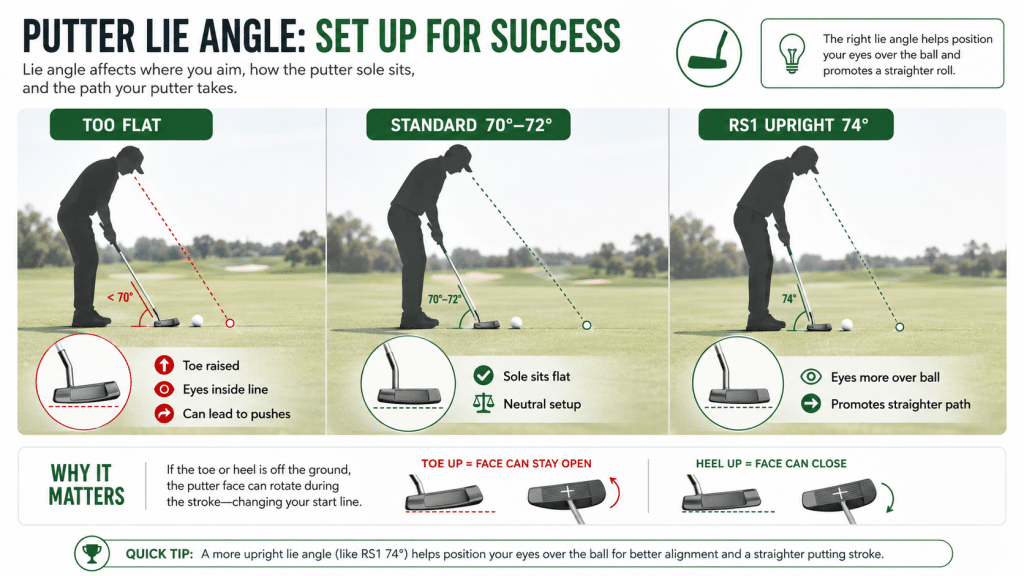
- A lie angle that is too upright lifts the toe at address and pushes putts left; too flat raises the heel and sends putts right — and most golfers never connect the dots.
- L.A.B. Golf has built an entire putter fitting system around Lie Angle Balance technology, designed to remove torque from the stroke entirely.
- Height alone does not determine your ideal lie angle — two golfers of identical height can need completely different specs, which is why fitting matters more than most players think.
Most Golfers Miss Putts Because of This One Spec
Your putting stroke might be perfectly repeatable, your read spot-on, your speed dialed in — and you can still miss putt after putt because the putter in your hands was built for someone else's body.
Lie angle is one of the most overlooked specs in all of golf equipment. While players obsess over blade vs. mallet, face insert feel, and alignment aids, the angle at which the shaft meets the sole quietly wrecks directional control for millions of golfers every round. The fix is often simpler than you think, but first you have to understand what is actually happening.
For golfers serious about dialing in every spec, L.A.B. Golf has built their entire putter line around solving this exact problem — using a proprietary Lie Angle Balance fitting process to match each putter precisely to each player's stroke.
What Putter Lie Angle Actually Means
Putter lie angle is the angle formed between the shaft of the putter and the sole (the bottom of the putter head) when the putter is resting flat on the ground. Picture the putter sitting square on a flat putting surface — the angle you see between the shaft going up and the ground going sideways is the lie angle.
The Angle Between the Shaft and the Sole
At one extreme, a 90-degree lie angle would position the shaft perfectly vertical — completely straight up and down. The Rules of Golf actually prohibit this. At the other extreme, a very flat lie angle would have the shaft nearly parallel to the ground.
Real-world putters live somewhere in between, with the shaft tilted at a meaningful angle that directly affects how the putter interacts with your body, your posture, and ultimately the face direction at impact. For those interested in exploring different putter options, consider checking out the best putters for mid-handicappers to find one that suits your needs.
Why 70 Degrees Is the Standard Starting Point
Most putters manufactured today are built and shipped with a lie angle of approximately 70 degrees. This number has become a de facto industry standard because it works reasonably well for a broad range of golfers standing at average height with average arm length and average posture. But reasonable for many is not optimal for you — and in putting, even a small directional error compounds over distance. A lie angle that is off by just a few degrees can move the ball several inches offline by the time it reaches a hole 10 feet away.
Why Lie Angle Is Not the Same as Loft
These two specs get confused regularly, even among experienced golfers. Loft refers to the angle of the putter face relative to vertical — it affects how quickly the ball transitions from skidding to rolling after impact. Lie angle, by contrast, is about the shaft's relationship to the ground and affects directional control. Both matter, both are adjustable, and both should be considered in a proper fitting — but they are solving completely different problems. For more insights on putter selection, check out our comparison of RS1 vs S7K putter.
How the Wrong Lie Angle Causes Directional Misses
When your lie angle does not match your natural setup and posture, one end of the putter head lifts off the ground at address. That imbalance does not just look awkward — it physically changes the direction the face points at impact, even if your stroke feels completely normal to you.
Too Upright: Why the Toe Lifts and Putts Go Left
If your putter's lie angle is too upright — meaning the degree number is higher than what your posture requires — the toe of the putter rises off the ground when you sole it at address. The heel stays down, the toe comes up, and the face subtly closes relative to your target line. For a right-handed golfer, this consistently pushes putts to the left. The stroke itself can be fundamentally sound, but the equipment geometry is working against you on every single putt.
This is especially common among taller golfers or players who stand more upright over the ball. They are often fitted with longer putters in an attempt to match their height, which can inadvertently make the lie angle problem worse if the shaft angle is not adjusted accordingly.
Too Flat: Why the Heel Rises and Putts Go Right
The opposite problem happens when the lie angle is too flat. The heel of the putter lifts at address, the toe drops, and the face opens slightly relative to your intended line. For right-handed golfers, this produces consistent misses to the right. It is a pattern that looks like a stroke path problem or even a mental block, when in reality the putter simply does not match the golfer's body.
Shorter golfers and players who bend more aggressively from the hips tend to run into this issue. They crouch lower, their hands drop closer to the ground, and a standard 70-degree putter that worked at the manufacturer's test bench is now sitting heel-up in their hands.
Quick Reference: Lie Angle Misses for Right-Handed Golfers
Lie Angle Issue What Happens at Address Direction of Miss Too Upright Toe lifts off the ground Misses left Too Flat Heel lifts off the ground Misses right Correctly Fitted Sole rests flat on the ground Ball starts on intended line
For left-handed golfers, the miss directions are simply reversed — too upright sends putts right, too flat sends them left. The physics are identical, just mirrored.
Why Height Alone Does Not Determine Your Ideal Lie Angle
This is the assumption that sends golfers in the wrong direction more than anything else. Height is one input — but arm length, torso length, how aggressively you bend from the hips, and where your hands naturally hang at address all shape your ideal lie angle just as much as how tall you are. For more insights, check out the knuckle test to better understand your setup.
Two golfers who are exactly six feet tall and buy the same off-the-shelf 34-inch putter with a 70-degree lie angle can have completely different results. One golfer may have shorter arms and stand more upright, needing a more upright lie angle of perhaps 72 or 73 degrees. The other may have longer arms and a deeper bend, needing something closer to 67 or 68 degrees. Without fitting, both golfers are essentially guessing — and paying for that guess on every green.
How Lie Angle Interacts With Your Setup and Posture
Lie angle does not exist in isolation. It is deeply connected to how you stand over the ball, where your eyes end up relative to the target line, and how your arms hang naturally from your shoulders. Get the lie angle right and everything else becomes easier. Get it wrong and you spend years compensating for a problem you may not even know you have.
Arm Length and Torso Length Change Everything
How Body Dimensions Influence Ideal Lie Angle
Body Characteristic Effect on Setup Likely Lie Angle Adjustment Long arms relative to height Hands hang lower at address Flatter than standard Short arms relative to height Hands sit higher at address More upright than standard Long torso, short legs Bend more aggressively from hips Flatter than standard Short torso, long legs Stand more upright over the ball More upright than standard
When a fitter watches you putt, they are not just checking whether the putter looks pretty in your hands. They are analyzing where the sole of the putter makes contact with the ground, where your eyes line up relative to the ball, and whether your natural posture is being forced or supported by the putter's geometry.
A putter that forces you into an unnatural posture creates a cascade of problems. Your eye position shifts, your alignment changes, your stroke path adapts to compensate — and suddenly you are working against yourself with every stroke, blaming your technique for a problem that started with the equipment spec on the putter's hosel.
This is why qualified putter fitters spend significant time watching a golfer's natural address position before they ever suggest adjusting a lie angle. The goal is to fit the putter to the golfer's natural, comfortable setup — not to force the golfer to adapt their setup to fit an off-the-shelf putter.
Why Two Golfers the Same Height Can Need Completely Different Lie Angles
Stand two six-foot golfers side by side and they look like they should use identical equipment. But one might have a 36-inch inseam with a short torso, while the other has a 32-inch inseam with a long torso. Their hands hang at completely different heights at address. Their natural bend from the hips is different. The angle at which their arms connect to their shoulders is different. All of these factors feed directly into the lie angle that will allow the putter sole to rest flat on the ground — and they have nothing to do with how tall either golfer is.
Putter Length Makes Lie Angle Problems Worse
How Putter Length Affects Posture, Eye Position, and Lie Angle
Putter Length Issue Posture Effect Eye Position Lie Angle Impact Too short Forces excessive hunch Eyes move outside ball Encourages too-flat lie angle Too long Forces upright stance Eyes move inside ball Encourages too-upright lie angle Correctly fitted Natural, comfortable bend Eyes directly over ball Lie angle sits flush to ground
Putter length and lie angle are not independent variables — they are deeply connected. Change one and you almost always need to revisit the other. This is why buying a putter off the rack without fitting is essentially a two-variable gamble, and most golfers are losing both bets simultaneously without knowing it.
The standard putter length sold in most golf shops is 34 inches for men and 33 inches for women. These numbers, like the 70-degree lie angle standard, are averages built to serve the widest possible market. They are not built to serve your specific posture, arm drop, or eye position. When the length is wrong, it forces your body into a compromised setup — and a compromised setup changes the effective lie angle even if the putter's actual spec is perfectly correct for your dimensions.
Think of it this way: a putter that is built to your correct lie angle but is two inches too long will force you to stand more upright than your natural posture. That upright position effectively makes the putter play more upright than its stamped lie angle — and you end up back in the same position of the toe lifting and putts missing left. The fitting process has to address both specs together, not one at a time. If you're struggling with similar issues, you might find these Tiger Woods putting tips helpful.
Too Short Forces You to Hunch and Pushes Eyes Outside the Ball
When a putter is too short, you bend deeper from the waist to reach the ground comfortably. That deeper bend pushes your eyes outside the target line — meaning you are looking at the ball from an angle, not directly over it. Your brain then perceives the target line as being slightly to the left of where it actually is, and your alignment shifts accordingly. The result is a recurring pattern of pulls and misread lines that feels like a mental or stroke issue but is rooted entirely in equipment length.
The lie angle consequence is equally damaging. Hunching deeper moves your hands lower toward the ground, which effectively flattens the putter's playing lie angle regardless of what the spec sheet says. The heel begins to lift, the face opens, and putts start drifting right — the exact opposite direction from where your misaligned eyes were already aiming.
Too Long Makes You Stand Upright and Moves Eyes Inside the Ball
A putter that is too long pushes you into an artificially upright stance. Your eyes move inside the ball — now you are looking at the target line from a position that makes it appear to angle to the right of its actual direction. Your alignment shifts right to compensate. The upright posture simultaneously plays the lie angle more upright than its spec, the toe lifts, and putts start leaking left. Two alignment errors compounding each other, both caused by one incorrect length measurement.
83% of a Putt's Starting Direction Comes From Face Angle at Impact
Research on putting has consistently shown that face angle at impact accounts for the overwhelming majority of where a putt initially starts — with stroke path playing a secondary role. When lie angle and putter length are both wrong, the face angle at impact is compromised before you even take the putter back. No amount of practice or stroke work will consistently fix a directional problem that is built into the equipment geometry. This is the single most important reason to get fitted before you work on technique.
How to Tell If Your Lie Angle Is Wrong Right Now
You do not need a launch monitor or a fitting appointment to get a quick read on whether your lie angle is causing problems. Start by addressing a putt normally and having someone take a photo from directly behind you at ground level. If the toe of the putter is visibly off the ground, your lie angle is too upright.
If the heel is raised, it is too flat. You can also look at wear marks on the sole of your putter — consistent scuffing on just the toe or just the heel confirms the putter is not sitting flush through impact. A properly fitted lie angle leaves a centered wear pattern across the full width of the sole. Beyond the visual check, the pattern of your misses tells the story: chronic left misses for right-handed golfers point to too upright, chronic right misses point to too flat.
How to Fix a Lie Angle That Does Not Fit Your Stroke
The good news is that lie angle is one of the more straightforward putter specs to correct — at least on traditional metal-necked putters. The solution does not require buying a new putter. It requires a few minutes with a qualified club fitter and the right bending equipment.
Before any bending happens, a proper fitter will first watch you putt in your natural, comfortable stance. They are looking for how the sole interacts with the ground, where your eyes fall relative to the ball, and whether any compensation patterns have crept into your stroke as a result of a poorly fitted putter. Skipping this observation phase and going straight to bending is guesswork — a good fitter never does this.
Once the correct lie angle is identified, the adjustment itself is mechanical. Most traditional blade and mallet putters with a hosel can be bent to a new lie angle using a loft and lie machine — the same tool used for iron fittings. The degree of adjustment needed is usually small, often just two to four degrees in either direction, but the on-course impact is significant.
Most Traditional Putters Can Be Bent by a Fitter in Minutes
If your current putter has a traditional hosel — the small cylindrical neck connecting the shaft to the head — a certified club fitter can almost certainly adjust its lie angle in a single session. The process typically takes less than 15 minutes and costs a fraction of buying a new putter.
Putters with welded necks, insert-style connections, or certain premium face materials may have limitations, so always confirm with your fitter before assuming any putter is adjustable. The key point is that you do not have to start from scratch — your current putter might be one small adjustment away from fitting your game perfectly.
What to Expect From a Putter Fitting Session
A full putter fitting goes well beyond lie angle. A qualified fitter will assess your natural stroke arc to determine the right amount of toe hang, evaluate your eye position to confirm the correct length, measure the static loft on your current putter, and watch your impact patterns on a putting mat or green.
Expect the session to take between 45 minutes and 90 minutes if it is thorough. Fitters working with brands like L.A.B. Golf will also walk through their proprietary Lie Angle Balance process, which involves building the putter to your exact length, lie angle, grip, and shaft specifications after the fitting is complete — rather than pulling something off a shelf and hoping it is close enough.
Lie Angle Balanced Putters: What They Are and Who They Suit
Traditional putter fitting corrects the lie angle so the sole sits flat on the ground at address. Lie Angle Balance technology takes this concept further — it is engineered so that the putter is in a state of gravitational balance at the correct lie angle for each individual golfer. When the putter is in balance, there is no rotational torque trying to twist the face open or closed during the stroke. The face simply wants to stay square.
Most conventional putters, even properly fitted ones, still have some degree of torque because of where the mass is distributed relative to the shaft axis. The toe is typically heavier than the heel, which creates a natural tendency for the toe to rotate downward through the stroke.
Golfers with strong arc strokes use this to their advantage — the toe drop is part of how the face naturally opens on the backswing and closes through impact. But for golfers with a straight or minimal-arc stroke, that rotational torque becomes a source of inconsistency rather than a tool.
Lie Angle Balance putters are engineered so the center of gravity sits directly on the shaft axis at the correct lie angle. Practically speaking, this means the putter can be balanced on a horizontal surface at its correct lie angle without the toe or heel dipping. There is no torque. There is no rotational tendency. The face stays where you put it throughout the stroke — which for many golfers translates directly into more consistent face angle at impact and more putts rolling on their intended line.
How Face-Balanced Putters Differ From Toe-Hang Putters
A face-balanced putter, when balanced on your finger under the shaft, will have the face pointing straight up toward the sky. This means the center of gravity is directly below the shaft axis, and the putter has no tendency to rotate open or closed on its own. Face-balanced putters suit golfers with a straight-back, straight-through stroke because the putter's natural balance matches the stroke's geometry. Mallet-style putters — the large, multi-material heads you see on tour — are almost always face-balanced.
A toe-hang putter, by contrast, will rotate so the toe points downward when balanced on your finger. The amount of drop — full toe hang, mid hang, or slight hang — tells you how much rotational tendency the putter has. Blade putters typically have significant toe hang, making them well-suited for golfers with a pronounced arc in their stroke.
The natural rotation of the putter matches the natural rotation of the face through an arc stroke. Matching your stroke arc to your putter's toe hang is just as important as matching your body geometry to your lie angle — and again, it is something that requires fitting to get right.
What Lie Angle Balance Technology Does to the Stroke
When a putter has true Lie Angle Balance at your specific lie angle — not just face balance, but balance at the angle the putter actually sits in your hands — the result is a stroke that requires significantly less active manipulation to keep the face square.
Many golfers who switch to a Lie Angle Balanced putter report that their stroke feels simpler and more natural almost immediately. There is no need to consciously hold the face open on the backswing to counteract toe drop, and no need to consciously rotate the face closed through impact. The putter's geometry handles it. For golfers who have spent years working on stroke mechanics that were compensating for an unbalanced putter, this can be a genuinely transformative change.
Straight Stroke vs. Arc Stroke: Which Putter Type Fits You
Your stroke shape is the starting point for every putter fitting conversation. A straight-back, straight-through stroke keeps the face square to the target line throughout the entire motion — no rotation, no arc, just a pendulum moving along a single plane.
This stroke pairs naturally with a face-balanced or Lie Angle Balanced putter that has minimal toe hang, because the putter's balance geometry matches the stroke's geometry. Forcing a toe-hang blade into a straight stroke creates the same problem as a wrong lie angle — the equipment and the golfer are working against each other.
An arc stroke is exactly what it sounds like. The putter head travels inside the target line on the backswing, returns square at impact, and follows through back inside the line. The face opens slightly relative to the target line going back and closes through impact. This rotation is intentional and natural — and it requires a putter with some degree of toe hang to complement it.
A full-arc stroke typically suits a blade putter or a putter with significant toe hang. A moderate arc suits a mid-hang or slight toe-hang putter. A qualified fitter will watch your stroke on video or a putting mat to determine which category you fall into before recommending a head style or balance type.
Which Putter to Buy Based on Your Lie Angle Needs
Once you understand your stroke arc, your natural posture, and the lie angle your body geometry requires, the putter selection process becomes much more focused. You are no longer browsing a wall of putters looking for something that feels vaguely right — you are looking for a specific combination of lie angle, length, toe hang, and head style that matches the data from your fitting. That combination is your starting point, not a guess. For more insights, check out this guide on putter specs and lie angle.
Off-the-Shelf Putters vs. Custom-Fitted Putters
Off-the-shelf putters are built to standard specs — typically 33 to 35 inches in length, 70 degrees of lie angle, 3 to 4 degrees of loft, and a toe hang determined by the manufacturer's design priorities rather than your stroke. For a golfer whose body geometry and stroke happen to align with those standards, an off-the-shelf putter can work perfectly well. But that golfer is genuinely lucky rather than strategically equipped.
Custom-fitted putters, by contrast, are built or adjusted to the exact specs identified in a fitting session. The lie angle, length, loft, grip size, grip weight, shaft type, and head style are all selected based on your individual measurements and stroke characteristics. The price premium for a custom-built putter is real — but it is almost always smaller than the price of years of missed putts, expensive putter replacements, and wasted lesson fees spent fixing a technique problem that was actually an equipment problem.
What to Ask a Fitter Before You Buy
Walk into any putter fitting armed with the right questions and you will get far more useful information than a golfer who simply asks to try a few options.
Here is what matters most:
- What is my natural lie angle based on my address position? — This should be the first measurement taken, before any product discussion begins.
- How does my eye position relate to the correct putter length for me? — A fitter should be able to show you exactly where your eyes are relative to the ball with different lengths.
- What is my stroke arc? — Ask them to classify it: straight, slight arc, moderate arc, or strong arc — and explain which toe-hang range that suggests.
- Can my current putter be bent to the correct lie angle? — Before spending on a new putter, find out if your existing one is adjustable.
- What loft am I currently playing, and is it correct for how I set up? — A forward press at address, for example, delofts the putter and changes the effective loft at impact.
- Is a Lie Angle Balanced putter worth considering for my stroke type? — If your stroke is straight or low-arc, this technology is genuinely worth evaluating.
Get Fitted Before You Spend $500 on the Wrong Putter
Premium putters from major manufacturers regularly retail between $300 and $600. Tour-level custom putters from boutique brands can push well past $1,000. These are significant investments in equipment that will directly influence your score on every single hole of every single round you play.
And yet the majority of golfers make this purchase based on how a putter looks at address, how it feels on a few indoor putts at a golf shop, and whether a tour player they admire uses something similar. None of those factors tell you whether the lie angle matches your body.
A putter fitting session from a qualified fitter typically costs between $50 and $150 as a standalone service — and many premium putter brands include fitting as part of the purchase price when you buy direct. That investment gives you data: your exact lie angle, your correct length, your stroke arc classification, and your ideal toe hang. Armed with that data, every putter purchase you make for the rest of your life becomes a smarter, more informed decision. The fitting cost is not an added expense. It is insurance against buying wrong.
The putting green is where scores are genuinely made and lost. Tour professionals average around 29 putts per round. Amateur golfers typically average between 32 and 36 putts — a gap that represents multiple strokes per round, most of which happen inside 15 feet. Closing that gap is not just about reading greens better or developing a more repeatable stroke, though both matter. It starts with having a putter that was actually built for your body, your posture, and your stroke. Lie angle is not a small detail. It is the foundation of every putt you hit.
Frequently Asked Questions
Lie angle questions come up constantly among golfers who are starting to take equipment fitting seriously. Here are the most common ones answered directly.
What is the standard lie angle for a putter?
The standard lie angle for most putters sold off the rack is approximately 70 degrees. This is the angle between the shaft and the sole of the putter when it rests flat on the ground. The 70-degree figure is an industry average designed to suit a wide range of golfers, but it is not a universal prescription. Depending on your height, arm length, torso dimensions, and natural posture, your ideal lie angle could range from around 67 degrees on the flat end to 73 or 74 degrees on the upright end. A proper fitting will identify the exact number your setup requires.
Can I adjust the lie angle on my current putter?
In most cases, yes. Putters with a traditional hosel — the cylindrical neck that connects the shaft to the head — can be adjusted using a loft and lie machine at any qualified club fitting facility. The process is fast, typically taking under 15 minutes, and the cost is usually minimal. The degree of adjustment available will depend on the putter's construction and materials, so confirm with your fitter before assuming any putter is fully adjustable. Putters with welded connections, exotic materials, or non-standard neck designs may have more limited adjustability.
How do I know if my putter lie angle is too upright or too flat?
The most reliable method is to have someone photograph your address position from directly behind you at ground level and check whether the toe or heel of the putter is lifted. Toe up means too upright; heel up means too flat.
You can also examine the wear pattern on the sole of your putter — consistent scuffing on just the toe or just the heel confirms the putter is not making full-width contact through impact, which indicates a lie angle mismatch. Your pattern of directional misses is another signal: chronic left misses for right-handed golfers suggest too upright, while chronic right misses suggest too flat.
Does putter lie angle affect right-handed and left-handed golfers differently?
The physics are identical for both — what changes is the direction of the resulting miss. For right-handed golfers, a lie angle that is too upright (toe lifts) causes putts to miss left, and a lie angle that is too flat (heel lifts) causes putts to miss right. For left-handed golfers, the directions simply reverse: too upright sends putts right, and too flat sends putts left. .
Beyond the directional miss difference, the fitting process and the variables involved — posture, arm length, torso length, eye position — are completely identical for right-handed and left-handed golfers. The same questions need to be answered, the same measurements need to be taken, and the same adjustments are available through a qualified fitter. Left-handed golfers sometimes find fewer off-the-shelf fitting options available to them, which makes the case for a custom-built putter even stronger when a specific lie angle is identified.
Is putter lie angle more important than putter length?
Neither spec exists in isolation — they are interconnected in a way that makes ranking them against each other somewhat misleading. Putter length directly affects your posture and eye position, which in turn affects how the lie angle plays at address. A putter with the correct lie angle but the wrong length will still compromise your setup. A putter with the correct length but the wrong lie angle will still produce directional misses. Both need to be correct simultaneously for the putter to perform as intended.
That said, if you are trying to prioritize where to focus first, lie angle tends to produce the most immediate and measurable impact on directional control. A lie angle that is off by three or four degrees can visibly deflect a putt off line within the first few feet of travel. Length errors tend to manifest more subtly through posture compensation and alignment drift over time. Both matter enormously — but lie angle errors are often more directly connected to the specific misses that cost you strokes on the scorecard.
The most practical answer is to address both at the same time in a single fitting session. Trying to solve one without the other is like fixing the aim on a rifle while leaving the trigger misaligned — you have addressed part of the problem but not the whole system.
A qualified fitter will evaluate length and lie angle together as a single connected system, identify the combination that supports your natural posture and eye position, and give you a putter spec that works as a complete package rather than a collection of isolated numbers. That is when the putting improvements become real and repeatable — and when the investment in fitting starts paying for itself on the very first round.
The putter lie angle is a crucial aspect of your golf setup that can significantly impact your stroke. A proper lie angle ensures that the putter head is flat on the ground, promoting a more consistent and accurate stroke. Understanding how the lie angle affects your setup and stroke can help you make informed decisions when purchasing a putter.