
Range time is the scarcest resource in recreational golf. Between work, a 40-minute drive, and $18 a bucket, most golfers who genuinely want to fix a slice get maybe two sessions a month — which is not enough repetition to change anything.
Here's the good news, and it's bigger than it sounds: most of what causes your slice happens before the ball moves. Grip, alignment, shoulder position, ball position, tension. All of it can be rehearsed at home, at zero cost, in ten minutes, without hitting a single ball.
In fact, for the specific problem of a slice, at-home reps are arguably better than range reps, because on the range you're distracted by ball flight and outcome. At home you can only focus on the position — which is the thing that actually needs to change.
Here are seven drills, ordered from most to least valuable, with what you need for each.
Drill 1: The Mirror Grip Rep (5 minutes, any club)
What you need: a club and a mirror. A phone camera works too.
Take your grip while facing a mirror, then check your knuckle count on the lead hand — you're looking for two to two-and-a-half. Take the grip off entirely. Rebuild it. Check again. Repeat 20 times.
This sounds absurdly simple, and it's the single highest-value at-home drill there is. A grip change fails because it feels foreign, and the only cure for foreign is repetition. Twenty rebuilds a day for two weeks is 280 reps — far more than you'd get in six range sessions, and you can do it during a commercial break.
Checkpoint: by day ten, your hands should find the new grip without conscious thought. That's when it'll survive the first tee.
Drill 2: Shoulder Alignment Mirror Check (3 minutes)
What you need: a mirror positioned in front of you (face-on view) and a club.
Set up as if to hit a driver. Hold a second club across the front of your shoulders and look at where it points relative to square. Most slicers discover their shoulders aim 10–20 yards left of their feet — which is the setup that all but guarantees an over-the-top downswing.
Adjust until the shoulder line matches the foot line, and hold the position for ten seconds so your body records what square actually feels like. Do it five times.
Why it matters at home specifically: you can't see your own shoulders on the course, and you can't judge them by feel. The mirror is the only honest referee, and this is the drill golfers most often skip.
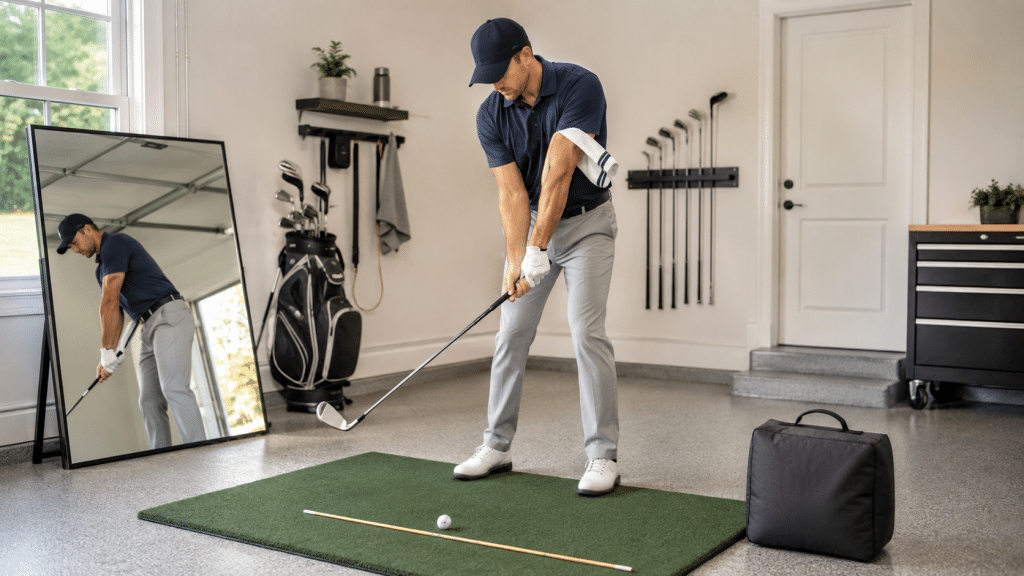
Drill 3: The Towel-Under-Trail-Arm Drill (5 minutes, needs swing space)
What you need: a small towel and enough room for a slow half-swing — a garage or backyard.
Tuck a towel under your trail armpit and make slow, controlled half-swings without dropping it. The towel prevents your trail arm from separating from your body, which is the physical signature of the over-the-top move that produces an out-to-in path.
Go slowly. This drill is worthless at full speed — the point is to teach the connected feeling, not to hit anything.
Checkpoint: you should feel the club working more “around” you and less “over” you. If the towel drops on every swing, shorten the swing until it doesn't.
Drill 4: Grip Pressure Calibration (2 minutes, anywhere)
What you need: a club. That's it. Do it on the couch.
Hold the club at what feels like a 2 out of 10. Then 5. Then 8. Then find 4 and hold it for 30 seconds — that's your target. Do this five times.
Grip pressure is invisible, un-coachable in the moment, and the silent reason many grip changes don't work. Calibrating it at home, without a ball to hit, is the only way to actually learn what a 4 feels like in your hands.
Advanced version: hold a 4 at address, then make a slow backswing and check whether your pressure has crept to an 8 at the top. It probably has. That spike is what prevents the face from squaring.
Drill 5: Ball Position Rehearsal With an Alignment Stick (5 minutes)
What you need: an alignment stick or a spare club, and floor space. A driveway or lawn is ideal.
Lay the stick on the ground perpendicular to your target line, at the inside of your lead heel. Set up to it repeatedly, checking that a real ball would sit at that spot rather than off your lead toe. Take 15 setups.
Ball position drifts by a quarter-inch at a time over months, which is why it's worth rehearsing rather than assuming. Fifteen reps at home resets the reference point your body uses on the tee.
Drill 6: Slow-Motion Path Rehearsal (5 minutes, needs space)
What you need: room for a full slow swing, no ball.
Make full swings at about 25% speed, exaggerating an in-to-out path — feeling like the club travels toward the right field for a right-hander. No ball means no outcome anxiety, so you can actually feel the new motion rather than steering toward a target.
Important caveat: this drill only helps after your face is closer to square. Rehearsing an in-to-out path while your face is still wide open builds a bigger face-to-path gap and a worse slice. Do Drill 1 first, for two weeks, before adding this one.
Drill 7: Impact Bag or Cushion Work (5 minutes)
What you need: an impact bag, or a firm couch cushion / stuffed duffel against a wall.
Swing slowly into the bag and hold the position at “impact.” Check three things: your hands are ahead of the clubhead, your chest is rotating toward the target rather than spinning open early, and — the key one — the clubface is square against the bag, not open.
This gives you the tactile feedback of a squared face at impact, which is precisely the sensation that's missing from a slicer's swing.
Building a 15-Minute At-Home Routine
You don't need all seven daily. Here's a realistic split:
Daily (10 minutes): Drill 1 (grip reps), Drill 4 (pressure), Drill 2 (shoulder mirror check).
Three times a week (add 10 minutes): Drill 5 (ball position), Drill 3 (towel), Drill 7 (impact bag).
After two weeks of the above: add Drill 6 (path rehearsal), once the grip is automatic.
That's a genuinely realistic amount of practice for someone with a job and a family — and it targets exactly the pre-swing variables that cause the majority of amateur slices.
What At-Home Practice Can't Do
The honest limits. Without ball flight, you get no feedback on whether the changes are working — you're building positions on faith until your next round. So the routine above should be paired with reading your ball flight the next time you play or hit balls, using the traffic light system, so you can confirm the at-home work is landing.
At-home drills also can't fix strike location, and they can't diagnose a sequencing problem. If your grip is verifiably neutral, your alignment is square, and the ball still starts left and slices, no amount of garage rehearsal replaces a session with a launch monitor.
The Bottom Line
Your slice was built before the club ever started moving — in your grip, your shoulders, your ball position, and your grip pressure. All four are rehearsable in a garage, in ten minutes, for free.
Twenty grip rebuilds a day for two weeks will do more for your ball flight than four buckets of range balls hit with the grip that caused the problem. Start with Drill 1 tonight, add the mirror check, and let your next round tell you whether it's working.
FAQ
Can you fix a golf slice without hitting balls? Largely, yes. Most slice causes are pre-swing — grip, shoulder alignment, ball position, and grip pressure — and all four can be rehearsed at home with a mirror and a club. At-home reps are often more effective for these than range sessions, because you're focused on the position instead of the outcome.
What is the best at-home drill for a slice? Mirror grip repetitions. Take your grip, check for two to two-and-a-half knuckles on your lead hand, remove the grip, and rebuild it — 20 times a day. That's roughly 280 reps in two weeks, far more than several range sessions provide, and it's what makes a new grip survive under pressure on the first tee.
Do I need an impact bag or special equipment? No. A mirror, a club, an alignment stick or spare club, and a towel cover the highest-value drills. A firm couch cushion or a stuffed duffel bag against a wall substitutes for an impact bag.
Should I practice an in-to-out swing path at home? Only after your clubface is closer to square — usually two weeks after starting grip work. Rehearsing an in-to-out path while the face is still wide open widens the face-to-path gap and produces a worse slice, not a better one.