
Article-At-A-Glance: What's Really Causing Your Slice
- Your slice comes from one of two causes — an open clubface at impact, an out-to-in swing path, or a combination of both — and fixing the wrong one wastes your time on the range.
- Clubface angle is the dominant factor in where your ball starts and curves, accounting for roughly 75–85% of the ball's initial direction according to modern ball-flight laws.
- You can self-diagnose your slice in under 60 seconds by reading your ball flight, checking your divot, and running a simple grip check — no launch monitor required.
- Most recreational golfers have a face problem, not a path problem, which is why fixing your swing path alone rarely cures a slice for good.
- Keep reading to find out which drill fixes each cause fastest — and what to do when both problems show up at the same time.
Your slice isn't random — it has a specific mechanical cause, and once you know which one, fixing it is surprisingly straightforward.
Most golfers spend years on the range working on their swing path, buying new drivers with draw-bias weighting, and repositioning their stance — all without ever solving the real problem. That's because a slice can come from two very different sources: an open clubface at impact or an out-to-in swing path. They look similar in the air but require completely different fixes. Understanding the difference is the first step to hitting straighter, more consistent shots.
For golfers who want a structured, expert-guided approach to diagnosing and fixing swing faults like this one, Me And My Golf offers in-depth coaching content built specifically around the most common ball-flight problems recreational players face.
Your Slice Has One Real Cause — Here’s How to Tell Which
Before you change anything in your swing, you need to understand what's actually happening at impact. The ball doesn't lie — every flight pattern is a direct readout of two things: the direction the clubface is pointing and the direction the clubhead is traveling. These two variables interact at impact to produce every possible shot shape, including your slice.
Modern ball-flight laws — supported by launch monitor data from systems like TrackMan and Foresight Sports — confirm that the clubface angle at impact is responsible for approximately 75–85% of the ball's starting direction. The swing path then influences the spin axis, which determines how much the ball curves. This means your ball is starting and curving based on a very precise combination of these two factors, and guessing which one is the issue leads to the wrong fix every time.
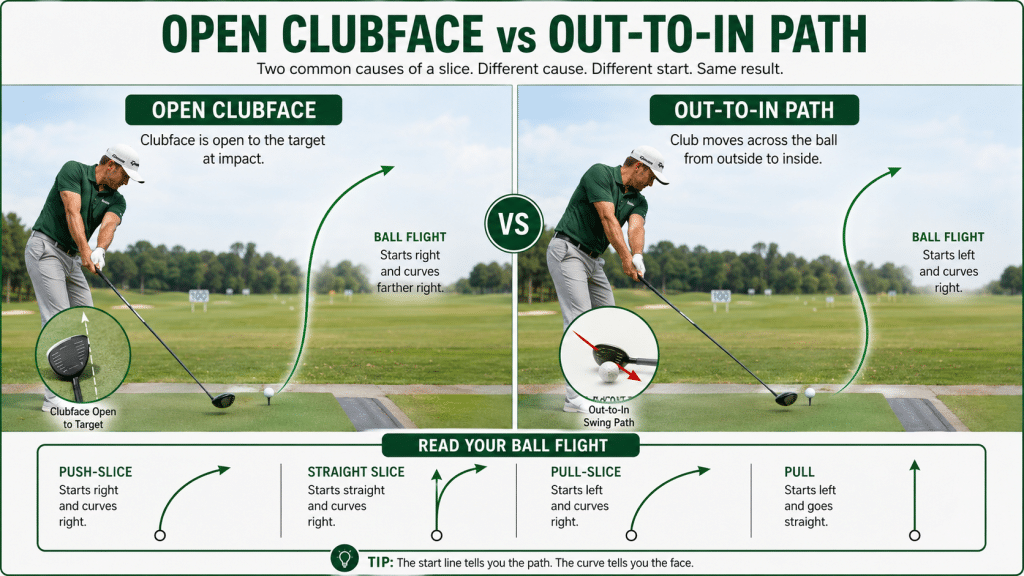
Slice Type Face at Impact Swing Path Ball Flight Push-Slice Open In-to-Out or Square Starts right, curves further right Straight Slice Open Roughly Square Starts slightly right, curves hard right Pull-Slice Open Out-to-In Starts left, curves back right Pull (no slice) Square Out-to-In Starts left, minimal curve
Reading this chart with your own ball flight in mind already narrows down your cause. If your ball starts left and curves right, you have both problems working together. If it starts right and curves further right, the face is the primary culprit. This distinction matters enormously for how you practice.
What an Open Clubface Actually Does to Your Ball
An open clubface means the face is pointing to the right of your swing path at the moment of impact (for a right-handed golfer). This is the single most common cause of a slice, and it operates independently of your swing path. You could have a perfectly neutral in-to-out swing path and still slice the ball if your face is open at impact.
- The open face launches the ball to the right of your intended target line
- It creates a clockwise spin axis on the ball, which produces left-to-right sidespin
- The more loft a club has, the more the open face tilts the spin axis, which is why your driver slices more than your 9-iron
- Even a face that's only 3–5 degrees open at impact can produce a dramatic slice with a driver due to the low loft amplifying the spin effect
This is why so many golfers hit their irons reasonably straight but can't stop slicing their driver. It's not a different swing — it's the same open face producing a much more visible result because of the reduced loft.
How Clubface Angle Controls Ball Flight Direction
Ball-flight laws tell us that the ball launches in the direction the face is pointing at impact, not in the direction the club is swinging. This is counterintuitive for most golfers who were taught that the swing path dictates starting direction. In reality, a clubface that's open by 5 degrees will launch the ball approximately 4 degrees to the right of the swing path, regardless of where the club is traveling. That starting direction to the right — combined with the leftward sidespin from the path being left of the face — creates the classic slice curve.
The Spin That an Open Face Puts on Your Shot
When the face is open relative to the path, it creates a tilted spin axis. Think of a globe tilted to the right — the ball spins along that axis and curves in the direction the top of the axis is leaning, which for a slice is to the right. The greater the difference between face angle and swing path (called the face-to-path relationship), the more the spin axis tilts and the more dramatic the curve. A 10-degree open face with a 4-degree out-to-in path creates a face-to-path gap of 14 degrees — enough to produce a severe, distance-robbing slice.
Why Most Slicers Have a Face Problem, Not a Path Problem
Research from instructor communities and data from TrackMan University consistently shows that the majority of recreational golfers who slice have an open clubface as their primary issue. The out-to-in path often develops as a compensation — golfers unconsciously reroute their swing to the left to try to correct a shot that's already starting too far right. Fixing the path without addressing the face doesn't solve the root cause. It just changes the shape of the miss.
What an Out-to-In Swing Path Does to Your Ball
An out-to-in swing path means the clubhead is traveling from outside the target line to inside the target line through the impact zone — cutting across the ball from right to left (for a right-handed golfer). On its own, with a square face, this path produces a pull: a shot that flies straight but left of the target with minimal curve. The slice only happens when this leftward path combines with a face that's open relative to that path.
How Out-to-In Path Creates a Pull or a Slice
The path determines the spin axis direction relative to the face. When the club travels out-to-in and the face is square to the path, the ball pulls left with little curvature. When the face is square to the target but the path is out-to-in, the ball starts slightly left and curves right — because the face is now open relative to the path, even though it's square to the target line. This is the most misunderstood concept in golf ball-flight, and it's why golfers who aim left to “compensate” for their slice end up making it worse.
The Difference Between a Pull-Slice and a Straight Slice
A pull-slice starts left of the target and then curves back to the right, often finishing near the target line but with a dramatic banana shape. A straight slice starts on or just right of the target and curves hard to the right. The pull-slice typically indicates both an out-to-in path and an open face. The straight slice usually points more directly at an open face with a less severe path issue. Knowing which one you hit tells you exactly where to focus your practice time.
How to Diagnose Your Own Slice in 60 Seconds
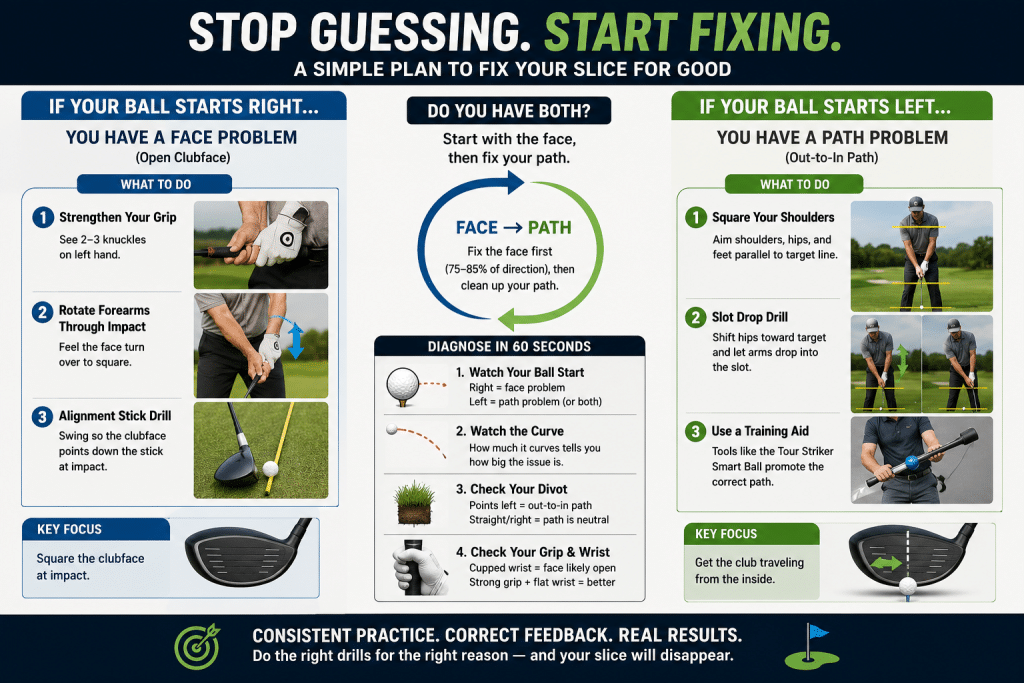
You don't need a launch monitor to figure out what's causing your slice. Your ball flight, your divot, and a quick grip check give you all the information you need. Work through each of these four checkpoints in order, and you'll have a clear picture of whether your face, your path, or both are the problem.
The key is to observe without correcting during this process. Hit five shots and watch the flight honestly, without making any swing changes. You're gathering data, not practicing.
1. Watch Your Ball’s Starting Direction
The ball's starting direction is your first and most important data point. If the ball starts right of your target, your face is open at impact — full stop. If the ball starts left of your target, your path is out-to-in and your face is open relative to that path (but may be closer to square relative to the target). If it starts at the target and then curves right, you have a moderate face issue with a fairly neutral path. Mark down which of these patterns matches what you see, because everything else you do should be based on this observation.
2. Watch How Much Your Ball Curves
The amount of curve tells you how large the gap is between your face angle and your swing path at impact. A ball that starts left and curves only slightly right suggests your face and path are fairly close together — your path is out-to-in, but your face isn't dramatically open. A ball that starts left and curves wildly to the right tells you the face-to-path gap is large, meaning both problems are significant. A shot that barely curves but goes far right means your face is very open but your path is relatively neutral.
Use this as a severity gauge. Mild curve means a small adjustment will go a long way. Dramatic curve — the kind where the ball lands two fairways over — means your face angle at impact could be 8–12 degrees open or more, and you need a more deliberate, structured fix rather than a quick tip.
3. Check Your Divot Direction After Impact
After each iron shot, look at the divot your club leaves in the turf. A divot that points left of your target line confirms an out-to-in swing path. A divot pointing straight at the target or slightly right suggests your path is neutral or in-to-out, which means the face is almost certainly your sole problem. This is one of the fastest and most reliable feedback tools available without any equipment — the ground records exactly where your club was traveling at the moment of contact.
4. Look at Your Clubface at the Top of Your Backswing
Have someone film your swing from behind, or use a mirror. At the top of your backswing, check the angle of your lead wrist and clubface. If your lead wrist is cupped (bent backward, away from the target), the clubface is open and will almost certainly return open at impact unless you make a compensating move through the downswing.
A flat or slightly bowed lead wrist at the top corresponds to a much squarer or even closed face through impact. Dustin Johnson's famously bowed left wrist is an extreme version of this — it's why he hits a draw despite a dramatically in-to-out path.
How to Fix an Open Clubface Slice
Fixing an open clubface is not about swinging differently — it's about returning the face to a square position at impact consistently. The good news is that clubface angle is heavily influenced by grip, wrist position, and forearm rotation, all of which are trainable with deliberate, focused practice. You don't need to rebuild your entire swing.
The three most effective interventions for an open face are strengthening your grip, training forearm rotation through the impact zone, and using an alignment stick drill that gives you real-time feedback on face angle. Work on these in order, because grip changes alone solve the problem for a large percentage of golfers before they ever need to think about rotation drills.
One important note: when you first close the face, your shots will likely go left. This is normal and actually confirms the fix is working. Your brain will want to revert to the old swing to avoid the left miss, but resist that urge. The left shots are proof your face is finally square — now your path just needs to catch up.
Fix What It Addresses Time to See Results Difficulty Level Strengthen Grip Face angle at impact 1–2 range sessions Low Forearm Rotation Drill Face rotation through impact 2–4 range sessions Medium Alignment Stick Drill Real-time face angle feedback 1–3 range sessions Low Bowed Lead Wrist Training Face position at top of backswing 3–6 range sessions Medium-High
Strengthen Your Grip First
A stronger grip means rotating both hands more to the right on the handle (for right-handed golfers) so that you can see two to three knuckles on your left hand at address. Most slicers grip the club with a weak, neutral grip where the hands sit on top of the handle — this makes it nearly impossible to return the face square without an exceptional amount of wrist action through impact. Moving to a stronger grip position pre-sets the face in a slightly closed orientation, which naturally corrects to square at impact without any additional effort. Start here before changing anything else in your swing.
Train Your Forearm Rotation Through Impact
Even with a strong grip, some golfers hold the face open through impact by failing to rotate their forearms. The lead forearm (left arm for right-handers) needs to rotate counterclockwise through the hitting zone so the face turns over from open to square to slightly closed as the club passes through impact.
A simple drill: make slow-motion half swings focusing on feeling your right forearm cross over your left just after contact. If you can hear and feel a crisp strike with the face turning over, you're doing it correctly. Slow, deliberate repetitions build the motor pattern faster than hitting full shots at full speed.
The Alignment Stick Drill That Fixes Face Angle Fast
Stick an alignment rod in the ground just outside your lead foot, angled slightly toward the target. Make practice swings and focus on swinging the club so the face points down the alignment stick through impact — not open to it, not closed past it, but directly at it. This gives your eyes and nervous system a visual reference point that pure swing thoughts can't provide. Do this drill for 10–15 repetitions before each range session and you'll start to feel immediately when the face is releasing on time versus staying open through the zone.
How to Fix an Out-to-In Path Slice
Fixing an out-to-in path requires changing where the club travels in the downswing, which almost always means addressing what your upper body is doing first. The path doesn't get fixed at the point of impact — it gets fixed in the transition from backswing to downswing, and for most golfers, the problem starts with the shoulders.
Unlike face fixes, which can produce results very quickly, path corrections take slightly longer to groove because they involve larger muscle groups and more complex movement patterns. Be patient with these drills, and expect the first few sessions to feel awkward and produce inconsistent contact. That's a normal part of rewiring the movement.
Why Your Shoulder Alignment Is Probably the Culprit
Most golfers with an out-to-in path set up with their shoulders aimed left of the target — often significantly. This open shoulder alignment creates a downswing where the arms and club have no option but to travel across the ball from outside to inside. It's a geometrical inevitability, not a swing flaw in isolation. Check your shoulder alignment at address by laying an alignment stick across your shoulders — if it points left of the target, you've found the root of your path problem before you've even swung the club.
Correcting this feels uncomfortable at first because squaring your shoulders to the target will feel like you're aimed far to the right. This is an illusion created by years of compensating with an open stance. Trust the alignment stick and give your brain 3–5 sessions to recalibrate its sense of direction. Most golfers see a measurable path improvement within two practice sessions of simply addressing with square shoulders.
The Slot Drop Drill to Fix Your Downswing
The “slot” refers to the position the club needs to reach in the early downswing — just inside the target line, with the shaft shallowing as it drops from the top. Most out-to-in slicers do the opposite: they throw the club over the top, sending it outside the target line early in the downswing.
To practice the slot drop, take your normal backswing and then focus on the first move down being a lateral hip shift toward the target while your arms drop passively. Don't swing the club down — let it fall. The hip shift creates the space for the arms to drop into the slot naturally, rather than being thrown outward by an active shoulder turn. This is the same sequencing pattern you see in every tour player's downswing, regardless of how different their backswings look.
A useful training aid for this drill is the Tour Striker Smart Ball, which you hold between your forearms during practice swings. It forces the connection between your arms and body that keeps the club from going over the top. Ten slow-motion slot drop rehearsals before hitting full shots will groove the sequencing pattern faster than any tip about “swinging out to the right” — which, without fixing the sequence, almost never translates to the full swing under pressure.
What If You Have Both Problems at Once
Having both an open face and an out-to-in path at the same time is actually the most common scenario among recreational golfers — and it's the reason so many players feel like nothing they try ever fully fixes their slice. The two problems feed each other in a cycle: the open face produces a shot that goes right, so the player unconsciously aims left, which opens the shoulders, which steepens the path, which makes the face problem worse. Breaking this cycle requires knowing which problem started it.
Which Issue to Fix First
Always fix the clubface first. This is not just a preference — it's backed by the physics of ball flight. Since the face controls roughly 75–85% of the ball's starting direction, even a perfect path cannot produce a straight shot if the face is open at impact. Correcting the face first gives you accurate feedback about what your path is actually doing, because once the ball starts flying straighter, you can finally read the shot shape without the face distortion masking your path data.
Once your face is consistently square at impact, your ball will likely start going left — which means your out-to-in path is now visible without the open face canceling it out. That leftward flight tells you it's now time to work on your path using the shoulder alignment and slot drop drills outlined above. This sequenced approach is far more efficient than trying to fix both simultaneously, which overwhelms your nervous system and makes it nearly impossible to isolate which change is producing which result on the range.
How Fixing Your Face Can Naturally Improve Your Path
One of the most encouraging aspects of fixing your clubface first is that it often partially corrects your path on its own — without any deliberate path work. Here's why: when the face is open, your brain subconsciously adjusts your swing to pull the ball back toward the target.
That adjustment is the out-to-in path. Once the face is square and the ball is no longer flying right, your brain no longer needs to make that compensating move. Many golfers who fix their grip and forearm rotation report that their divots automatically become less left-pointing within just a few practice sessions, simply because the body stops trying to compensate for a problem that no longer exists.
Stop Guessing and Fix the Right Problem
The fastest route to eliminating your slice is accurate diagnosis followed by targeted, specific practice — not generic swing tips, heavier draw-biased drivers, or aiming further left. Use your ball flight to identify whether your face, your path, or both are the issue. Then fix the face first, use the drills that match your specific diagnosis, and give your nervous system enough repetitions to build the new pattern before judging the results.
Every single shot you hit gives you data. The starting direction, the amount of curve, and the divot direction are a complete diagnostic readout if you know how to read them. Stop guessing, start observing, and fix the right problem — your ball flight will tell you exactly when you've done it.
Frequently Asked Questions
Can an out-to-in swing path cause a slice even with a square clubface?
Technically, yes — but it requires a specific definition of “square.” If your face is square to the target line but your path is out-to-in, the face is actually open relative to your swing path. That face-to-path relationship still creates the tilted spin axis that produces a left-to-right curve. A true slice — with significant rightward curve — requires a face that is open relative to the path, regardless of where the face points relative to the target.
How much does grip pressure affect clubface angle at impact?
Grip pressure has a direct and often underestimated effect on how the face returns at impact. Gripping the club too tightly — above a 6 or 7 on a scale of 1 to 10 — tightens the forearm muscles and inhibits the natural rotation of the forearms through impact. This tension holds the face open through the hitting zone even when the grip position itself is correct.
The ideal grip pressure keeps the club secure without creating muscular tension in the forearms. Think of holding a tube of toothpaste firmly enough that it won't slip, but not so tightly that paste squirts out. Loosening grip pressure is one of the fastest and simplest changes a slicer can make, and for some golfers, it produces an immediate improvement in face rotation without any other adjustment.
Is a slice always caused by the same thing with every club?
The underlying physics are the same across every club — open face relative to path equals left-to-right curve. However, the severity of the slice changes dramatically based on the loft of the club. Lower-lofted clubs like the driver amplify the spin axis tilt created by an open face, producing a much more dramatic curve than the same face angle would create with a 9-iron. This is why your slice looks catastrophic with the driver but manageable with short irons, even though the root cause — and often the face angle — is identical.
Why does my driver slice but my irons do not?
This is one of the most frequently asked questions in golf instruction, and the answer comes down to two factors: loft and ball position. The driver's low loft (typically 9–11 degrees) amplifies sidespin dramatically compared to irons with 30–45 degrees of loft. Additionally, the driver is played further forward in the stance, which means the club must travel slightly more in-to-out at the point of contact to strike the ball squarely. Most golfers' swings are not in-to-out enough to accommodate this, making the path effectively more out-to-in relative to where the ball sits.
A face angle that produces a 5-yard fade with a 7-iron will produce a 30–40 yard slice with a driver. You don't necessarily have a different swing with the driver — you have the same swing flaw being amplified by physics. The fix is the same: square the face and improve the path sequencing, then apply those corrections specifically to driver setup by checking ball position and tee height.
How long does it take to fix a slice once you identify the real cause?
For golfers whose slice is primarily a grip and face angle issue, noticeable improvement can happen within one or two dedicated range sessions once the grip is strengthened and forearm rotation is trained. The ball will start flying straighter almost immediately, though it will feel unfamiliar and sometimes go left while the brain recalibrates.
Path corrections typically take longer — expect 3–6 focused practice sessions before the new sequencing pattern feels natural and shows up consistently on the course. The key variable is the quality of practice, not just the quantity. Fifty slow-motion slot drop rehearsals with deliberate focus will outperform 200 full-speed range balls hit without awareness of the specific change you're making.
On the course, expect a transition period where the slice reappears under pressure. This is normal — the nervous system reverts to its old pattern when stress increases. The fix is to keep practicing the specific drills for your diagnosed cause, not to abandon the new technique just because it isn't perfect under pressure yet.
The most important thing is to stop practicing without a diagnosis. Random swing changes based on generic tips will extend your timeline by months or years. With a correct diagnosis and targeted practice, most recreational golfers can turn a severe slice into a manageable fade — or eliminate it entirely — within 4–8 weeks of structured work.