
The Short Answer
If you have never had a qualified instructor look at your swing, take a lesson first. One hour with a competent local pro will do more for you than any app, and it costs less than PG1's annual tier in most of the country.
If you've had lessons before, practice regularly, and want structure between sessions, an app like PG1 is reasonable value — and cheaper per month than a single lesson.
The honest version of this comparison isn't “which is better.” It's “which is better for someone in your specific situation,” and those answers genuinely differ.
What Each One Costs
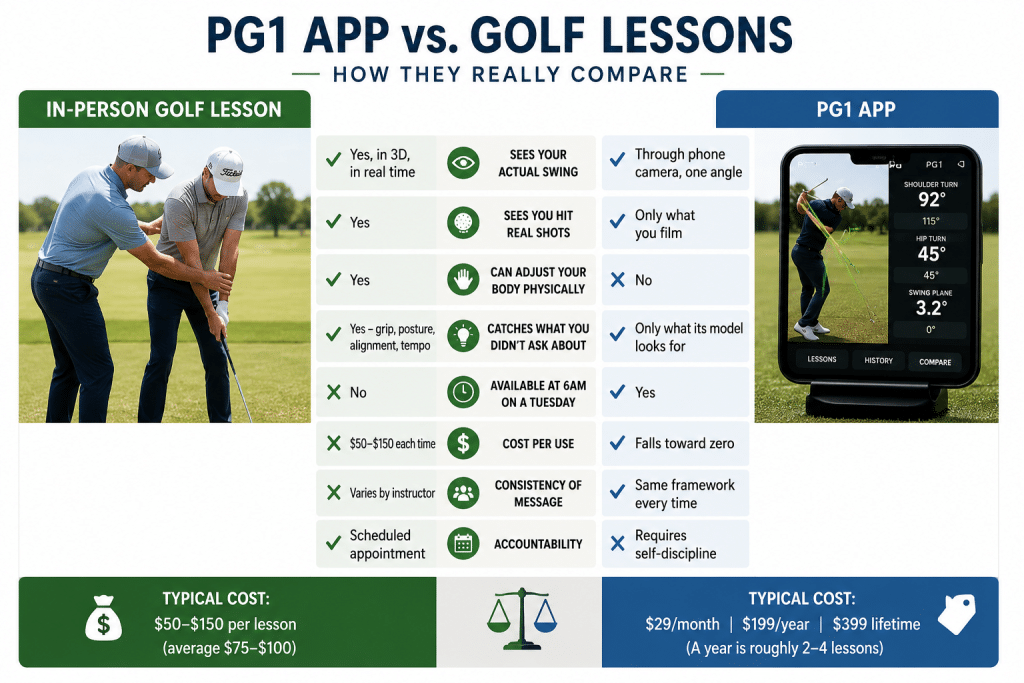
Golf lessons. Certified PGA or LPGA professionals typically charge $50 to $150 per hour, with the national average landing around $75 to $100. Entry-level and assistant pros start lower. Nationally recognized instructors run $200 to $400 or more, which is overkill unless you're already a very good player.
Geography matters more than most people expect. An instructor charging $175–$250 an hour in Scottsdale or Naples might charge around $110 for the same hour in a smaller Midwest market. Municipal courses sometimes offer subsidized private lessons in the $45 range, though those book weeks out and often use rotating staff rather than an assigned instructor.
Group lessons run roughly $20 to $50 per person. Packages usually save 5–20%.
The high end is worth knowing about. GolfTEC typically charges $150 to $300 per lesson, sold in packages of 10 to 52 sessions, with totals from $1,500 to over $10,000. Against that, PG1's $399 lifetime tier is not an expensive product.
PG1. $29 per month, $199 per year, or $399 lifetime. Roughly the cost of two to four private lessons for a year of access, or four to eight lessons for the lifetime tier.
The Comparison That Actually Matters
Price is the easy part. Here's where they genuinely differ.
| In-person lesson | PG1 app | |
|---|---|---|
| Sees your actual swing | Yes, in three dimensions, in real time | Through a phone camera, one angle |
| Sees you hit real shots | Yes | Only what you film |
| Can adjust your body physically | Yes | No |
| Catches what you didn't ask about | Yes — grip, posture, alignment, tempo | Only what its model looks for |
| Available at 6am on a Tuesday | No | Yes |
| Cost per use | $50–$150 each time | Falls toward zero |
| Consistency of message | Varies by instructor | Same framework every time |
| Accountability | Scheduled appointment | Requires self-discipline |
The single biggest advantage of a lesson is that a good instructor notices things you didn't know to ask about. You come in wanting to fix your slice; they notice your ball position is two inches too far back and your trail shoulder is high at address, and they fix the thing upstream of the thing you complained about. An app answers the question you asked it. A person answers the question you should have asked.
The single biggest advantage of an app is repetition. One lesson gives you excellent information once. Then you go to the range eight times over the next month with nobody watching, and by week three you've quietly drifted back to your old pattern. An app is there for all eight sessions. That's a real gap it fills.
The Honest Case Against Buying PG1 First
If you've never had a lesson, buying an app instead is usually a mistake, for three reasons.
One angle isn't enough. Phone video from down-the-line misses a lot. Face-on shows different faults entirely. An instructor walks around you.
You don't know what you don't know. The value of a first lesson is largely in the audit — grip, posture, alignment, ball position — the boring fundamentals that cause most amateur problems. Most golfers are shocked by how much of their first lesson is spent on things that happen before the club moves.
An app can't tell you your equipment is wrong. If you're playing clubs that are two degrees flat with shafts that are too stiff, no swing app will diagnose that. A pro spots it in ten minutes.
The Honest Case For It
If lessons aren't practically available to you, the comparison changes completely. Rural golfers, people with irregular schedules, and anyone whose nearest qualified instructor is an hour away are choosing between an app and nothing. An app wins that comparison easily.
If you practice often, the per-use math flips hard. Someone hitting the range twice a week gets over a hundred sessions a year. At $199, that's under $2 a session. No instructor is $2 a session.
If you've already had lessons and keep losing the changes, that's precisely the between-lessons gap an app addresses. You already know your fundamentals are sound; you need something checking that you're still doing them.
If you're on a real budget, $199 for a year beats $100 once. That's not a close call for someone who can't do both.
The Approach Most Golfers Should Actually Take
Not either/or. Sequenced.
- Do the free diagnosis first. Film your swing on your phone, check your grip, run the half-speed test to separate causes from compensations. We covered the full method in how to find your root swing flaw. Costs nothing, and it might resolve your question entirely.
- Take one lesson. Not a package — one. Tell the instructor you want a fundamentals audit and one priority to work on. Around $75–$100 in most markets.
- Then decide about an app. Now you know your baseline, you know what a qualified person said your priority is, and you can judge whether an app's diagnosis matches. That's an informed purchase instead of a hopeful one.
If you do it in that order and PG1 tells you something completely different from what your instructor said, that's valuable information about the app — information you cannot get if the app is your only input.
Before You Buy Either One
The uncomfortable truth underneath this whole comparison: neither one works without practice.
A lesson you don't follow up on is $100 spent on ninety minutes of feeling optimistic. An app you check twice and abandon is $199 spent the same way. The variable that predicts improvement isn't which product you bought — it's how many times you went to the range afterward and worked on one thing.
If you know you won't practice, save your money on both.
If you do buy PG1, be aware Performance Golf has a documented history of billing complaints, mostly involving trials attached to physical product purchases. We covered what to watch on your statement in detail — screenshot your confirmation, set a calendar alarm before any trial ends, and cancel in writing rather than by phone.
Frequently Asked Questions
Is the PG1 app better than golf lessons? For a golfer who has never had a qualified instructor look at their swing, an in-person lesson is generally the better first purchase. An instructor sees your swing in three dimensions, can physically adjust your position, and catches fundamental issues you didn't know to ask about. An app is better value for golfers who have already had lessons, practice frequently, or don't have practical access to a local instructor.
How much do golf lessons cost compared to the PG1 app? Private lessons with a PGA or LPGA certified professional typically cost $50 to $150 per hour, averaging around $75 to $100 nationally. PG1 costs $29 per month, $199 per year, or $399 for lifetime access. A year of PG1 is roughly equivalent to two to four private lessons.
Can a golf app replace an instructor? Not fully. A phone camera captures one angle and an app analyzes only what its model is designed to look for. An instructor observes your whole setup, watches real shots, can make physical adjustments, and can identify equipment problems an app cannot detect. Apps are better understood as support between lessons than as replacements for them.
Is it worth taking just one golf lesson? Yes. A single lesson focused on a fundamentals audit — grip, posture, alignment, ball position — delivers most of the value beginners and mid-handicappers need, and gives you a qualified baseline to judge any other instruction against. Ask specifically for one priority to work on rather than a list.
What is the cheapest way to improve my golf swing? Filming your own swing costs nothing and, combined with a grip check and a half-speed test to separate root causes from compensations, resolves the question for many golfers. If that doesn't work, one lesson at around $75 to $100 is the next cheapest meaningful step.