
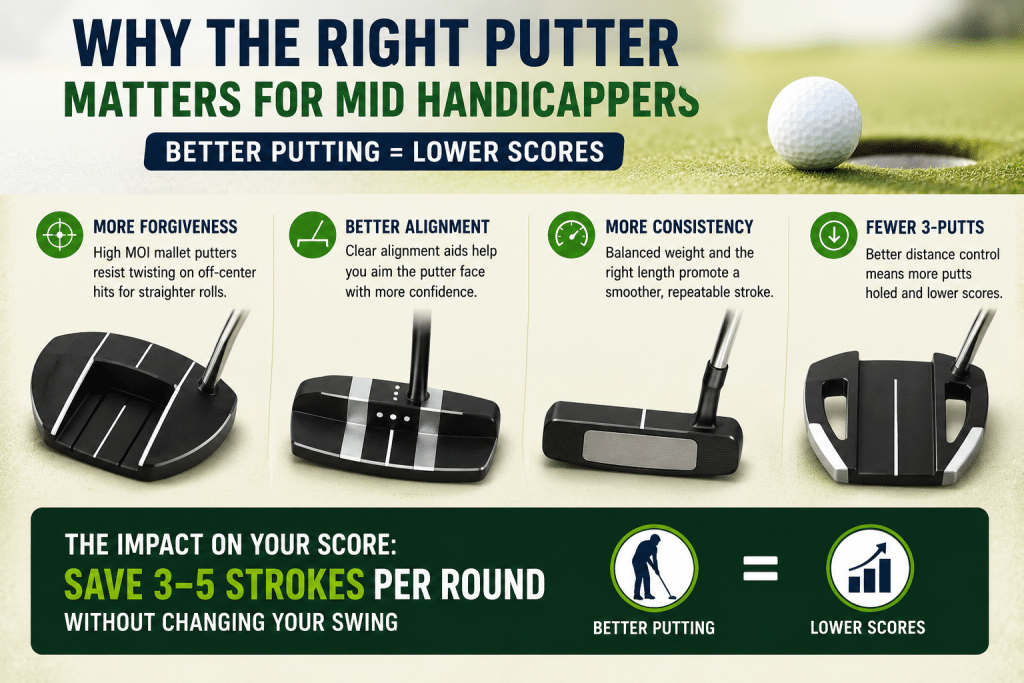
- Mid handicappers (index 10–20) lose more shots on the green than anywhere else — the right putter can realistically save 3–5 strokes per round without changing your swing.
- Mallet putters dominate for mid handicappers because their high MOI forgives the off-center strikes that are common at this skill level.
- Zero-torque putters like the L.A.B. Golf OZ.1i HS are a game-changer for players who struggle with face rotation at impact — one of the most common mid handicap putting flaws.
- Matching your putter to your stroke type (arc vs. straight-back straight-through) matters more than brand loyalty or price tag.
- Scroll down to see which of the 7 putters ranked best in head-to-head testing — including a budget pick under $150 that punches above its weight class.
The fastest way to lower your score isn't a new driver — it's fixing what's happening on the green.
Mid handicappers, typically playing to an index between 10 and 20, are in a unique position. The ball-striking is good enough to reach greens in regulation with real frequency, but the scoring doesn't reflect it. That gap almost always points to putting. Whether it's a chronic push, inconsistent distance control, or a string of three-putts that deflate an otherwise solid round, the putter is where mid handicap games go to die. At Today's Golfer, they've tested over 11,500 putts across the newest models to find what actually works — not just what looks good in a product photo.
This guide cuts through the noise. Every putter on this list was selected because it addresses the specific problems mid handicappers face: face rotation at impact, inconsistent alignment, and a lack of forgiveness on mishits. These aren't just popular models — they're the right tools for where your game actually is right now.
Mid Handicappers Waste More Strokes on the Green Than Anywhere Else
Statistics consistently show that putting accounts for roughly 40% of all strokes in a round of golf. For a mid handicapper shooting in the mid-to-high 80s, that can mean anywhere from 32 to 38 putts per round — well above the tour average of 29. The math is simple: drop two putts per round and you're suddenly shooting in the low-to-mid 80s. The equipment you use on the green has a direct, measurable impact on that number in a way that a new iron set simply doesn't.
What Makes a Putter Right for a Mid Handicapper
Not every putter on the shelf is built with your game in mind. Tour players have grooved, repetitive strokes from thousands of hours of practice — they can make a blade putter work through sheer consistency. Mid handicappers don't have that luxury, which means the putter needs to do more of the heavy lifting. Forgiveness, alignment assistance, and stroke-matching are the three pillars that matter most at this level.
Face Forgiveness and Why Mishits Cost You More Than You Think
A mishit on the putting green isn't as dramatic as a fat iron shot, but it's just as damaging. When you strike the ball even slightly off the putter's sweet spot, two things happen: the face twists at impact, and the ball loses energy unevenly, sending it off your intended line.
High Moment of Inertia (MOI) putters resist that twisting, which is why large mallets with perimeter-weighted heads consistently outperform blades in amateur testing. For mid handicappers, this isn't a nice-to-have — it's a necessity.
Mallet vs. Blade: Which Head Shape Fits Your Stroke
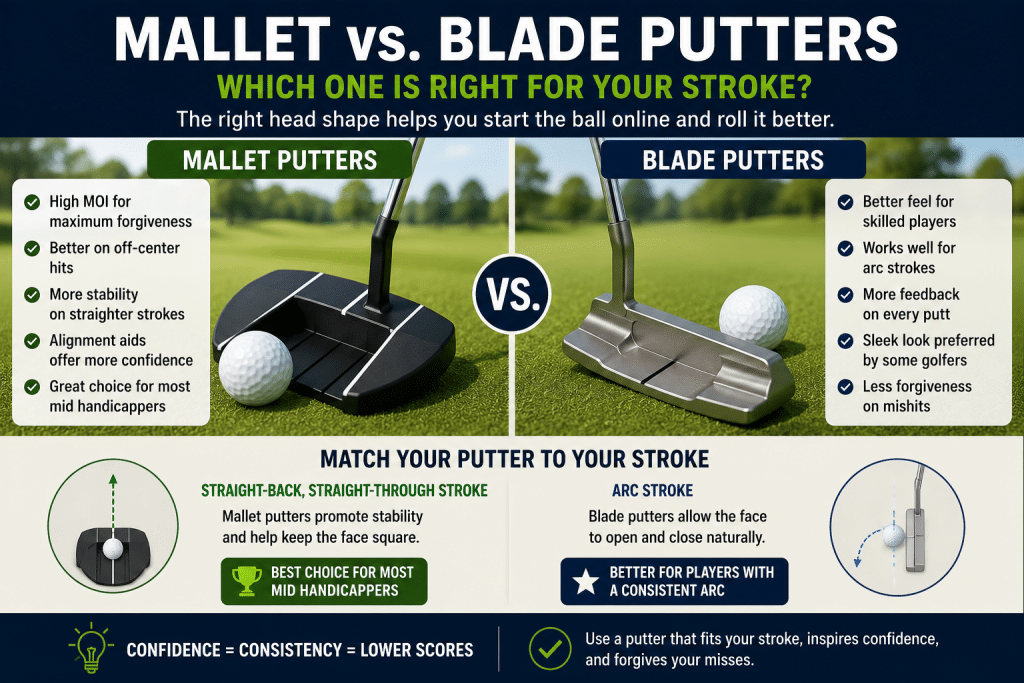
The choice between a mallet and a blade isn't just about aesthetics — it's about how your stroke naturally moves. Blade putters work best for players with a pronounced arc stroke, where the face opens and closes through the hitting zone. Mallets, especially larger high-MOI designs, tend to suit straighter strokes and offer more built-in stability.
For most mid handicappers, the mallet is the smarter starting point. The forgiveness profile is simply better suited to strokes that aren't perfectly grooved. That said, a mid-mallet — something like the Ping Scottsdale DS72 — offers a genuine middle ground: more stability than a blade without the visual bulk of a full mallet. It comes down to what inspires confidence when you stand over a five-footer.
Alignment Aids That Actually Help (Not Just Look Good)
Alignment lines, dots, and sight systems on putter heads only work if they're actually accurate and easy to use under pressure. The best alignment systems use multiple reference points — a center line combined with a wider frame — so you can verify your aim quickly and confidently. The TaylorMade Spider Tour's True Path Alignment System is a strong example: it uses a bold geometric design that makes misalignment visually obvious before you pull the trigger, not after.
Putter Length and Weight for Mid Handicap Consistency
Standard putter length runs between 33 and 35 inches, and getting this right affects your posture, eye position, and ultimately your stroke path. If your eyes are inside the ball at address, a shorter putter can help bring them directly over the line. Counterbalanced putters — which add weight to the grip end — can also help mid handicappers who struggle with a twitchy stroke, providing extra stability through the hitting zone without requiring a technique overhaul.
1. TaylorMade Spider Tour — Best Overall Mallet Putter
The TaylorMade Spider Tour has been one of the most trusted mallet putters in the game for over a decade, and the current iteration earns its place at the top of this list. It scored a 90.0% rating in the Today's Golfer 72-putter test — the highest of any mallet tested — and it's not hard to understand why.
The combination of tour-proven performance, exceptional forgiveness, and one of the best alignment systems available makes this the most complete putter option for mid handicappers right now. It's priced at $350, which puts it in the premium range, but the performance justifies the cost.
True Path Alignment System
The True Path Alignment System on the Spider Tour uses a contrast-heavy geometric design across the top of the mallet to give you two reference points simultaneously — a center aim line and an outer frame that lets you instantly detect any misalignment. Most players pick it up within the first few practice putts.
The visual clarity this system provides under on-course pressure is genuinely different from a single painted line, and for mid handicappers who tend to struggle with aim consistency, it's one of the most practically useful features on any putter at this price point.
The Spider Tour also uses a pure roll insert in the face — a soft polymer material that produces a smoother, more consistent roll off the face compared to raw steel. This directly helps with distance control, which is one of the biggest putting weaknesses at the mid handicap level. In testing, balls struck even slightly off-center stayed closer to the intended line than with most competing mallet designs.
Who This Putter is Best Suited For
The Spider Tour is the right call for mid handicappers who have a relatively straight putting stroke, struggle with aim consistency, and want the most forgiving mallet design currently available. It's face-balanced, which means it naturally suits a straight-back straight-through stroke rather than a pronounced arc. If you're currently three-putting more than twice a round and you haven't had a putter fitting, this is the model most likely to immediately tighten up your distance control and directional consistency.

2. Performance Golf RS1 Plus — Best Overall for Face Rotation Problems
Best for: Mid handicappers with a consistent directional miss pattern
If you miss putts consistently to the same side — right lip outs, or consistently short left — face rotation during your stroke is almost certainly the cause. The RS1's Forward Axis Weighting places over 75% of its 360-gram head mass in the front 25% of the clubhead, creating a gravitational force that actively pulls the face back toward square throughout the stroke arc.
This is not a passive zero-torque design and it's not a gimmick — it's a straightforward application of physics that independent reviewers from Plugged In Golf and Breaking Eighty have tested on course and found genuinely effective for players with measurable face rotation tendencies.
We recommend the Plus configuration over the Standard specifically for mid-handicap golfers because the graphite shaft's acoustic dampening and vibration reduction makes the putter meaningfully more comfortable over an 18-hole round — which directly supports the feel-dependent distance calibration mid-handicappers need on lag putts.
What to know before buying: The RS1 requires three to five dedicated practice sessions to recalibrate distance control on lag putts. Short putt improvement is immediate. The 365-day return policy removes the financial risk from this adjustment period.
The honest limitation: If your primary putting problem is distance control rather than face angle, the RS1 solves a different problem. Consider the Odyssey White Hot OG or TaylorMade Spider options below instead.

3. Ping PLD Milled Anser — Best Blade Putter
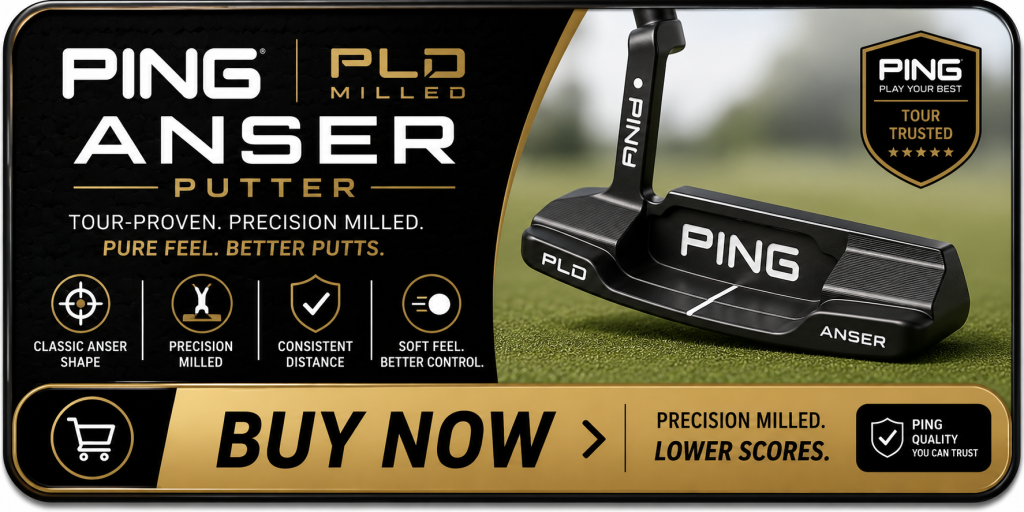
If you've tested mallets and they simply don't inspire confidence at address, the Ping PLD Milled Anser is the blade to beat in 2026. Ping's PLD (Putting Lab Design) line is precision-milled from a single block of 303 stainless steel, and the tolerances are tight enough that each face is functionally identical from one club to the next.
For a mid handicapper who has a consistent arc stroke and prefers the clean, minimal look of a blade at address, this putter offers tour-level face consistency without requiring you to play on tour to benefit from it. If you're looking for a putter designed specifically for senior golfers, consider checking out the RS1 putter for senior golfers.
Precision Milling and Face Consistency
- Material: Milled from 303 stainless steel for a soft, responsive feel that gives clear feedback on mishits
- Face texture: Precision-milled face pattern promotes consistent ball speed across the entire face, not just the sweet spot
- Toe hang: Moderate toe hang suits players with a natural arc stroke — the face opens and closes with the swing rather than fighting it
- Hosel design: Plumber's neck hosel provides one full shaft of offset, helping players who tend to push putts get the face back to square at impact
- Weight: 350g head weight provides a firm, planted feel through the hitting zone
What separates the PLD Milled Anser from the dozens of other blade putters on the market is the quality of feedback it provides. When you miss the sweet spot, you know it immediately — not because it punishes you with a harsh sound, but because the feel difference is distinct and informative. That feedback loop is genuinely valuable for mid handicappers who are actively working to improve their stroke mechanics.
The Anser shape has been one of the most replicated putter designs in history for a reason — its weight distribution and hosel geometry produce a natural, predictable roll that suits a wide range of arc-style strokes. Ping's PLD version takes that proven shape and elevates the manufacturing precision to a level that eliminates the small inconsistencies that can creep into cast alternatives.
The trade-off is forgiveness. The PLD Milled Anser has a smaller head and lower MOI than any mallet on this list, which means off-center strikes will show up in your results more clearly. If your current putting stats include a lot of distance control problems rather than directional problems, a blade might actually help you dial in feel faster. But if you're missing left and right with regularity, start with a mallet.
4. L.A.B. Golf DF3 — Best for Straight-Back Straight-Through Strokes
Where the OZ.1 is L.A.B. Golf's broad-appeal zero-torque option, the DF3 is purpose-built for players who use a straight-back straight-through (SBST) stroke. It has a distinctive single-shaft design that looks unlike anything else on the market, and that unconventional appearance is entirely functional — every geometric decision in the DF3's construction exists to maintain perfect lie angle balance through a linear stroke path. If your stroke doesn't arc, this putter was built specifically for you.
How the DF3 Eliminates Face Rotation
The DF3 achieves its zero-torque balance through an extremely precise lie angle and a single-bend shaft geometry that positions the center of gravity of the head directly below the grip axis. This means that when the putter hangs naturally, gravity acts straight down through the system — there's no rotational pull in any direction. The practical result is that the face stays square through the entire stroke without any compensatory hand action required.
For mid handicappers who've been told to “keep the face square” without being given a mechanical way to achieve it, the DF3 provides that mechanism automatically. Players who switch to the DF3 after years on a conventional mallet or blade frequently report that their stroke feels simpler and less effortful within the first session — not because they've changed their technique, but because the equipment is no longer working against their natural motion.
Ideal Handicap Range and Green Speed Conditions
The DF3 performs across a wide range of green speeds but shines most on medium-to-fast greens where precision matters more than power. For those interested in exploring more options, check out this comparison of the best putters in 2026. Here's a quick breakdown of who gets the most from this putter:
L.A.B. Golf DF3 — Ideal Player Profile
✓ Handicap index between 10 and 18
✓ Straight-back straight-through stroke (minimal arc)
✓ History of pushing or pulling putts despite solid contact
✓ Comfortable with unconventional putter aesthetics
✓ Plays on courses with medium-to-fast green speeds (Stimp 9+)
✗ Not ideal for strong arc strokes — the geometry works against natural face rotation
✗ Not recommended if you prefer traditional looks at address
The DF3 is also a strong option for mid handicappers who've already worked with a putting coach and confirmed their stroke is SBST but can't seem to stop the face from rotating anyway. In many cases, the problem isn't the stroke — it's the putter's geometry fighting the player's natural movement pattern. For those looking for alternatives, you might consider the RS1 putter which offers a different approach to putter design.
One practical note: the DF3 takes a round or two to fully adjust to. The balance feels unusual at first because your hands are accustomed to subconsciously correcting for torque that suddenly isn't there. Stick with it through the adjustment period — most players report the click happening around the third or fourth round.
At its price point, the DF3 sits in the premium tier, but for a mid handicapper whose putting has plateaued despite lessons and practice, it's one of the few pieces of equipment that can create a genuine step-change in performance rather than a marginal improvement. For those interested in comparing options, check out the RS1 vs S7K putter review for more insights.

5. Odyssey Ai-ONE Milled — Best AI-Designed Face Putter
- Face Technology: AI-designed milled face with variable depth grooves optimized for consistent ball speed across different impact locations
- Head Style: Available in multiple head shapes including mallet and mid-mallet configurations
- Insert Material: Milled aluminum face paired with a white hot microsheet for a blend of firmness and feel
- MOI: High MOI design in the mallet variants provides strong off-center forgiveness
- Price Range: Mid-to-premium tier, offering strong value relative to custom-milled alternatives
Odyssey has been a dominant force in putting for decades, and the Ai-ONE Milled represents their most technically sophisticated face design to date. The face was engineered using artificial intelligence to analyze thousands of real-world putting strokes and identify exactly where amateur golfers make contact — and then optimize groove depth and pattern at each of those impact zones to produce consistent ball speed regardless of where on the face you hit it.
The result is a putter that is exceptionally forgiving on distance control. A mid handicapper who catches the ball slightly toward the toe still gets a roll that travels close to the intended distance, rather than coming up short. That's a meaningful improvement in practical terms, because distance control errors on longer putts are the primary driver of three-putts — the single most score-damaging putting mistake at this level.
The Ai-ONE Milled also benefits from Odyssey's long-standing strength in feel engineering. The combination of a milled aluminum face and white hot microsheet insert produces a sound and feel at impact that is satisfying without being artificially soft. You get clear feedback on strike quality while still enjoying a responsive, comfortable feel across a range of green speeds and temperatures.
What AI Face Milling Does for Distance Control
Traditional putter faces are either flat-milled or have a uniform insert that produces the same face stiffness across the entire hitting area. The problem is that impact location changes the effective energy transfer — a ball struck at the toe or heel doesn't compress against the face the same way a center strike does, which means it leaves the face at a different speed.
The AI-designed variable depth milling on the Ai-ONE face compensates for this by making the face slightly more flexible in areas where contact is less efficient, effectively equalizing ball speed across the face.
In practical terms, this is most valuable on putts between 15 and 35 feet — the range where distance control errors most frequently lead to three-putts. Mid handicappers who've struggled to dial in their lag putting will notice the difference quickly, particularly on putts struck slightly off-center where a conventional face would produce inconsistent distance.

6. Cleveland HB Soft Milled — Best Budget Putter for Mid Handicappers
Not every mid handicapper needs to spend $400 on a putter to see real improvement, and the Cleveland HB Soft Milled makes that case better than any other option in this price range. Cleveland has built a strong reputation for producing high-quality putting equipment at accessible price points, and the HB Soft Milled delivers a milled face, solid alignment aids, and genuine feel quality at a fraction of what the premium options cost.
For players who are newer to the mid handicap range or who want to improve their putting before investing in top-tier equipment, this is the place to start.
Where Cleveland Cuts Costs Without Hurting Performance
Cleveland achieves its lower price point primarily through material choices and manufacturing scale rather than by compromising on design quality. The HB Soft Milled uses a softer carbon steel body — less exotic than the 303 stainless used in premium options like the Ping PLD, but still milled rather than cast, which means the face geometry is accurate and consistent.
The alignment system is simpler than the TaylorMade Spider Tour's True Path design, but it's clean and functional. What you're not getting at this price is the same level of MOI refinement or the premium cosmetic finish — but on the green, where ball-rolling physics matter most, the performance gap is smaller than the price gap suggests.
Feel and Sound Comparison to Premium Options
The HB Soft Milled lives up to its name — the feel at impact is genuinely soft and muted, which many mid handicappers prefer because it removes the clinical sharpness that some premium milled putters produce.
The sound is a quiet, low thud that suits players who find firmer-feeling putters difficult to calibrate for distance. It's warmer and less precise than the Ping PLD Milled Anser, but more forgiving of mishits and less likely to cause distance control flinching on shorter putts.
Side by side with the Odyssey Ai-ONE Milled, the Cleveland HB Soft Milled feels slightly less responsive on longer putts, which is where the AI face technology of the Odyssey starts to earn its price premium. But for putts inside 20 feet — where mid handicappers need the most consistency — the Cleveland performs remarkably close to putters that cost twice as much.

7. Scotty Cameron Phantom 11 — Best Premium Putter
The Scotty Cameron Phantom 11 is the putter for mid handicappers who want the best of everything — premium materials, precision engineering, exceptional feel, and a design that works as hard as it looks good. The Phantom 11 is a large mallet with a multi-material construction that combines a stainless steel body with an aluminum sole and a distinctive open-framed back cavity that moves weight to the perimeter for maximum MOI.
It sits at the top of the price range, typically retailing above $400, and it earns that position through a combination of performance and craftsmanship that is immediately apparent when you pick it up.
For a mid handicapper, the Phantom 11 delivers the same high-MOI stability as the TaylorMade Spider Tour with the addition of Scotty Cameron's legendary feel quality and a visual profile that inspires confidence at address.
The alignment system uses a clean center line combined with dual sight dots that frame the ball at setup, making aim verification fast and instinctive. Is the price justified? If you're a serious mid handicapper who plays regularly, invests in lessons, and is committed to lowering your index — yes, without reservation. The Phantom 11 is a putter you buy once and use for years.
Is the Price Tag Justified for a Mid Handicapper
The Scotty Cameron Phantom 11 sits at a price point that gives many mid handicappers pause — and that hesitation is worth examining honestly. The premium comes from genuine manufacturing quality: each Phantom 11 is milled from multiple materials with tolerances that exceed what most players will ever be able to fully exploit.
The multi-material construction — stainless steel frame, aluminum sole plate — isn't cosmetic. It allows Scotty Cameron's engineers to position weight precisely where it needs to be for maximum MOI, something that cast or single-material putters simply can't replicate with the same accuracy.
If you're playing twice a week and shooting consistently in the low-to-mid 80s, the Phantom 11 is a justified investment. If you're playing once a month and still working on the basics of your full swing, the Cleveland HB Soft Milled or TaylorMade Spider Tour will serve you better per dollar spent.
The Phantom 11 rewards players who are already putting reasonably well and want to extract the last few strokes of improvement from their equipment — it's not a rescue club, it's a precision instrument.
How to Match Your Putter to Your Stroke Type
Every putter recommendation in this guide comes with an asterisk: it only works if it matches your stroke. Buying the highest-rated mallet on the market won't help if your natural stroke has a strong arc that the putter's face-balanced geometry is actively working against. Getting this right is the single most important factor in putter selection, and it's also the one most mid handicappers skip entirely.
How to Tell If You Have an Arc Stroke or Straight Stroke
The simplest self-test requires nothing more than a mirror or a phone camera positioned behind you at address. Take your normal putting stance and make several slow-motion strokes. Watch where the face points at the toe and heel of the stroke — if it opens slightly on the backswing and closes through impact, you have an arc stroke.
If the face stays pointed at the target line throughout the entire motion, you have a straight-back straight-through stroke. Most golfers have some degree of arc — a perfectly straight stroke is less common than putting instruction sometimes implies.
Stroke Type vs. Recommended Putter Design
Strong Arc Stroke: Toe-hang blade or mid-mallet (e.g., Ping PLD Milled Anser, Cleveland HB SOFT 2)
Moderate Arc Stroke: Mild toe-hang or slight face-balanced mallet (e.g., Ping Scottsdale DS72, Scotty Cameron Phantom 11)
Straight-Back Straight-Through: Face-balanced mallet or zero-torque design (e.g., TaylorMade Spider Tour, L.A.B. Golf DF3)
Inconsistent / Unsure: Zero-torque design to remove face rotation as a variable (e.g., L.A.B. Golf OZ.1)
If you're genuinely unsure which category your stroke falls into, a single 30-minute session with a putting coach or at a club fitting center will answer the question definitively. Many golf retail locations now have putting analysis technology — SAM PuttLab and Quintic Ball Roll are the two most commonly used systems — that can map your stroke path and face angle data in real time.
It's the fastest, most accurate way to match yourself to the right putter design.
One important nuance: your stroke type can change depending on green speed, fatigue, and how long you've been playing. A stroke that arcs naturally on fast greens may flatten out on slower surfaces. This is why mid handicappers who play a variety of courses often benefit from zero-torque designs — they're the most adaptable option across different conditions because they remove hand-tension variables rather than relying on a specific stroke geometry to work.

Face Balanced vs. Toe Hang: Which You Actually Need
Face balance refers to how the putter head sits when the shaft is balanced horizontally on your finger. A face-balanced putter will have the face pointing straight up to the sky — the center of gravity is directly below the shaft axis, so there's no rotational pull. A toe-hang putter will have the toe dropping toward the ground, indicating that the center of gravity is offset from the shaft axis.
This offset creates a natural tendency for the face to open on the backswing and close through impact, which complements an arc stroke rather than fighting it. For more information on choosing the right putter, check out Breaking Eighty's guide on the best golf putters.
For mid handicappers, the practical guideline is straightforward: if your stroke arcs, you want some degree of toe hang. If your stroke is straight, you want face balance. Using a face-balanced putter with a strong arc stroke forces your hands to compensate by holding the face open longer — which is exactly the kind of unnecessary complexity that leads to pushed putts under pressure. Getting this right costs nothing — it just requires knowing which category your stroke is in before you walk into a golf shop.
Testing Putters Before You Buy
Always test on an actual putting green rather than the carpet in a golf shop. The roll characteristics, sound, and feel of a putter change significantly between a carpeted display surface and real turf. Most reputable golf retailers and pro shops will allow you to take demo models onto a practice green — take advantage of that. Roll putts from 6 feet, 15 feet, and 30 feet. Pay attention to how the putter feels on mishits, not just pure center strikes. The putter that feels best on your worst strike is usually the right choice for a mid handicapper's game.
The Right Putter Won't Fix a Bad Stroke — But It Will Stop Punishing a Good One
Here's the honest reality of putter fitting: the best putter in the world won't compensate for fundamentally flawed mechanics. If your grip is creating tension through impact, if your eyes are misaligned at address, or if your stroke path is inconsistent, equipment can only do so much.
What the right putter does do — and does meaningfully — is remove the equipment from the list of things working against you. When your putter matches your stroke type, your alignment is supported rather than confused, and your forgiveness profile suits your current ball-striking consistency, the equipment gets out of your way.
That's not a small thing. For mid handicappers, clearing that variable alone can be worth two to four strokes per round without a single technical swing change.
The seven putters on this list were chosen because each one does that for a specific type of mid handicapper. Whether you need maximum forgiveness from the TaylorMade Spider Tour, zero face-rotation from the Performance Golf RS1, precision feedback from the Ping PLD Milled Anser, or budget-smart performance from the Cleveland HB Soft Milled — there's a right answer here for your game. Find it, commit to it, and stop leaving three-footers short.
Frequently Asked Questions
Choosing a putter as a mid handicapper raises a lot of questions — particularly around how much to spend, which style to choose, and whether equipment is even the right place to focus improvement efforts. The answers below are based on real testing data and practical on-course performance rather than marketing language.
The most common mistake mid handicappers make when buying a putter is choosing based on what looks good in the bag rather than what matches their stroke. The second most common mistake is dismissing higher-MOI options as beginner equipment — high MOI benefits any golfer who doesn't hit the sweet spot on every single putt, which is every golfer on earth, including tour professionals. For those unsure about which putter to choose, comparing different models like the RS1 vs S7K putter can provide valuable insights.
Use these FAQs as a final checklist before you make your decision. If the answers point you toward a different choice than your gut instinct, trust the data.
| Putter | Best For | Head Style | Price Range | Stroke Type |
|---|---|---|---|---|
| TaylorMade Spider Tour | Best Overall | Large Mallet | $350 | Straight / Mild Arc |
| Performance Golf RS1 | Face Rotation | Forward-Weighted | $399-$499 | Any / Unsure |
| Ping PLD Milled Anser | Best Blade | Blade | $449 | Arc |
| L.A.B. Golf DF3 | SBST Strokes | Single-Shaft | $399 | Straight |
| Odyssey Ai-ONE Milled | Distance Control | Mallet / Mid-Mallet | $399 | Straight / Mild Arc |
| Cleveland HB Soft Milled | Best Budget | Mallet | $199 | Mild Arc / Straight |
| Scotty Cameron Phantom 11 | Best Premium | Large Mallet | $499+ | Straight / Mild Arc |
What Handicap is Considered Mid Handicap in Golf?
A mid handicapper is generally defined as a golfer with a handicap index between 10 and 20. Players in this range typically shoot between the low 80s and mid-90s depending on course difficulty, and they're consistent enough to hit greens in regulation but inconsistent enough that putting is still a significant source of dropped shots. The 10–20 index range represents the largest single group of golfers in most club memberships, which is exactly why putter selection at this level has such a disproportionate impact on scoring.
Should Mid Handicappers Use a Blade or Mallet Putter?
Most mid handicappers will see better results with a mallet or mid-mallet putter than a traditional blade. The higher MOI of a mallet design forgives off-center strikes more effectively, and the larger head provides more surface area for alignment aids that genuinely help aim consistency.
That said, a mid handicapper with a confirmed strong arc stroke who finds blade putters visually comfortable at address should not be steered away from a quality blade like the Ping PLD Milled Anser — stroke type and confidence at address both matter. The key is matching the putter to your actual stroke, not following a blanket rule.
How Much Should a Mid Handicapper Spend on a Putter?
You don't need to spend $400 to get a putter that meaningfully improves your game. The Cleveland HB Soft Milled proves that a well-designed putter at an accessible price point can deliver genuine on-course performance for mid handicappers. That said, the performance gap between mid-tier and premium putters is real — particularly in face consistency, MOI refinement, and long-term durability.
A practical guideline: spend as much on your putter as you comfortably would on a single iron in your set. If you're playing mid-range irons, a $200–$300 putter is proportionate and appropriate. If you've invested in premium irons and spend time practicing, a $350–$450 putter like the TaylorMade Spider Tour or Scotty Cameron Phantom 11 is a worthwhile upgrade. The putter is used on every single hole — arguably more than any other club in the bag — and that usage frequency justifies proportionate investment.
Does Putter Length Matter for Mid Handicappers?
Putter length directly affects your posture, eye position at address, and ultimately your stroke path — so yes, it matters more than most mid handicappers realize. The standard range is 33 to 35 inches, with most off-the-shelf putters arriving at 34 or 35 inches. The correct length for you is determined by your height, arm length, and how you naturally stand at address.
When the length is right, your eyes will be directly over the ball or just inside the target line, your arms will hang naturally without reaching or crowding, and your stroke will feel free rather than restricted.
A putter that's too long forces you to stand too upright, pushing your eyes inside the line and making it harder to see the correct aim. Too short and you'll hunch over, which tightens the stroke and reduces consistency. If you've never been fitted for putter length, a simple test is to take your natural putting posture and have someone measure the distance from your top hand to the ground — that measurement is your starting point for the correct putter length.
How Do I Know If My Current Putter is Hurting My Game?
The clearest sign is a persistent directional miss that doesn't improve despite conscious effort to correct it. If you're consistently pushing putts to the right (for a right-handed player) even when you're focused on face angle, your putter's geometry may be fighting your natural stroke. Similarly, if you're constantly misjudging distance on longer putts despite regular practice, the face insert or milling of your current putter may not be producing consistent ball speed across impact locations.
Another telling sign is lack of confidence at address. If you stand over putts and feel uncertain or uncomfortable with how the putter looks behind the ball, that visual discomfort translates directly into tension — and tension is the enemy of a consistent putting stroke. Confidence at address isn't a luxury, it's a performance variable.
A third indicator is your three-putt rate. If you're three-putting more than twice per round on a consistent basis, your putter is likely contributing — either through poor distance control (a face technology issue), poor aim (an alignment aid issue), or both. Track your three-putt frequency over five rounds and compare it against your practice green performance. If the numbers diverge significantly, equipment is likely a factor.
Finally, consider how long you've been using your current putter and whether it was chosen deliberately or by default. Many mid handicappers are playing with a putter they bought years ago without a fitting, or one that came in a beginner set, or one they liked the look of in a shop without testing it on grass. If any of those descriptions apply, the probability is high that a properly matched putter would improve your results — not because your current one is broken, but because it was never specifically chosen for your stroke.
If you can check two or more boxes from the indicators above, it's time to get a proper putter fitting before your next equipment purchase. The fitting itself — not the new putter — is often the most valuable part of the process, because it gives you information about your stroke that you can apply to any equipment decision going forward.