
Somewhere in every slicer's improvement arc comes a dangerous moment. The ball stops banana-ing and starts drifting — a gentle move left to right, landing in the short grass, adding up to a perfectly respectable golf shot.
And the golfer keeps tinkering. Because it's “still curving,” and straight is the goal, right?
That's how golfers who fixed their slice end up hooking it two weeks later, then re-slicing it, then having no idea where the ball is going at all. They passed through the target zone without recognizing it.
So let's define the line clearly: where does a fade end and a slice begin, and how do you know when you've arrived?
The Actual Difference (It's Not Just Size)
Most people define the difference by amount of curve, and that's most of it — but there are three real distinctions.
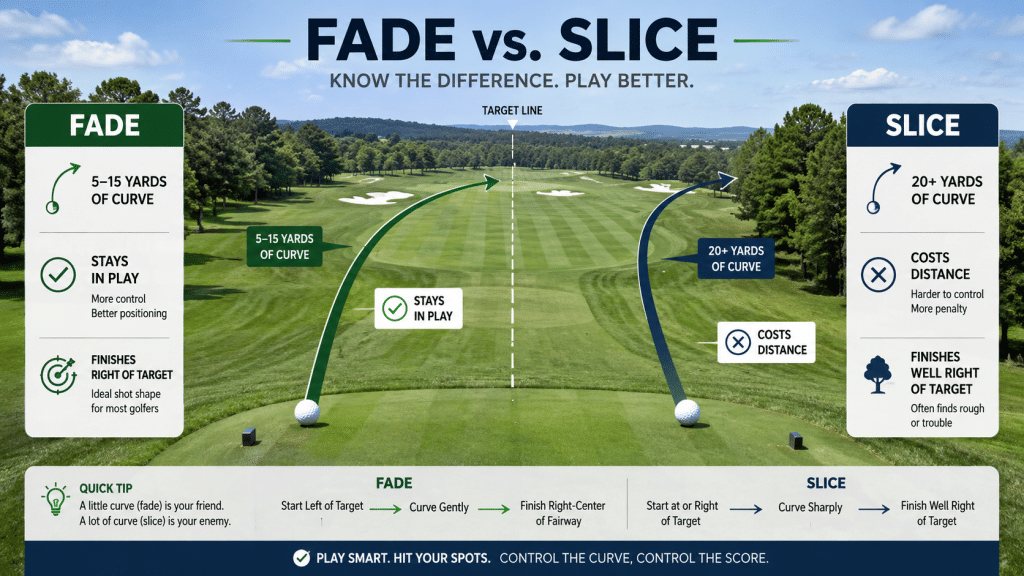
Curve amount. A fade moves roughly 5–15 yards left to right. A slice moves 20+ yards, often 30–40. The gray zone between 15 and 20 is real; call it a “big fade” and judge it by whether it stays in play.
Start line. This is the tell that separates them best. A fade starts at or slightly left of the target and curves back to it — it's aimed, intentional geometry. A slice usually starts right of target and curves farther right, or starts left with an aim compensation and curves across the fairway. A fade finishes where you aimed; a slice finishes where it wants.
Spin efficiency. A fade is produced by a small face-to-path gap — a few degrees. A slice comes from a large gap, which tilts the spin axis heavily, launches the ball high on excess spin, and kills rollout. This is why fades lose almost no distance while slices cost 30+ yards.
Simple version: a fade is a shot you hit. A slice is a shot that happens to you.
Why a Fade Is Genuinely Good (Not a Consolation Prize)
Golfers treat a fade like a participation trophy — the thing you settle for when you can't hit a draw. That's backwards. A controlled fade has real advantages:
It lands softer. More height and gentler descent means it holds greens on approach shots and stops rather than releasing into trouble.
It's easier to control on the correct side. A fade's curve is predictable, so you can aim at the left edge of a fairway and let the ball work into the middle. You've turned half the golf course into your target.
It fights the hook. The most destructive miss in golf for most amateurs isn't the fade — it's the low, running, unpredictable hook. A player whose fundamental shape is a fade rarely hits one.
Plenty of great players fade it on purpose. Ben Hogan built his post-comeback career on a controlled fade. Jack Nicklaus's stock shot was a high fade. It has never been a second-class ball flight.
The much-loved draw does add a few yards of rollout, but for a recreational golfer the value of predictability beats the value of 8 extra yards, every single round.
The Test: Is Your Miss Playable?
Forget the labels. Run this three-question test on your last five rounds:
1. Does it stay in play? If your normal tee shot finds the fairway or the light rough on the correct side, it's playable — regardless of how much it curves.
2. Does it curve the same amount every time? A repeatable 12-yard fade is a weapon. An unpredictable curve between 5 and 30 yards is a problem, even if the average is modest. Consistency matters more than magnitude.
3. Can you aim it? If you can aim down the left side and let the ball work back, you own the shot. If you're aiming and hoping, you don't yet.
Three yeses means stop working on ball flight and start working on something else — your wedges, your putting, your course management. That's where your remaining strokes are hiding, and they're cheaper to collect than another five yards of curve reduction.
The Over-Tinkering Trap
Here's the failure mode this whole article exists to prevent.
A golfer fixes their grip, arrives at a playable 10-yard fade, and thinks: “great, now let's get it dead straight.” So they strengthen the grip a bit more. Now they're hooking. So they weaken it. Now they're slicing again. Two months later they have no reliable ball flight and less confidence than when they started with the slice.
Dead-straight golf shots are not a realistic target. Even tour professionals play a shape, deliberately, because a straight ball requires the face and path to match perfectly — and a shot with no built-in curve can miss on either side, which means you can't eliminate half the course from your thinking.
One predictable curve beats an unpredictable straight ball. When you reach green on the traffic light system, write down your grip and setup, take a photo of your hands at address, and defend that position. Your job switches from adjusting to repeating.
When You Should Keep Working
The honest other side. Keep working on your ball flight if any of these are true:
- Your curve still exceeds 20 yards, or reaches the rough on most drives
- Your ball still starts right of target and curves right — that's a face problem that hasn't been fixed, just reduced
- Your curve varies wildly round to round
- You're losing balls out of bounds on the right
- The fade only appears with the driver and your irons still slice
That last one matters: if the curve is inconsistent across the bag, the underlying face-to-path issue is still there and just getting masked by iron loft. Finish the job.
The Bottom Line
A fade curves 5–15 yards, starts at or left of your target, and finishes where you aimed. A slice curves 20+, starts wherever it likes, and costs you 30-plus yards. The gap between them is a few degrees of face-to-path relationship, not a different swing.
When your miss stays in play, repeats itself, and can be aimed — you're done. Photograph your setup, defend it, and go spend your practice time on the shots that happen inside 100 yards, where the actual strokes live.
The goal was never straight. The goal was predictable.
FAQ
What's the difference between a slice and a fade? A fade curves roughly 5–15 yards left to right, starts at or slightly left of the target, and finishes where you aimed. A slice curves 20 or more yards, typically starts right of target and curves farther right, and loses significant distance to excess spin. The underlying difference is the size of the gap between clubface angle and swing path at impact.
Is a fade bad in golf? No — a controlled fade is a legitimate stock shot with real advantages: it lands softer and holds greens, it's predictable enough to aim down one side of the fairway, and it rarely turns into the destructive low hook. Ben Hogan and Jack Nicklaus both played fades as their primary shape.
How many yards of curve is acceptable? Anything up to about 15 yards that repeats consistently and stays in play is a weapon rather than a fault. Consistency matters more than magnitude — a repeatable 12-yard fade is more valuable than a curve that varies between 5 and 30 yards.
When should I stop trying to fix my slice? When your shot stays in play, curves a similar amount every time, and can be aimed reliably. Continuing to chase a dead-straight ball from a playable fade commonly produces hooks, then re-slicing, and ends with no reliable ball flight at all. Keep working only if the curve exceeds 20 yards, varies wildly, starts right of target, or costs you balls out of bounds.