

Face drift is one of the most damaging putting problems a recreational golfer can have — and one of the hardest to identify, because it happens faster than conscious perception and often feels completely square even when it isn't.
If you're a golfer who consistently misses putts on the same side, struggles with short putts despite a seemingly good stroke, or finds that your putting practice doesn't translate to on-course results, face drift is very likely a contributing factor. Understanding what it is and how it works is the first step toward fixing it.
What Face Drift Is
Face drift is the tendency of the putter face to rotate open or closed during the putting stroke — specifically, between the moment you start the backswing and the moment of impact with the ball.
The term “drift” is deliberately chosen. This isn't a dramatic, visible manipulation of the club. It's a subtle, gradual rotation of the face — often less than 2 degrees — that accumulates through the stroke arc without the golfer feeling or noticing it.
At address, your face may be perfectly square to the target line. By the time the putter reaches the ball, it has drifted open or closed by a degree or two. That drift is invisible to the naked eye during the stroke. It feels square. But the ball tells the truth — it leaves the face on a slightly different line than intended, and the putt misses.
The physics of why this matters are unforgiving. On a 10-foot putt, a face angle error of just 2 degrees at impact produces approximately 4 inches of directional error at the hole. The cup is 4.25 inches wide. A 2-degree face drift turns a makeable putt into a lip-out with mathematical reliability.
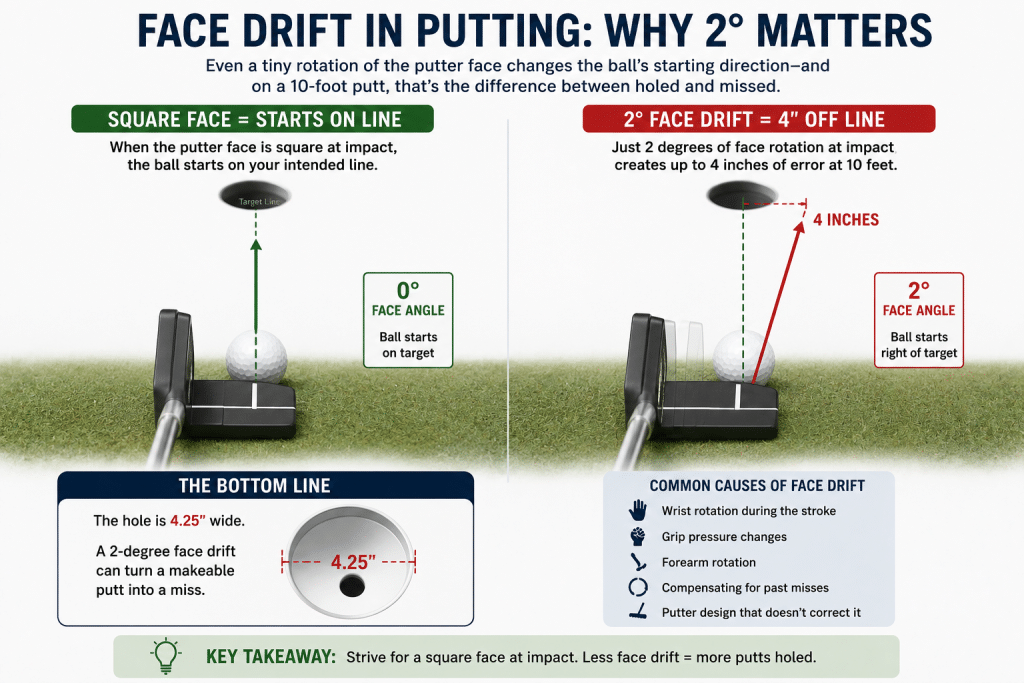
What Causes Face Drift
Face drift originates from several sources, often working together simultaneously.
Wrist Rotation
The most common cause. During the backstroke, the wrists naturally have some tendency to hinge or rotate — a movement pattern that works well for full shots but introduces face rotation in putting. Small amounts of wrist rotation through the stroke create corresponding face rotation that compounds through impact.
Grip Pressure Changes
Grip pressure that varies during the stroke — typically spiking at impact due to subconscious effort — causes the hands to tighten around the grip unevenly, which torques the face. Golfers who grip tighter with the trail hand through impact introduce open-face drift. Golfers who grip tighter with the lead hand introduce closed-face drift.
Forearm Rotation
The forearms naturally want to rotate during any swinging motion. In a full golf swing this rotation is desirable. In putting, forearm rotation through the hitting zone introduces face rotation that most golfers cannot consciously prevent — it's a deeply ingrained motor pattern that the brain produces automatically under the stress of trying to make a putt.
Stroke Path Compensation
Golfers who know (consciously or not) that their face tends to drift open often develop a compensating manipulation — closing the face deliberately through impact to counteract the drift. This compensation works sometimes but fails under pressure, producing inconsistent results even with a technically similar stroke on each putt.
Equipment Geometry
A putter whose design doesn't work with the natural physics of your stroke can amplify face drift rather than remaining neutral to it. Conventional putters with rear-weighted or balanced head geometry have no corrective mechanism — whatever rotation your hands introduce is what the ball receives, unfiltered.
How to Tell If Face Drift Is Your Problem
The most reliable indicator is your miss pattern. Answer these questions honestly:
Do you miss putts consistently to the same side? Right lip outs for right-handed golfers typically indicate open-face drift at impact. Consistent left misses typically indicate closed-face drift.
Do you miss short putts — inside 8 feet — more often than the distance should allow? Short putts missed from inside 8 feet are almost never a read problem. They're almost always a face angle problem. If you're missing more than 20 to 25 percent of 6-foot putts despite feeling like your stroke was good, face drift is the most likely explanation.
Do your putts feel square but miss consistently? The defining characteristic of face drift is that it feels correct. A dramatic face manipulation is something you can feel. A 1 to 2 degree drift through the stroke arc is below the threshold of conscious perception. If your stroke feels good and the results are inconsistent in a directional pattern, invisible face drift is a primary suspect.
Has your putting practice not translated to the course? Golfers who putt well on the practice green and poorly under pressure often have a face drift problem that's manageable when relaxed but amplifies when grip pressure increases under stress.
If you have access to a putting analysis system like SAM PuttLab, a single session will measure your face angle at impact precisely and tell you definitively whether you have a directional drift tendency and how many degrees it measures. This is the most direct diagnostic available.
How to Fix Face Drift
There are three broad approaches to fixing face drift, and the right one depends on the severity of your drift, your commitment to practice, and your preference for technique versus equipment solutions.
Approach 1 — Technique Adjustments
Technique-based fixes address the underlying cause of face drift. They take time and consistent practice to ingrain but produce lasting improvement that isn't equipment-dependent.
Grip pressure equalization. Practice putting with deliberately light, equal pressure in both hands throughout the entire stroke. A useful reference: grip the club lightly enough that someone could pull it from your hands with mild effort. This reduces the wrist tension that's the most common source of face rotation.
Forearm alignment at address. Position your forearms parallel to the target line at address. This setup reduces the tendency for forearm rotation to occur during the stroke because the arms are already in their most natural, rotation-resistant position relative to the target.
Stroke path practice with alignment aids. Use alignment sticks or putting rails to develop a stroke path that naturally brings the face back to square at impact. A straight-back-straight-through path has less opportunity for face drift than an arcing path because there's less rotational arc for the face to track through.
Cross-handed or claw grip. Both grip styles reduce the trail hand's ability to dominate and rotate the face through impact. The cross-handed grip in particular produces a naturally more level lead wrist position that resists the breakdown most commonly responsible for open-face drift. As we cover in our RS1 grip compatibility guide, these grip styles work well with multiple putter designs.
Approach 2 — Equipment Solutions
Equipment-based fixes address face drift through the physical geometry of the putter itself rather than relying on technique adjustment alone.
Forward Axis Weighting — active correction. The Performance Golf RS1 putter addresses face drift by concentrating over 75% of its head mass in the front 25% of the clubhead. This creates a constant gravitational pull toward a square, face-down position throughout the stroke arc. When face drift begins to occur, the forward-weighted head actively resists and corrects it. This is an active correction mechanism — it works continuously during the stroke rather than relying on the golfer's technique to stay square.
For a detailed explanation of the physics behind this technology, see our Forward Axis Weighting guide.
Zero-torque design — passive neutrality. The LAB Golf DF3 uses Lie Angle Balancing to eliminate all rotational torque from the putter head, leaving the face completely neutral — no tendency to open or close in either direction. This passive approach doesn't actively correct drift, but it removes the equipment's contribution to any drift that occurs. For golfers whose face drift stems primarily from their stroke mechanics rather than equipment, this neutrality is a clean canvas for technique work.
See our RS1 vs LAB Golf DF3 comparison for a detailed breakdown of which approach suits different player profiles.
High-MOI mallets. A high moment of inertia mallet putter doesn't actively correct face drift but does reduce the severity of the off-line result when drift occurs — because the head resists twisting on mishits, maintaining slightly better face angle through impact than a blade would. This is a mitigation rather than a correction, but it's worth understanding as a factor in putter selection.
Approach 3 — Combination Approach
The most effective resolution for significant face drift typically combines technique work with appropriate equipment. Using a forward-weighted putter like the RS1 to reduce the mechanical expression of drift, while simultaneously working on grip pressure and stroke path to reduce the underlying cause, produces faster and more durable improvement than either approach alone.
The RS1's 365-day return policy makes it practical to run this combination experiment without long-term financial commitment. If the equipment solution significantly reduces your drift and improves your results within the year window, you've found your answer. If technique work resolves the issue independently and the equipment advantage becomes marginal for your refined stroke, you can evaluate accordingly.
Face Drift vs Other Putting Problems
Face drift is not the only putting problem, and it's worth being clear about what it isn't — so you can accurately identify whether it's your primary issue.
Face drift vs distance control problems. Distance control errors produce three-putts from long range because first putts leave an uncomfortable second putt. Face drift produces missed putts that are the right distance but the wrong direction. If your primary problem is three-putting from 40 feet rather than missing 8-footers, distance control is a more likely culprit than face drift.
Face drift vs read errors. A misread sends the ball on the correct face-angle line for the wrong target. Face drift sends the ball on the wrong face-angle line for the correct target. If you make well-read putts but miss consistently in a directional pattern, face drift is more likely than misreading.
Face drift vs stroke path errors. A severe stroke path error — extreme inside-out or outside-in — sends the ball offline regardless of face angle. Moderate path errors are often less impactful than face angle because face angle accounts for approximately 83% of a putt's initial direction. Face drift and path errors can occur simultaneously, but face angle is almost always the higher-priority variable to address first.
Frequently Asked Questions
Is face drift the same as the putter face opening? Face drift is the umbrella term for any gradual rotation of the putter face during the stroke — either opening (rotating away from the target) or closing (rotating toward the target). An open face at impact is the most common form of face drift for right-handed golfers and produces putts that miss to the right.
Can I fix face drift through practice alone? Yes, for many golfers — particularly those with mild to moderate drift and the time to invest in focused practice. Grip pressure equalization and stroke path work can significantly reduce face drift through technique improvement. Equipment solutions accelerate the process for golfers who want faster results or whose drift is severe enough that technique alone is insufficient.
How much face drift is normal? Research suggests that most recreational golfers have some degree of measurable face drift — often 1 to 3 degrees — that they are unaware of. Even 1 degree of consistent drift is enough to miss a meaningful percentage of 10 to 15 foot putts. Zero drift is the goal; less drift is always better.
Does the RS1 putter fix face drift? The RS1's Forward Axis Weighting actively resists and corrects face drift during the stroke by pulling the face toward square throughout the swing arc. For golfers with a consistent directional drift tendency, this active correction produces measurable improvement in face angle at impact. It doesn't eliminate the need for reasonable technique, but it provides a constant mechanical buffer against the micro-rotations that cause most recreational golfers' face drift. See our complete RS1 buying guide for full details.
What's the fastest way to know if I have face drift? A SAM PuttLab session with a qualified putting instructor or fitter will measure your face angle at impact precisely and give you exact data on whether and how much drift you have. Short of that, a consistent directional miss pattern — always right, or always left — is the most reliable real-world indicator.
Last updated June 2026.
Related Reading: