
The Short Answer
Standing up during your swing is called early extension — your hips push toward the ball and your spine straightens before impact, instead of maintaining the angle you set at address. It causes thin shots, blocks to the right, hooks, and inconsistent contact.
Here's the part most golfers get wrong: early extension is usually a compensation, not a root cause. Your body is standing up to solve a problem it detected earlier in the swing. Which means “stay in your posture” — the advice everyone gives — almost never works, because you're being told to remove the solution while leaving the problem in place.
What Early Extension Actually Is
At address you set a spine angle, bent forward from the hips. Early extension is the loss of that angle before the club reaches the ball: the pelvis thrusts toward the ball line, the torso rises, and you finish standing taller than you started.
You'll recognize the misses. Thin shots and low screamers, because the low point moved up. Blocks right, because your arms ran out of room and got stuck behind you. Snap hooks, because your hands flipped to save the block. And the maddening inconsistency where two swings that felt identical produce completely different results.
Most golfers describe it as “I lifted my head.” That's not what happened. Your head came up because your hips came forward — it's the last visible link in a chain that started lower.
Why “Just Stay Down” Doesn't Work
If you've tried to fix this, you've probably been told to keep your head down, stay in your posture, or stay down through the shot. You held the position for three swings, hit it worse, and went back to normal.
That's not a discipline failure. It's diagnostic.
Early extension is your body creating something it needs — usually space. If your arms are trapped behind your body on the downswing, standing up is a genuinely intelligent solution to get them through. Remove the standing up without fixing the trap, and now you're stuck with no escape route. The ball goes further right, or you flip harder to save it, and it feels awful.
This is why early extension is the clearest example of a symptom people treat as a cause. The fix is almost never in the position you can see.
The Four Things That Actually Cause It
1. Trapped arms on the downswing. If the club drops too far behind you — shaft shallow, hands stuck inside — your torso has to rise to make room for the arms to pass. This is the most common cause among decent players and single-digit handicaps. The early extension is pure rescue work.
2. Restricted trail hip rotation. To rotate properly in the backswing, your trail hip needs internal rotation. If that motion isn't available — from tight hips, prior injury, arthritis, or just decades of sitting — your body finds another way to turn, and standing up is the most convenient substitute.
This matters more with age, and it's the reason early extension shows up so often in golfers over 50. If this is your cause, no amount of swing thought will fix it. You're asking your body for a range of motion it physically does not have. That's a mobility problem wearing a swing-fault costume.
3. Setup errors. Standing too far from the ball forces you to reach, and reaching pulls you toward the ball through impact. Excessive knee flex at address leaves nowhere to go but up. Both are fixable in a minute, which makes them worth checking before anything else.
4. Trying to lift the ball. A fundamental misunderstanding of how a golf ball gets airborne. Golfers who believe they need to help the ball up will instinctively rise through impact — which is exactly backwards, since hitting down on it is what creates height.
How to Diagnose Your Own Cause
Three tests, in order. Do them before you buy anything or book anything.
The butt-line test. Set a chair, alignment stick, or your golf bag so it just touches your backside at address. Make slow swings. If you lose contact with it on the downswing, you're early extending. This is the standard check and it takes thirty seconds.
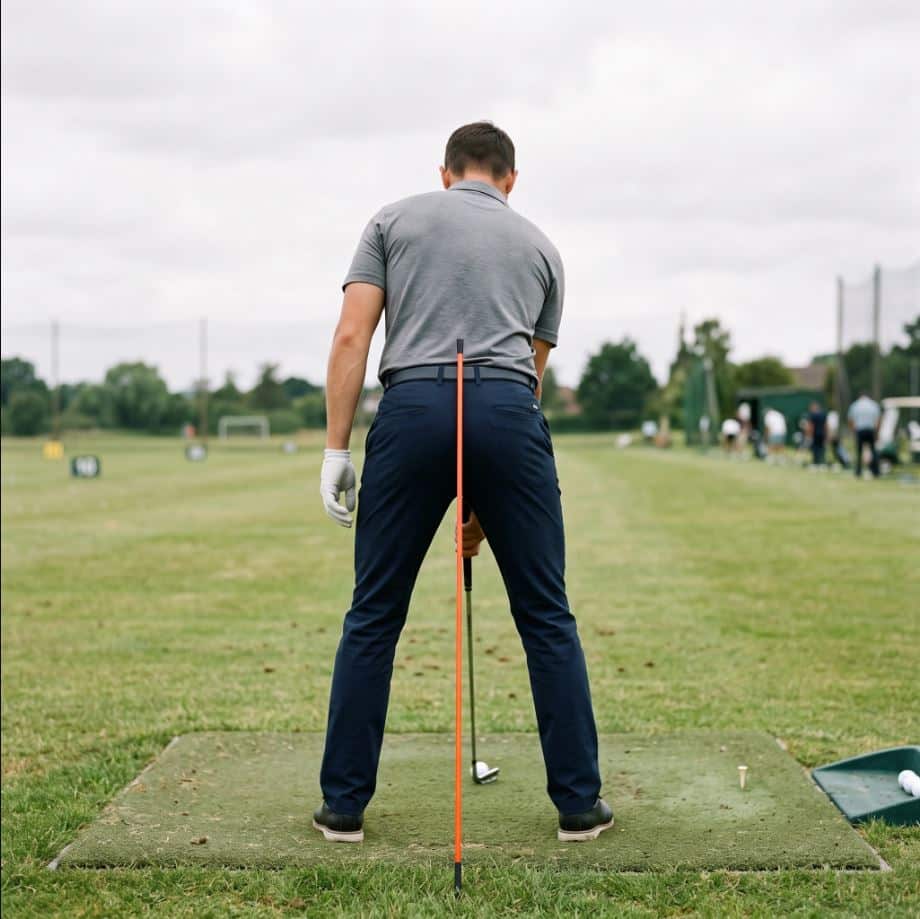
The half-speed test. Swing at roughly 50% speed. If the early extension disappears, it's a compensation — your body only needs the escape hatch at full speed when the arms genuinely get trapped. If it's still there at half speed, you're looking at either a mobility restriction or a setup problem, both of which are primary.
This single test sorts most golfers into the right bucket, and it's the same principle we use across the whole root swing flaw diagnosis method.
The seated hip rotation test. Sit upright in a chair, feet flat, knees at ninety degrees. Keeping your knee still, rotate your trail foot outward — this tests internal rotation of the trail hip. Compare both sides. If your trail hip is noticeably more restricted than your lead hip, or if the movement is small and uncomfortable, mobility is very likely your root cause.
What to Do About Each Cause
If it's trapped arms: the work is in the transition, not in holding your posture. Feel the club staying more in front of your chest as you start down, with the lead arm connected to the chest rather than drifting behind. Once the arms have room to pass, the standing up stops on its own — often within a session, which is how you know you found the real cause.
If it's hip mobility: stop working on your swing and work on your hips. Trail-hip internal rotation stretches, 90/90 hip work, and hip flexor mobility, done consistently for a few weeks, will do more than a hundred range balls. This is also the one case where an honest instructor will send you to a physio rather than sell you a lesson package.
If it's setup: measure your distance from the ball — arms hanging naturally, roughly a hand's width between the butt of the grip and your thigh — and reduce excessive knee flex. Athletic, not squatted.
If it's ball-lifting instinct: hit deliberate low shots for a bucket. Feel the club travelling down and forward through impact. Watch where your divot starts relative to where the ball was.
Where Swing-Analysis Apps Fit
Early extension is one of the faults phone video handles well, because it's visible from down-the-line and it's a large, obvious movement. Filming yourself costs nothing and will confirm whether you're doing it.
What video won't tell you is why. That's the part that matters, and it's where the difference between products and people shows up.
Performance Golf's PG1 app is built explicitly around identifying what it calls your root swing flaw — its SwingScan feature analyzes phone video against a library of fault patterns and gives you one thing to work on. Early extension is squarely in the category of fault it's designed to catch. Whether it correctly distinguishes early extension caused by trapped arms from early extension caused by a restricted hip is the open question, and it's a hard problem — the two look similar on camera and have opposite solutions.
It definitely cannot assess your hip mobility, which is the root cause for a large share of golfers over 50. No camera-based system can. If the seated rotation test above showed a restriction, that's the thing to address, and an app won't tell you so.
If you want the full breakdown of what PG1 costs and what to watch on your statement, we covered that here. If you're weighing it against a lesson, that comparison is here.
The One-Paragraph Version
Standing up in your swing is early extension. It's real, it's costing you shots, and it's almost never the thing you should be working on directly. Run the butt-line test to confirm it, the half-speed test to find out whether it's primary or a compensation, and the seated hip test to rule out a mobility restriction. Fix whatever those point to. The standing up will take care of itself.
Frequently Asked Questions
Why do I stand up during my golf swing? Standing up through the swing is called early extension, and it happens when your hips push toward the ball and your spine angle straightens before impact. The most common causes are arms getting trapped behind the body on the downswing, restricted trail hip rotation, standing too far from the ball at address, or instinctively trying to lift the ball into the air.
What is early extension in the golf swing? Early extension is the loss of your address spine angle before impact, with the pelvis moving toward the ball line and the torso rising. It typically produces thin shots, blocks to the right, hooks from compensating hand action, and inconsistent contact.
Is early extension a root swing flaw or a symptom? Usually a symptom. In most golfers it is the body's solution to a problem created earlier — most often arms trapped behind the torso, needing space to pass through impact. It is a primary fault when caused by restricted hip mobility or a setup error. A half-speed swing test distinguishes the two: compensations tend to disappear at slower speeds, primary faults do not.
Why doesn't “stay in your posture” fix my early extension? Because it removes the compensation while leaving the underlying problem in place. If you are standing up to create room for trapped arms, holding your posture leaves the arms with nowhere to go, producing worse contact and blocks further right. The instruction fails not from lack of discipline but because it targets the symptom.
How do I know if I'm early extending? Set a chair, golf bag, or alignment stick against your backside at address and make slow swings. If you lose contact with it during the downswing, you are early extending. Filming from down-the-line on your phone will also show it clearly.
Can tight hips cause early extension? Yes, and it is a frequent cause in golfers over 50. Rotating properly in the backswing requires internal rotation of the trail hip. When that range of motion is unavailable due to tightness, injury, or arthritis, the body substitutes standing up to complete the turn. In these cases hip mobility work will help more than swing instruction.
Will a swing analysis app fix my early extension? An app can reliably identify that you are early extending, since it is a large movement visible on phone video. Determining the cause is harder, because early extension from trapped arms and early extension from restricted hips look similar on camera but require opposite solutions. No camera-based app can assess hip mobility, which is a common root cause in older golfers.
Try the half-speed test and tell me what happened. Did your early extension disappear when you slowed down, or was it still there? Those two answers point to completely different causes, and I'm curious which is more common among readers here. Let me know in the comments.