
If you've spent any time researching alignment putters, you've almost certainly encountered two terms that get used in very different contexts without much explanation of what they actually mean: active face squaring and passive face squaring. Both claim to solve the same problem — inconsistent face angle at impact — but they solve it in fundamentally opposite ways.
Understanding the real difference between these two approaches is the most important piece of analysis you can do before spending $400 to $800 on a technology-assisted putter. Get this distinction wrong and you'll buy a putter engineered for a different problem than the one you actually have.
This guide explains both technologies from first principles, compares them honestly, and gives you a clear framework for identifying which one matches your specific stroke.
The Problem Both Technologies Are Solving
Before comparing solutions, it's worth being precise about the problem.
Research consistently shows that face angle at impact accounts for approximately 83% of a putt's initial direction. Stroke path accounts for most of the remaining influence. This means that even a small face angle error — 1 to 2 degrees — produces a directional miss that no amount of good green reading or smooth tempo can overcome.
The challenge is that face rotation during the stroke is largely invisible. It happens in fractions of a second, feels square even when it isn't, and is below the threshold of conscious perception for most golfers. You finish what felt like a good stroke and watch the ball miss the right edge — again.
Conventional putters don't address this problem. They're mechanically neutral with respect to face angle — whatever rotation the hands and wrists introduce during the stroke is what the ball receives, unfiltered. Both active and passive stability technologies attempt to change this, but through entirely different mechanisms.
For a deeper look at face rotation specifically — what causes it, how to identify it, and how it affects your results — see our face drift guide.
What Passive Stability Means
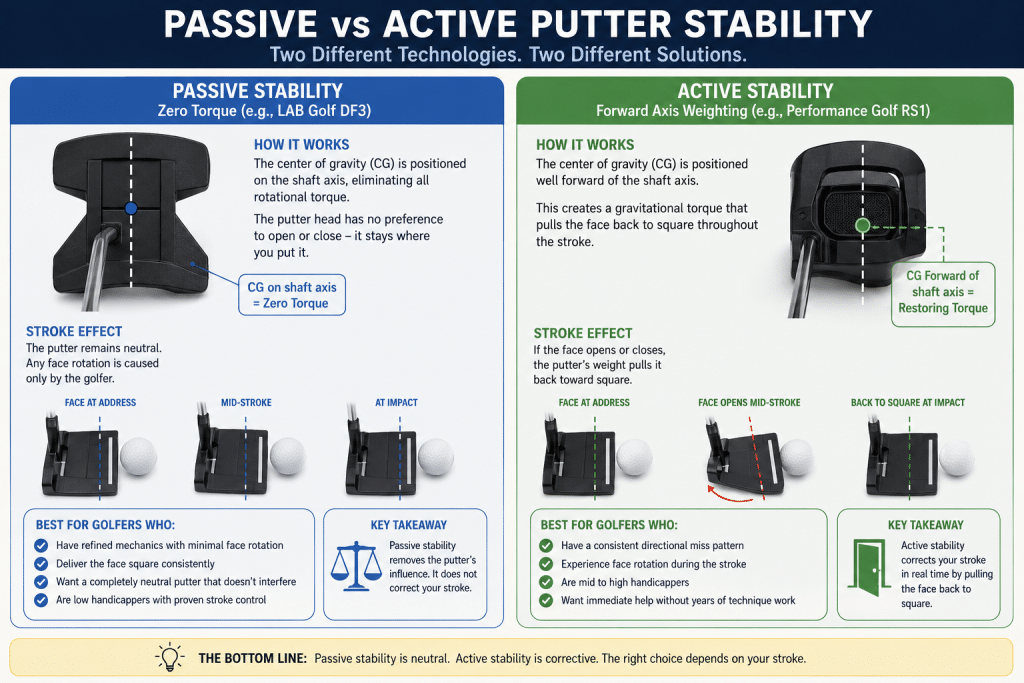
Passive stability, as implemented in putters like the LAB Golf DF3, works by eliminating all rotational torque from the putter head.
The engineering term for this is Lie Angle Balancing. By positioning the center of gravity (CG) directly along the shaft axis — the imaginary line running down through the hosel — LAB Golf removes any net gravitational force pushing the face open or closed. The face has no inherent directional preference at all. It stays wherever the golfer places it throughout the stroke.
Think of passive stability as a scale perfectly balanced at its center point. It takes no effort to keep it level because it isn't being pulled in either direction. Any weight you add to one side — any rotation your hands introduce during the stroke — moves the scale, but the scale itself contributes nothing to that movement.
What passive stability does: Removes the putter's own contribution to face rotation. Provides a genuinely neutral platform that expresses your stroke without adding or subtracting from it.
What passive stability does not do: Correct face rotation that your stroke introduces. If your hands and wrists create a 1.5 degree open face tendency during the stroke, a passive zero-torque design faithfully delivers exactly that 1.5 degrees of opening — efficiently and consistently, without amplifying it, but without correcting it either.
The underlying assumption: Passive stability is the right technology if your stroke mechanics are sufficiently refined that the main thing you need is a platform that doesn't interfere. It works best when face rotation is not your problem — when you simply want a neutral tool that expresses what you already do well.
What Active Stability Means
Active stability, as implemented in the Performance Golf RS1 putter, works through a completely different mechanism — not by eliminating torque but by deliberately creating a corrective one.
The RS1's Forward Axis Weighting concentrates over 75% of its 360-gram head mass in the front 25% of the clubhead. This pushes the CG significantly forward of the shaft axis. During the stroke, this forward mass creates a gravitational torque that continuously pulls the face toward its lowest, most stable position — which, when the putter is correctly soled at address, is square to the target line.
Think of active stability as a door with a self-closing hinge. Left alone, the door returns to closed on its own. Push it slightly open, and the hinge pulls it back. The greater the deviation from closed, the stronger the restoring force.
The RS1's gravitational squaring mechanism works the same way. Any face rotation introduced during the stroke — any deviation from square — immediately generates a corrective gravitational pull working against that rotation. The correction is proportional to the deviation: small drift gets a small correction, larger drift gets a larger correction.
What active stability does: Actively corrects face rotation during the stroke. Creates a physical buffer against the micro-rotations that cause most recreational golfers' directional miss patterns. Works continuously throughout the stroke arc without requiring conscious input from the golfer.
What active stability does not do: Eliminate the need for reasonable technique. Fix severe stroke path problems. Correct misreads. Guarantee results for every golfer regardless of their specific stroke characteristics.
The underlying assumption: Active stability is the right technology if your stroke has any measurable directional face rotation tendency — a consistent open or closed tendency that your technique has not resolved. It works best when the problem you're trying to solve is involuntary mid-stroke face drift.
The Physics Compared Side by Side
For technically-oriented readers, here is the underlying physics of each approach stated directly.
Passive zero-torque (LAB Golf DF3):
The net gravitational torque on the head equals zero when the CG lies on the shaft axis:
τ_net = m × g × d = 0 when d = 0
Where d is the perpendicular distance from the shaft axis to the CG. At d = 0, no gravitational moment is generated in either direction. The face rotates only as much as external forces — your hands and wrists — cause it to rotate. The club contributes nothing.
Active forward weighting (Performance Golf RS1):
The RS1 deliberately engineers d to be positive — CG forward of the shaft axis:
τ_restore = m × g × d × sin(θ)
Where θ is the angle of face deviation from square. Any deviation from square (θ > 0) generates a restoring torque pulling back toward square. The larger the deviation, the larger the correction. The club actively participates in face angle management throughout the stroke.
The key insight from the physics: these aren't better and worse versions of the same thing. They're genuinely different interventions designed for different stroke profiles.
Which Approach Suits Which Golfer
This is the question that actually determines the right purchase decision.
The Case for Active Stability (RS1)
You have a consistent directional miss pattern. If you consistently miss putts to the same side — particularly on putts that felt square — face drift is almost certainly your problem and active correction directly addresses it.
Your stroke analysis shows a directional bias. If SAM PuttLab or similar technology has measured a consistent open or closed face tendency at impact, the RS1's corrective torque works directly against that specific, measured error.
You're a mid-to-high handicapper whose technique is solid but not elite. At 10 to 20 handicap, most golfers have enough technique consistency to benefit from active correction without the correction conflicting with refined motor patterns. The RS1 helps precisely where the stroke's natural variation lives.
You want a meaningful improvement without years of technique work. Active correction works immediately — from the first putt. The gravitational physics don't require practice to activate. For recreational golfers who want faster improvement without committing to extensive putting lessons, this matters.

The Case for Passive Stability (DF3)
You have verified elite stroke mechanics. If stroke analysis shows your face delivery is already close to square with minimal directional bias, passive neutrality lets that refined stroke express itself without any external influence in either direction.
You're a low handicapper who has resolved face control through years of practice. At 5 handicap and below, many golfers have genuinely refined their face delivery to a level where passive neutrality is the appropriate tool — one that stops amplifying errors without applying correction to a stroke that doesn't need it.
Budget is not a constraint. The DF3 costs $600 to $800 or more. For a golfer confident in their stroke mechanics and willing to invest at that level, passive stability is a premium option worth considering.
For a complete head-to-head breakdown of these two specific putters, see our RS1 vs LAB Golf DF3 comparison.
The Honest Middle Ground
Most golfers researching this topic fall somewhere between the two idealized profiles above. Here is a practical framework for making the decision without access to professional stroke analysis:
Step 1 — Identify your miss pattern. Stand over 10 putts from 10 feet and note which side you miss. Consistent right misses suggest open face drift. Consistent left misses suggest closed face drift. Random distribution suggests face rotation is not your primary problem.
Step 2 — Assess your handicap trajectory. Is your handicap improving through technique work? If yes, passive stability may be appropriate as your technique matures. If your handicap has plateaued despite practice, active correction may be the variable that breaks the stalemate.
Step 3 — Consider the return policy. The RS1's 365-day return policy converts the purchase into a year-long real-world experiment. If active correction doesn't produce measurable improvement in your specific stroke over a year, you can return the putter. This risk-free evaluation window is not available for most DF3 purchases. See our subscription and returns guide for full details on how to purchase safely.
Frequently Asked Questions
Is active or passive face squaring better? Neither is objectively better — they're designed for different stroke profiles. Active correction is better for golfers with a measurable face rotation tendency. Passive neutrality is better for golfers with refined mechanics who want a tool that expresses their stroke without interference. The right answer depends entirely on what your stroke actually does.
Does passive zero-torque help with face drift? Not directly. Zero-torque design removes the putter's own contribution to face rotation but doesn't correct face drift introduced by the golfer's stroke mechanics. If your hands rotate the face open during the stroke, a zero-torque putter will deliver that rotation faithfully.
Can active correction overcorrect my stroke? For golfers with extremely refined mechanics who deliver the face at or near square naturally, the RS1's corrective torque could theoretically apply a small corrective force to a stroke that doesn't need correction. This is the argument for passive stability for elite-level players. For recreational golfers with any measurable drift tendency, overcorrection is rarely the practical concern.
Is Forward Axis Weighting the only active face-squaring technology? Forward Axis Weighting as implemented in the RS1 is the most prominent active correction technology currently in production. The Cleveland Frontline series uses moderate forward weighting that provides a milder version of the same principle, though less aggressively engineered than the RS1's 75% front-loaded mass distribution.
How do I know which technology is right for me without a fitting? Your miss pattern is the most reliable indicator available without formal analysis. Consistent directional misses point toward active correction. Random variance with no directional pattern points toward passive neutrality or conventional equipment. When genuinely uncertain, the RS1's return policy makes it the lower-risk way to find out empirically.
Last updated June 2026.
Related Reading:
- What Is Face Drift in Putting and How Do You Fix It?
- How Forward Axis Weighting Works: The Physics Behind the RS1
- RS1 vs LAB Golf DF3: Active vs Passive Face Squaring Compared
- Performance Golf RS1 Putter: Complete Review and Buying Guide
- Best Putters for Mid Handicappers 2026
- Buying the RS1 Putter Without Subscription Headaches