
Every slicer has done the mental math on the tee: “If I could just hit it straight, I'd be 20 yards farther up there.”
You're underestimating it. Considerably.
A slice takes distance away through four separate mechanisms, and they stack. Then it takes strokes away through a fifth mechanism that never shows up on a launch monitor at all. Once you add it up, the case for spending two weeks on a grip change stops being about aesthetics and starts being about the only free 30 yards available to a recreational golfer.
Here's the honest accounting.
Loss #1: Sidespin Steals From Carry
The spin your ball generates is finite in its usefulness. When your clubface is open to your path, a chunk of the total spin gets tilted sideways — it becomes curve instead of lift and forward efficiency. Every unit of energy going into making the ball turn right is a unit not going into making it travel forward.
The rough numbers: a moderate slice (15–20 yards of curve) typically costs 8–12 yards of carry compared to the same swing delivering a square face. A severe slice (30–40 yards of curve) can cost 20–25 yards of carry or more. This is before any other factor.
Loss #2: The Open Face Adds Loft (and Spin)
Here's the one that surprises people. When you open a driver face, you don't just point it right — you effectively add loft to it. Face angle and dynamic loft are geometrically linked, and an open face at impact delivers more loft than the number stamped on the sole.
More loft means more backspin. More backspin on a driver means a higher, steeper, shorter ball flight — the classic slicer's balloon shot that climbs impressively and lands like it hit a wall. Slicers routinely spin the driver at 3,500–4,000+ rpm when 2,200–2,600 would maximize their distance.
The cost of excess spin alone: commonly 10–15 yards at typical amateur swing speeds.
Loss #3: The Angle Penalty (Free Yards You Never Count)
This is the loss that shows up on the course rather than the launch monitor, and it's the one nobody calculates.
Your distance to the hole isn't measured in a straight line from your ball — it's measured along the path to the green. When your drive finishes 35 yards right of the fairway, you haven't just lost carry; you've moved sideways, and the sideways yards don't advance you toward anything. Basic geometry: a 220-yard drive that finishes 35 yards off-line leaves you meaningfully farther from the green than a 220-yard drive in the fairway — you've spent yards traveling perpendicular to where you're trying to go.
Call it 5–10 yards of effective distance on a typical sliced drive. Not dramatic on its own, but it's free money you're leaving on the table every hole.
Loss #4: Rollout Disappears
A ball descending steeply with heavy sidespin doesn't roll — it lands, takes a hard right kick, and stops. A ball arriving on a shallower angle with efficient spin rolls out 15–25 yards on a firm fairway.
And the slice compounds this: the ball tends to finish in the rough, where rollout is near zero regardless of how it landed. 10–20 yards of lost rollout on a typical firm-fairway day.
The Total: What Straight Is Actually Worth
Stack the four losses for a moderate slicer:
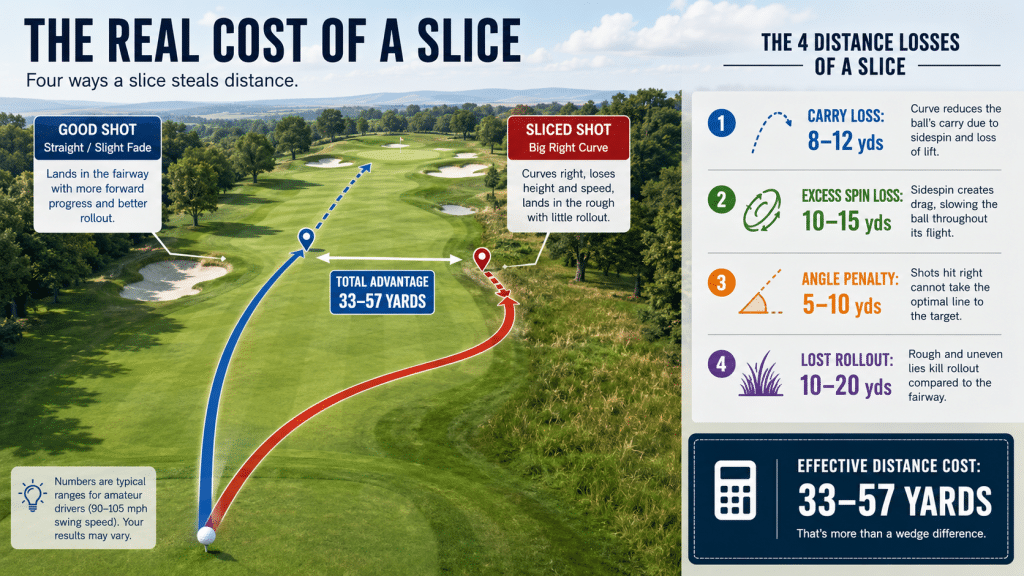
- Sidespin carry loss: 8–12 yards
- Excess spin from the open face: 10–15 yards
- Angle penalty: 5–10 yards
- Lost rollout: 10–20 yards
Total effective distance cost: roughly 33–57 yards.
That's not a typo, and it's why the “20 yards” you've been estimating is low. The average recreational slicer who converts to a playable fade doesn't gain 20 yards — they gain something in the 30–50 yard range of effective distance, which is the difference between a 7-iron and a 4-iron into most par 4s.
Worth noting the honest caveat: these are typical ranges, not guarantees. Your actual number depends on your swing speed, how severe your curve is, and course conditions. A golfer with a 10-yard fade is losing far less than these numbers; a golfer with a 40-yard banana is likely losing more.
Loss #5: The Scorecard Cost (The Expensive One)
Distance is the loss you feel. Strokes are the loss that matters.
The sliced drive doesn't just leave you short — it leaves you in the right rough, behind a tree, in a bunker, or out of bounds. Each of those has a cost:
Right rough: you can't reach the green with your normal club, so you lay up or hack out. Roughly half a stroke per occurrence.
Behind trees or a punch-out: a full stroke, sometimes more.
Out of bounds or lost ball: stroke and distance — two strokes gone, plus the mental damage to the next three holes.
For an 18-handicap slicer, driving typically accounts for 3–5 strokes of the total score. Cut your curve in half and keep three more drives per round in play, and breaking 90 stops being a twice-a-summer accident.
Why This Math Justifies Two Awkward Weeks
Here's the point of the accounting. A grip change feels wrong for about two weeks. Golfers abandon it in week one because the discomfort is immediate and the payoff is delayed.
But run the trade: two weeks of feeling odd, in exchange for 30–50 yards of effective distance and 3–5 strokes per round, permanently, for free. There is no club purchase, no lesson package, and no training aid on the market that offers that return. The most expensive driver ever made will not buy you 30 yards. Your grip will.
Getting the Yards Back
The recovery order matters, and it's covered across this series:
Fix the face first — the knuckle test is where 70% of slicers find their answer, and it's the one that kills both the sidespin loss and the excess-spin loss at once. Then attack the path with ball position, stance, and shoulder alignment. Read each change with the traffic light method rather than guessing.
And calibrate your target correctly: you're not chasing a dead-straight ball. A 5–10 yard fade recovers nearly all of the distance losses above while remaining a repeatable, predictable shot. Straight is a bonus. Playable is the goal.
The Bottom Line
Your slice is costing you 33–57 yards of effective distance and 3–5 strokes per round. Not the 20 yards you assumed — considerably more, because sidespin, excess spin, the angle penalty, and lost rollout stack on top of each other, and then the penalty strokes arrive on top of that.
The fix is free. It just isn't comfortable for two weeks. Given the math, that's the best deal in golf.
FAQ
How much distance does a slice cost? Roughly 33–57 yards of effective distance for a moderate slicer, once you stack four separate losses: 8–12 yards of carry lost to sidespin, 10–15 yards lost to excess backspin from the open face, 5–10 yards to the angle penalty of finishing off-line, and 10–20 yards of lost rollout. Severity varies with swing speed and how much your ball curves.
Why does an open clubface add backspin? Face angle and dynamic loft are geometrically linked — opening a driver face effectively adds loft to it. The extra loft produces more backspin, often 3,500–4,000+ rpm when 2,200–2,600 would maximize distance. That's the balloon flight that climbs high and lands with no rollout.
How many strokes does a slice cost per round? Typically 3–5 strokes for an 18-handicap. The cost comes from recovery shots out of the right rough (about half a stroke each), punch-outs from behind trees (a full stroke), and out-of-bounds or lost balls (two strokes under stroke-and-distance).
Would I really gain 30 yards by fixing my slice? In effective distance, often yes — but it isn't 30 yards of pure carry. It's the combination of recovered carry, reduced spin, better rollout, and no longer traveling sideways. Golfers who convert a big slice into a 5–10 yard fade routinely find themselves two or three clubs closer on approach shots.