

This is one of the most common questions we get from golfers researching the RS1, and it usually comes from the same place: a feeling that a $399 technology-assisted putter is designed for serious golfers, not for someone who's still working on the basics.
That assumption is understandable. It's also mostly wrong — and understanding why requires looking at what the RS1 actually corrects, and whether high handicappers have that specific problem.
Spoiler: they almost always do, and more severely than lower handicappers.
What “High Handicapper” Actually Means for Putting
A high handicapper — roughly 20 and above — typically loses strokes in several places: off the tee, on approach shots, around the green, and on the putting surface. The putting problem for most high handicappers isn't mysterious. It comes down to two things:
Face angle at impact. The putter face arrives open or closed at the moment it strikes the ball, sending the putt offline. This is responsible for the majority of missed putts at every handicap level, but it's most severe at higher handicaps where grip pressure, wrist tension, and stroke inconsistency are most pronounced. This problem has a specific name — face drift — and it's the core problem the RS1 was engineered to fix.
Distance control on lag putts. Three-putts from distance because first putts leave an uncomfortable second putt. This is partly a face angle problem and partly a stroke calibration problem.
Both of these are things the RS1 directly addresses — and neither of them requires a polished stroke to benefit from.
Why High Handicappers Actually Benefit Most
Here's the counterintuitive truth: the RS1's Forward Axis Weighting technology has its strongest corrective effect precisely under the conditions most common in high-handicap putting.
High handicappers typically grip the putter more tightly than lower handicappers, especially under pressure. Tight grip pressure increases wrist tension, which increases face rotation during the stroke. Face rotation during the stroke is exactly the problem Forward Axis Weighting was engineered to correct — the forward-weighted head pulls the face back toward square throughout the stroke arc.
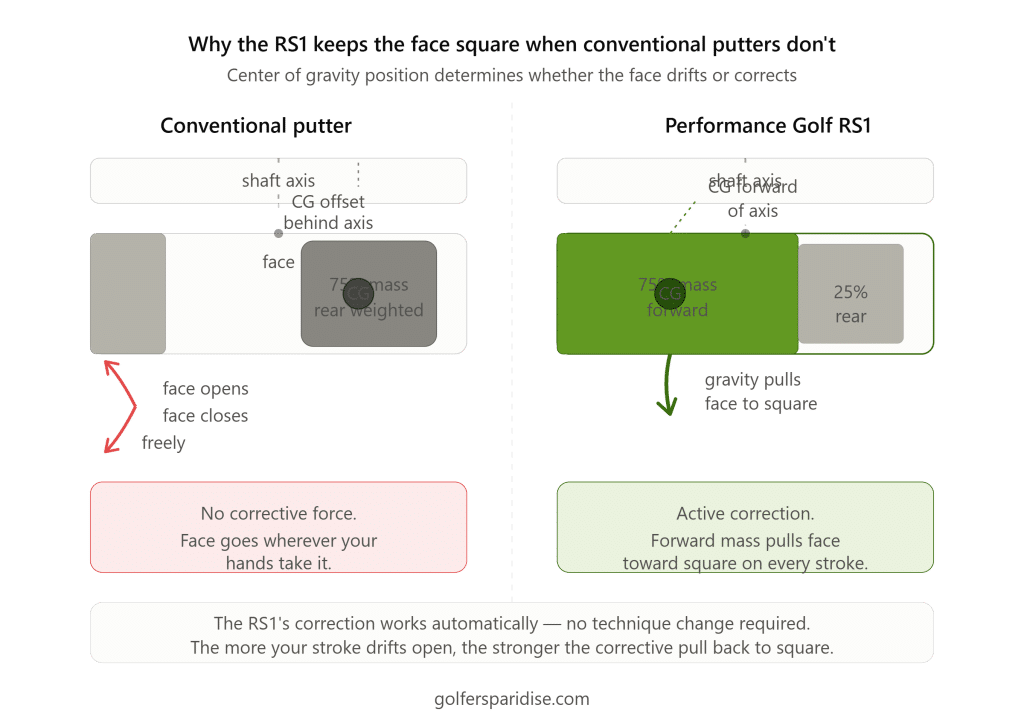
The more face rotation a stroke introduces, the more corrective work the RS1's gravitational mechanism does. A golfer with a 6-handicap and a well-groomed stroke may see modest improvement from the RS1's active correction because they're introducing less rotation to begin with — in fact, for golfers with very refined mechanics, a passive zero-torque design like the LAB Golf DF3 may be more appropriate. A golfer with a 24-handicap who grips the putter tightly, has inconsistent wrist control, and makes different strokes under pressure versus on the practice green — that golfer is in the RS1's wheelhouse.
This is not a niche edge case. This is the majority of high-handicap putting.
The Short Putt Problem — Where High Handicappers Lose the Most Shots
Most high handicappers' putting problems are concentrated inside 10 feet. The three-putts from 40 feet are frustrating, but they're ultimately a distance control issue. The real scoring damage happens on 4, 5, and 6-foot putts that should be makeable but aren't.
Missed short putts are almost never a read problem. At 5 feet on a relatively flat surface, the read is straightforward. The misses come from face angle — the face arrives at impact open or closed by a degree or two and the ball slips past the edge of the cup.
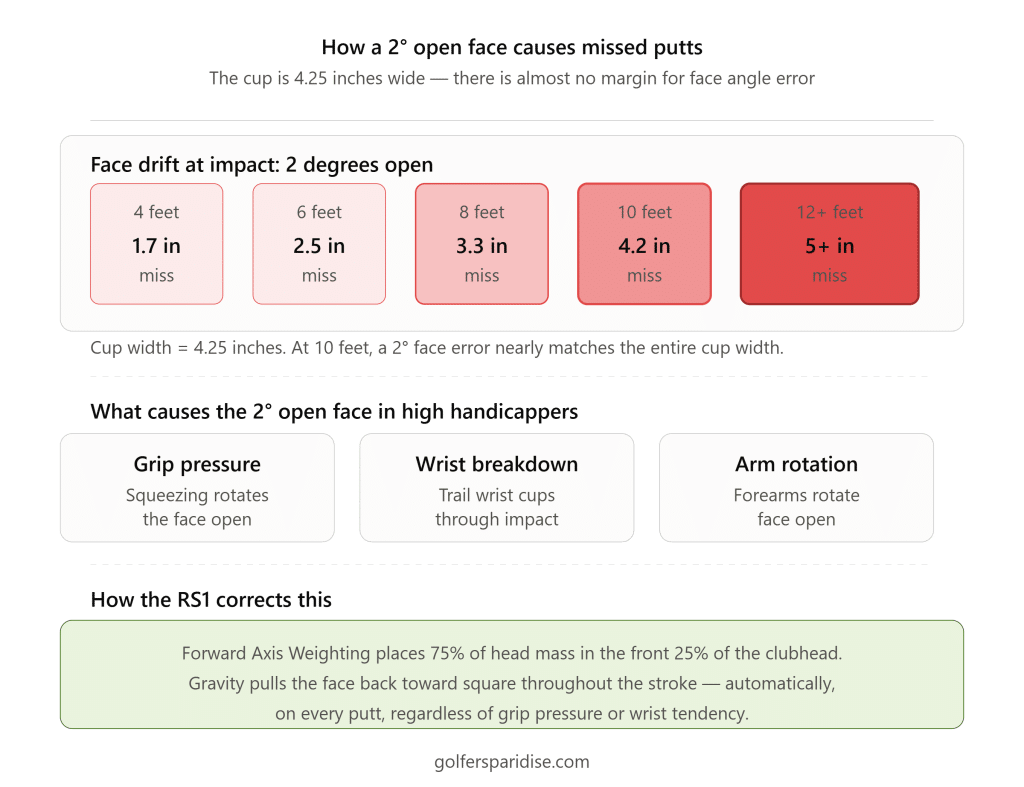
The RS1's gravitational correction is most powerful on short, compact strokes. On a 5-foot putt the backstroke is brief, the forward swing is brief, and the forward-weighted head has the maximum relative influence over face position at the bottom of that short arc. The physics work in your favor on the putts that matter most for your scorecard.
Many high handicappers who try the RS1 report that short putt improvement is the first thing they notice — often within the very first session — before any other aspect of their putting changes. This tracks exactly with what the engineering predicts.
What About the Learning Curve?
The adjustment period for the RS1 — primarily around lag putting distance calibration — applies to high handicappers as much as any other player. We cover the specific three-session practice approach in detail in our RS1 Adjustment Guide.
The honest reality for high handicappers specifically: the lag putting recalibration is real but it needs to be kept in perspective. If you're currently three-putting from 35 feet regularly, you already have a distance control problem with your current putter. Switching to the RS1 introduces a brief recalibration period but doesn't make your existing distance control problem worse — it gives you a club that will improve your short putt conversion rate immediately while your lag putting recalibrates over a few sessions.
The net result for most high handicappers: immediate improvement on short putts, a brief adjustment period on lag putts, and meaningful overall improvement within three to five practice sessions.
Is the RS1 Too Advanced for a Beginner?
This question comes up often enough to deserve a direct answer: no.
The Forward Axis Weighting technology doesn't require the golfer to understand it, master it, or consciously activate it. It operates through basic physics during every stroke regardless of the golfer's skill level or awareness of the mechanism. You don't need to putt well to benefit from a club that helps you putt better.
The analogy that applies here: power steering doesn't require you to be a skilled driver to work. It helps all drivers, and it helps less experienced drivers more than experienced ones because experienced drivers have already learned to manage the greater effort of manual steering.
The RS1 is not a club for golfers who have already figured out putting. It's a club for golfers who want help with the part of putting they can't consciously fix — and that describes most high handicappers precisely.
The One Honest Limitation for High Handicappers
There is one area where the RS1's relationship with high handicappers deserves honest qualification: stroke path errors.
The RS1's Forward Axis Weighting corrects face angle during the stroke. It does not correct severe stroke path problems — an extremely outside-in or inside-out path that sends the ball offline regardless of face angle. For a deeper look at what active correction does and doesn't fix, our active vs passive putter stability guide covers this distinction clearly. For a high-handicap golfer whose putting miss comes primarily from a dramatically wrong stroke path rather than face rotation, the RS1 addresses the secondary problem while leaving the primary one untouched.
In practice, most high-handicap putting misses involve both face rotation and some path deviation simultaneously. Correcting the face angle component while the golfer works on stroke path through practice is still a net improvement over correcting neither. But if your instructor has specifically identified stroke path as your primary putting fault and face angle as secondary, that context is worth knowing before purchasing.
For everything else — and that's the majority of high handicappers — the RS1 addresses the most common and most impactful putting problem directly.
The 365-Day Return Policy Changes the Risk Calculation
For a high handicapper evaluating a $399 putter, the return policy matters more than it does for a low-handicapper making the same purchase. If the RS1 doesn't produce measurable improvement for your specific game within a year, you return it and you're out nothing but shipping.
For a high handicapper who is genuinely unsure whether the technology will work for them, the 365-day window converts the purchase from a gamble into a year-long experiment with full exit rights. On configuration, most high handicappers will want the RS1 Plus over the Standard — the graphite shaft's softer feel makes it more forgiving on the hands and easier to putt confidently with from day one. That's a fundamentally different risk profile than a standard 30-day return window.
For full details on how to purchase the RS1 without subscription enrollment risk, see our subscription and billing guide. For everything about the RS1's technology, configurations, and pricing, see our complete RS1 buying guide.
Our Verdict for High Handicappers
The RS1 is a strong recommendation for high handicappers — arguably a stronger recommendation than it is for low-handicappers, because the conditions most common in high-handicap putting align almost exactly with the conditions under which the RS1's active correction does its best work.
If you're losing shots to missed short putts inside 10 feet, if you miss consistently to the same side, or if your putting feels inconsistent between the practice green and the course, the RS1 addresses each of those problems more directly than any conventional putter at this price point.
The 365-day return policy removes the financial risk. The short putt improvement is typically immediate. The adjustment period is manageable. For most high handicappers, this is the right putter.
Frequently Asked Questions
Is the RS1 putter good for a 30 handicap golfer? Yes — if anything, a 30-handicap golfer is closer to the ideal profile for the RS1's active correction technology than a 10-handicap golfer. Higher face rotation tendencies, higher grip pressure under stress, and less ingrained muscle memory all work in favor of the RS1's gravitational squaring mechanism producing immediate, measurable improvement.
Will the RS1 help me stop three-putting? The RS1 addresses face angle during the stroke, which improves directional accuracy on all putts. Three-putts from long distance often involve a face angle error on the first putt that leaves a difficult second putt — correcting that first putt's direction reduces the frequency of three-putt scenarios. Distance control on lag putts requires a brief adjustment period but also improves with the RS1 once calibrated.
Do I need to take putting lessons before using the RS1? No. The RS1's correction technology operates independently of your technique level. That said, basic fundamentals — reasonable setup, consistent grip pressure, smooth tempo — will help any putter perform better, including the RS1. The club corrects face rotation; it works best when paired with a reasonably consistent stroke.
Is there a cheaper alternative to the RS1 for high handicappers? The Cleveland Huntington Beach Soft Premier is a solid conventional putter at around $150 to $180. The Kirkland Signature KS1 offers 303 stainless steel quality at $100. Neither provides active face correction — they're conventional designs that perform well for golfers whose technique is sound. If face rotation is your primary putting problem, which it is for most high handicappers, neither addresses it the way the RS1 does. See our best putters for mid handicappers guide for a full comparison across price points.
How long before I see improvement with the RS1? Short putt improvement — inside 10 feet — is typically noticeable within the first practice session. Lag putting distance calibration takes three to five dedicated practice sessions. Full integration into your on-course game typically happens within two to three weeks of regular use.
Last updated October 2026.
Leave a Comment
Have you tried the RS1 as a high handicapper, or are you still weighing up whether it's worth it for your game? Drop your questions or experiences in the comments below — we read every one and answer as many as we can.