

You bought the RS1. It arrived, you took it to the practice green, and the face-squaring technology did exactly what it promised — your short putts felt noticeably more reliable. Then you rolled a 35-footer and watched it die six feet short of the hole.
This is the most common experience new RS1 owners report in the first session with the club, and it has a specific, well-understood cause. It is not a sign that the putter isn't working.
It is not a sign that you made a mistake. It is a predictable, temporary recalibration your brain needs to make — and with the right practice approach, most golfers complete it within three dedicated sessions.
This guide explains exactly what's happening, why it happens, and the specific drills that compress the adjustment window so you're not sacrificing competitive rounds while you adapt.
For the full RS1 technology breakdown and configuration comparison, see our complete RS1 buying guide.
Why the Adjustment Happens: The Physics in Plain Language
Your brain has spent months or years calibrating a specific relationship between backstroke length and ball distance for your previous putter. That calibration is stored as muscle memory — an automatic, below-conscious mapping of “this much stroke produces this much distance.”
When you switch to the RS1, two things change simultaneously that affect how the head moves through the stroke:
First, the weight distribution is different. The RS1 concentrates over 75% of its 360-gram head mass in the front 25% of the clubhead. This forward concentration changes the pendulum dynamics of the stroke — the head swings with slightly different momentum characteristics than a conventionally balanced or rear-weighted putter.
Specifically, the forward-heavy head has a slightly stronger tendency to decelerate through impact compared to a rear-weighted head at the same stroke speed.
Second, your grip pressure may be lower. The Dual Pistol grip's ergonomic design actively encourages reduced grip tension, and many new RS1 users find themselves naturally holding the club more lightly than their previous putter.
Lower grip pressure generally produces a smoother, less forceful stroke — which is beneficial for face control, but also means your habitual stroke produces slightly less power output than you're used to.
The combination of these two factors means your calibrated backstroke length — the one that produced a 35-foot putt reliably with your old putter — will initially produce a putt that comes up short. The brain hasn't yet updated its mapping. The adjustment process is simply teaching it the new relationship.
The good news: this recalibration is faster than most golfers expect when approached deliberately. The brain is extremely efficient at updating motor patterns when given clear, focused feedback. The golfers who struggle for multiple rounds are almost always those who went straight from the box to competitive play without any dedicated practice green time first.

What Adjusts Quickly vs What Takes Longer
Understanding which aspects of your putting adapt fast and which take more time helps you set realistic expectations and prioritize your practice sessions appropriately.
Adjusts Quickly (Often Within Session 1)
Short putt accuracy inside 10 feet. This is where most golfers notice immediate improvement with the RS1, and it makes sense given the physics. On a compact stroke for a 4 to 8 foot putt, the forward mass concentration and the brief arc of motion work together to deliver a reliably square face at impact.
Your brain barely needs to recalibrate here because the stroke is too short to accumulate meaningful timing errors.
Face angle consistency. The whole point of the RS1's Forward Axis Weighting mechanism is to reduce face rotation throughout the stroke — and this benefit is available from your very first putt. You don't need to recalibrate anything to access the face-squaring correction; it's built into the club's physics and operates whether your brain has adapted or not.
Overall stroke confidence. Many new RS1 users report feeling more comfortable over the ball within the first session, even before distance calibration is complete. The Dual Pistol grip's ergonomic design reduces hand tension, and the knowledge that the club is actively assisting face control removes a layer of conscious effort from the stroke.
Takes More Time (Sessions 2 Through 3 Typically)
Lag putt distance control from 25 to 60 feet. This is the primary calibration challenge and the focus of the practice approach below. Your muscle memory's distance mapping needs to be rewritten for the RS1's specific pendulum characteristics, and that process requires deliberate repetition with feedback.
Distance control on uphill vs downhill putts. Slope variations add a layer of complexity to distance calibration because the effective “power requirement” changes with gradient. Once your flat-green lag calibration is solid, spend a session specifically on sloping putts to update that aspect of the mapping separately.
Grain-specific distance on Bermuda greens. If you play Bermuda grass regularly, the grain direction creates two effectively different putting surfaces — with the grain and against it — each requiring its own distance calibration. Budget an extra session or part of a session for grain-specific work once your flat-green calibration is established.
The 3-Session Adjustment Protocol
This is the specific practice approach we recommend to new RS1 owners. It's structured to give your brain the clearest possible feedback signal at each stage, which is what accelerates recalibration.
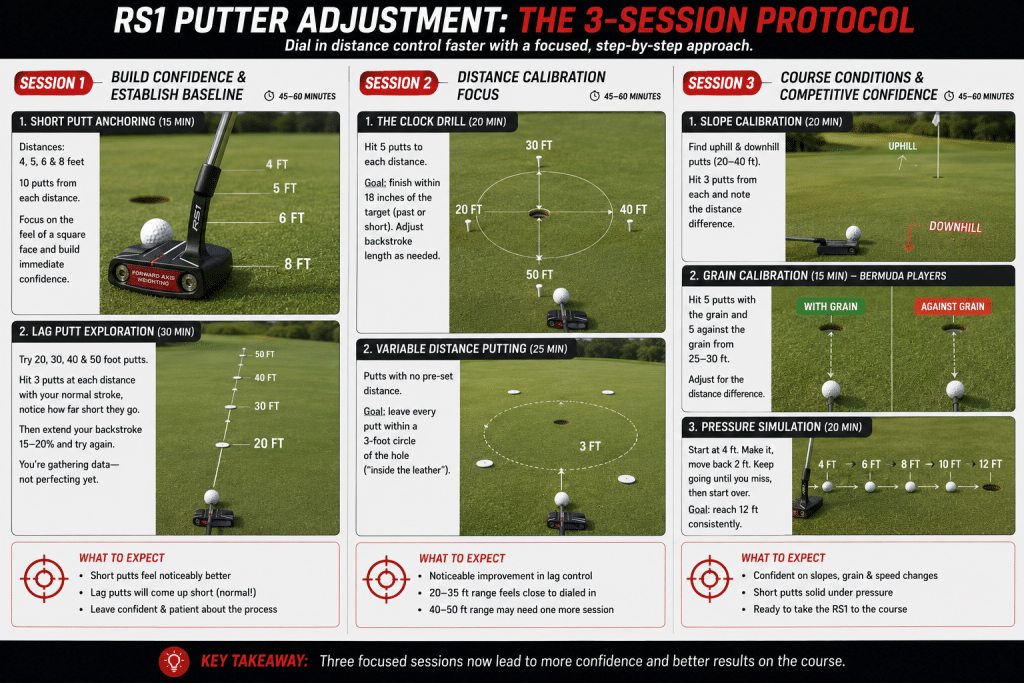
Session 1: Short Game Confidence and Baseline Calibration
Goal: Build immediate confidence in the face-squaring benefit, establish a baseline feel for how the RS1 moves, and begin rough distance calibration without pressure.
Duration: 45 to 60 minutes on a practice putting green.
Drill 1 — Short Putt Anchoring (15 minutes)
Set up at 4, 5, 6, and 8 feet from a hole. Hit 10 putts from each distance without worrying about making them — just focus on the feel of the face at impact. Notice how the club naturally wants to deliver square. After each putt, take a moment to absorb what the correct impact feels like with this specific club.
This drill serves two purposes: it builds the muscle memory of what a good RS1 stroke feels like at short range, and it gives you immediate positive reinforcement from the face-squaring technology before you encounter the lag putt distance challenge.
Drill 2 — Lag Putt Exploration (30 minutes)
Move to longer putts — 20, 30, 40, and 50 feet. Hit three putts from each distance and pay close attention to how far short of the hole your initial calibrated stroke lands. Don't try to overcorrect yet — just observe and log the gap mentally. Your brain is collecting calibration data with each putt.
After the first set of three at each distance, extend your backstroke slightly — roughly 15 to 20% more than your habitual length — and note the result. You're establishing the new mapping, not perfecting it yet.
What to expect: Your short putts will feel noticeably better immediately. Your lag putts will likely come up short by varying amounts. This is exactly correct. Leave Session 1 feeling confident about the short game improvement and patient about the lag calibration in progress.
Session 2: Distance Calibration Focus
Goal: Establish reliable distance control from 20 to 50 feet through focused repetition with feedback.
Duration: 45 to 60 minutes.
Drill 1 — The Clock Drill (20 minutes)
Find an open area of the practice green without a specific target hole. Place a tee at your starting position. Hit putts to four distances — 20, 30, 40, and 50 feet — marked by tees or alignment sticks placed at each distance. The goal is not to roll past or short of the marker by more than 18 inches in either direction.
Hit five putts to each distance in sequence, then return to the start. You're building a fresh distance-to-backstroke map specifically calibrated to the RS1. After each set of five, adjust your backstroke length based on whether you're consistently over or under the target.
Most golfers find their Session 2 calibration solidifies between 20 and 40 minutes into this drill. You'll feel a specific “click” moment when your brain has updated the mapping and the distance starts feeling automatic rather than effortfully calculated.
Drill 2 — Variable Distance Putting (25 minutes)
Switch to putting at actual holes with no pre-set distance. Walk to a random spot on the green, read the putt, and execute. The goal is to leave every putt within a 3-foot circle of the hole — what tour players call “inside the leather” from distance.
This drill tests whether your recalibration transfers from the controlled clock drill environment to a more realistic putting scenario. Most golfers are pleasantly surprised by how well it transfers at this stage.
What to expect: Meaningful improvement in lag distance control compared to Session 1. Your 20 to 35 foot range will likely feel close to calibrated. The 40 to 50 foot range may still need another session's worth of repetition.
Session 3: Course Conditions and Competitive Confidence
Goal: Complete calibration under variable conditions — slope, grain, speed variation — and build the confidence to take the RS1 into competitive play.
Duration: 45 to 60 minutes, ideally on the actual course greens you play most frequently rather than a generic practice facility green.
Drill 1 — Slope Calibration (20 minutes)
Find uphill and downhill putts of 20 to 40 feet. Hit three putts from each position, focusing specifically on how the uphill and downhill gradient changes your distance output compared to flat putts of the same stroke length. Establish mental reference points for slope compensation that layer on top of your flat-green calibration from Session 2.
Drill 2 — Grain Calibration for Bermuda Greens (15 minutes — Bermuda players only)
Find a hole where you can putt across the grain in both directions. Hit five putts with the grain and five putts against the grain from 25 to 30 feet. Note the distance difference and adjust your backstroke length reference accordingly.
Bermuda grain can add or reduce effective roll distance by 15 to 25% depending on how pronounced it is, and this adjustment needs to be part of your RS1 calibration if you play regularly on Bermuda.
Drill 3 — Pressure Simulation (20 minutes)
Set up a course on your practice green. Start at 4 feet and give yourself one putt to make it. If you make it, move back to 6 feet. Make that, move to 8. Keep going until you miss, then start over. The goal is to reach 12 feet consistently before missing.
This drill does two things: it tests your short putt calibration under mild self-imposed pressure, and it builds competitive confidence with the RS1 before your first real round. Golfers who complete this drill before their first competitive round consistently report feeling more settled and trusting of the putter under pressure than those who skip straight to the course.
When You're Ready to Play Competitively
Take the RS1 into competitive or regular play after Session 3 — not before, unless you're willing to accept some distance control inconsistency in the first round.
The single most common mistake new RS1 owners make is skipping the practice sessions and taking the club straight into a round with friends or a competitive game. Two or three lag putts that come up dramatically short in the first few holes can shake confidence in a club that is actually working exactly as intended — the problem isn't the putter, it's the uncalibrated brain controlling it.
Two to three deliberate practice sessions is a modest investment relative to the 365-day window the RS1 gives you to evaluate the technology. The golfers who end up returning the putter frustrated are disproportionately those who never gave their calibration the focused attention it required.
Frequently Asked Questions
How long does it realistically take to adjust to the RS1 putter? Most golfers complete meaningful distance recalibration within three dedicated practice sessions of 45 to 60 minutes each. Short putt improvement is typically immediate from the first session. Lag putting distance control is the primary adjustment challenge and usually resolves within sessions two and three.
Will my short putts get worse during the adjustment period? No — short putt performance typically improves immediately with the RS1 because the Forward Axis Weighting technology has its strongest corrective effect on short, compact strokes. The adjustment challenge is exclusively in the lag putt distance range.
I play Bermuda greens with significant grain. Does that make the adjustment harder? Slightly, because grain effectively creates two different putting surfaces with different distance characteristics. We recommend establishing your flat-green calibration first through sessions one and two, then dedicating part of session three specifically to grain direction calibration.
My putts are consistently coming up short after two sessions. Is something wrong? Not necessarily — some golfers take a fourth or fifth session to fully recalibrate, particularly if they had very deeply ingrained muscle memory with a previous putter they used for many years. Extend the clock drill from Session 2 and focus specifically on extending your backstroke length on putts over 30 feet.
Should I practice with the RS1 on an indoor putting mat? Indoor putting mats can be useful for stroke groove work and short putt repetition, but they are generally too short and too uniform for meaningful lag putt distance calibration. Sessions 2 and 3 in particular need to be done on a real putting green of reasonable size. Session 1 short putt work can be supplemented effectively indoors.
Last updated June 2026.
Related Reading: