
Both the Performance Golf RS1 and the S7K Stand Alone putter are marketed to the same broad audience — recreational golfers who are losing strokes on the green and want technology to help. Both are sold primarily through direct-to-consumer channels with aggressive video advertising. Both claim to solve alignment and consistency problems that conventional putters don't address.
But they solve fundamentally different problems, and understanding that distinction is what separates a purchase that genuinely improves your putting from one that addresses the wrong thing entirely.
This guide breaks down exactly what each putter does, where each one wins and loses the comparison, and which specific player profiles benefit most from each technology. For the complete RS1 product breakdown including configurations and pricing, see our main RS1 buying guide.
What Each Putter Actually Does
Before comparing them, it's worth being precise about what problem each putter is engineered to solve — because they're not the same problem.
The S7K Stand Alone Putter
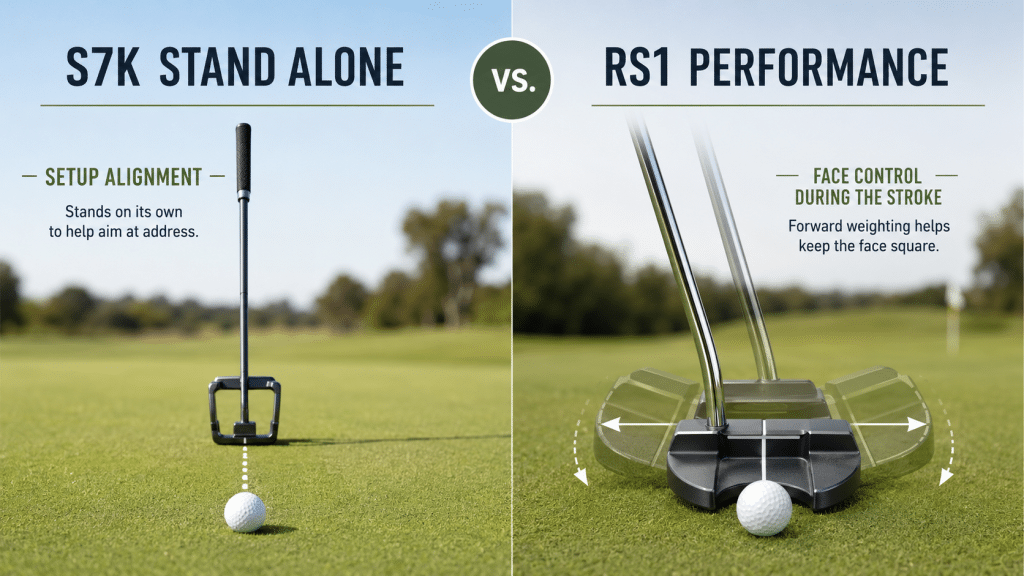
The S7K's defining feature is its ability to stand upright on the green without support. The engineering behind this — a heavy head paired with an extremely light shaft and grip — shifts the overall balance point of the club so dramatically that it stands independently when placed on a flat surface.
The intended benefit is alignment at address. When the putter stands on its own, it acts as a visual plumb line — a reference for checking your eye position, face angle at setup, and target line before you pull the trigger on the stroke. The theory is that better setup alignment produces more consistent results, even if the stroke itself isn't mechanically assisted during the swing.
The S7K addresses the problem of setting up incorrectly before the stroke begins.
The Performance Golf RS1
The RS1's Forward Axis Weighting places over 75% of its 360-gram head mass in the front 25% of the clubhead. This shifts the center of gravity forward of the shaft axis, creating an active gravitational force that pulls the face back toward square throughout the stroke arc.
The intended benefit is face angle control during the stroke — specifically, reducing the involuntary face rotation that occurs between setup and impact. The RS1 doesn't assist your setup alignment; it corrects the mechanical errors that occur after you've started moving.
The RS1 addresses the problem of face rotation happening during the stroke.

Why This Distinction Matters More Than Anything Else in This Comparison
Here is the honest framework for choosing between these two putters:
If your missed putts come from setting up misaligned — aiming left or right of your intended line before you even start the stroke — the S7K's setup alignment assistance addresses your specific problem and the RS1 does not.
If your missed putts come from face rotation during the stroke — the face arriving open or closed at impact despite a reasonable setup — the RS1 addresses your specific problem and the S7K does not.
Most golfers, if honest with themselves, miss putts for the second reason more than the first. Setup alignment is visible and correctable through practice, instruction, and the use of alignment aids during practice sessions. Face rotation during the stroke is often invisible — it happens faster than conscious perception, feels square even when it isn't, and is extremely difficult to correct through willpower or technique alone without mechanical assistance.
This is why the RS1 addresses a more pervasive putting problem for a larger segment of recreational golfers. But it's not a universal truth — if you genuinely know your miss comes from setup rather than mid-stroke rotation, the S7K deserves serious consideration.
Feel and Build Quality: An Honest Assessment
This is where the comparison becomes considerably less balanced, and we want to be direct about it.
S7K Feel and Acoustics
The S7K's engineering requirement — an extremely heavy head balanced against an extremely light shaft and grip — creates specific material constraints that have a significant impact on feel. The head construction necessary to achieve the stand-up balance point produces an impact sound that verified purchasers and independent reviewers consistently describe as hollow, harsh, and high-pitched. Comparisons to hitting a ball with an aluminum softball bat appear repeatedly across forum discussions and review platforms.
This isn't a minor aesthetic complaint. Feel and acoustic feedback are functional components of putting, particularly for experienced golfers who use sound as distance calibration input. A putter that produces feedback described as hollow and harsh is actively working against the tactile information experienced golfers rely on.
The light shaft and grip combination also produces a swing weight profile that feels unfamiliar and sometimes described as “floaty” or disconnected — a consequence of the extreme head-to-shaft weight ratio required for the stand-up feature.
RS1 Feel and Acoustics
The RS1 Standard produces a bright, high-pitched sound at impact due to its steel face and steel shaft combination — firmer than many recreational golfers are accustomed to from insert putters, but a sound profile that reviewers generally describe as crisp and informative rather than harsh or hollow.
The RS1 Plus, with its graphite shaft, shifts this profile considerably toward a deeper, more controlled “tock” that independent reviewers from Plugged In Golf and Breaking Eighty have described as genuinely premium. The multi-material construction — steel face, carbon composite crown, aluminum T-wing tail — produces a solid, substantial feel that reads as quality engineering rather than budget compromise.
The feel comparison is not close. The RS1 in either Plus or Standard configuration is a significantly more refined tactile experience than the S7K across every dimension reviewers have addressed.
Setup Assistance vs Stroke Correction: The On-Course Reality
The S7K's alignment benefit is real during practice and during the deliberate pre-shot setup routine on the green. But it raises a practical question worth considering: how much of your putting time is actually spent in that static pre-shot alignment phase?
On a typical putting green, the setup alignment moment lasts three to five seconds out of a total stroke duration of perhaps ten to fifteen seconds. The mechanical events that determine where the ball actually goes — face angle through impact, stroke path, contact quality — occur in the one to two seconds of the actual stroke movement.
The S7K helps you start in a better position. What happens after you start moving is entirely up to your stroke mechanics, without any mechanical assistance from the club.
The RS1 doesn't assist your pre-shot alignment. But it actively corrects mechanical errors throughout the stroke arc — the one to two second window where the ball's fate is actually determined.
For golfers who consistently set up well but lose accuracy during the stroke, the RS1's in-stroke correction is directly relevant to the problem. For golfers who know their setup is the issue, the S7K's pre-shot assistance matters more. The honest reality is that most recreational golfers have some degree of both problems — but mid-stroke face rotation is typically the larger contributor to missed putts at handicap levels above 10.
Price Comparison
| Performance Golf RS1 | S7K Stand Alone | |
|---|---|---|
| Price | $399 (Standard) / $429 (Plus) | Approximately $149–$179 |
| Return Policy | 365 days | Varies — typically 30 days |
| Build Quality | Multi-material premium construction | Budget-tier materials |
| Feel Profile | Crisp to refined depending on configuration | Hollow/harsh per verified reviewers |
The S7K is meaningfully less expensive, and that's a legitimate consideration. If budget is a genuine constraint, the price difference is real.
But the return policy difference matters significantly here. The RS1's 365-day guarantee converts a $399 purchase into a year-long risk-free trial. The S7K's typical 30-day return window gives you one month to evaluate a technology that can take several sessions to properly calibrate to. The risk-adjusted cost of the RS1 is considerably lower than the sticker price difference suggests.
Who Should Buy the S7K
The S7K makes the most sense for a specific, relatively narrow buyer profile:
Golfers whose primary putting problem is verifiably setup-related. If a teaching professional or stroke analysis session has confirmed that your face angle at address — not mid-stroke — is the primary source of your missed putts, the S7K's visual alignment assistance directly addresses your specific issue.
Very budget-conscious buyers who want any form of alignment assistance. At roughly $150, the S7K is a much lower financial commitment. If you're not ready to spend $399 on a putter, the S7K offers a different kind of alignment help at a fraction of the cost.
Golfers who do a lot of solo practice on the green. The stand-up feature has genuine utility during practice sessions for checking alignment and eye position without a physical training aid. As a practice tool, its value proposition is cleaner than as a primary on-course putter.

Who Should Buy the RS1
The RS1 makes more sense for a considerably broader buyer profile:
Golfers who miss putts consistently to the same side. A repeatable directional miss almost always indicates face rotation during the stroke rather than a setup alignment problem. The RS1's gravitational correction directly addresses this pattern. For a deeper look at this technology, see our Forward Axis Weighting explainer.
Golfers who feel like they're set up well but still miss. If your practice stroke looks square and your setup feels aligned but putts still miss, mid-stroke face rotation is the most likely culprit — and the RS1 is engineered specifically for this scenario.
Golfers who want a putter they can use seriously in competition. The RS1 is a USGA-conforming putter designed for legitimate on-course use. Its feel profile, particularly in Plus configuration, is competitive with premium putters from established manufacturers in the same price range.
Senior golfers managing grip strength or wrist stability changes. As we cover in detail in our RS1 for Senior Golfers guide, the demographic whose physical changes most closely match the conditions under which Forward Axis Weighting delivers its strongest benefit is senior recreational golfers.
Golfers who value feel quality as part of their putting experience. The RS1 Plus and Founder's Edition offer a tactile experience that independent reviewers have described as genuinely premium. The S7K does not.
Can You Use Both?
An interesting question that comes up occasionally: could you use the S7K during practice sessions for alignment work and the RS1 on the course?
In principle, yes — there's no rule against using different putters in different contexts. Some golfers use practice-specific training aids and then switch to their game putter for actual rounds. If the S7K's alignment assistance is valuable to you as a practice tool for identifying setup tendencies, and the RS1 is your on-course playing putter, the two aren't mutually exclusive.
That said, for most recreational golfers this approach introduces more variables than it resolves. Adapting to the RS1's distance calibration — as we cover in our adjustment guide — is best done by using the RS1 consistently rather than alternating between two putters with very different weight and balance profiles.
Our Verdict
For the majority of recreational golfers comparing these two putters, the RS1 is the stronger, more broadly applicable solution — because it addresses mid-stroke face rotation, which is a more pervasive and more scoring-impactful putting problem than setup alignment for most players. It does so with meaningfully superior build quality, a better feel profile, and a return policy that dramatically reduces purchase risk.
The S7K is the more appropriate choice for a narrower, more specific buyer profile — primarily budget-conscious golfers with a verifiable setup alignment problem and limited interest in a premium feel experience.
If you're genuinely unsure which problem your putting actually has, the RS1's 365-day return policy makes it the lower-risk way to find out. See our subscription and returns guide for full details on how to purchase the RS1 cleanly without subscription enrollment risk.
Frequently Asked Questions
Is the S7K putter legal for tournament play? The S7K is USGA conforming and legal for competitive play. The standing feature does not violate any current equipment rules.
Does the RS1 help with alignment at address like the S7K does? Not directly — the RS1's 74-degree upright lie angle naturally promotes a more consistent eye-over-ball position at address, which has indirect alignment benefits, but it doesn't provide the visual plumb-line reference of the S7K's stand-up feature.
Is the S7K's hollow sound as bad as reviewers say? Acoustic feedback is subjective, but the hollow, harsh impact sound is among the most consistently reported negatives in S7K reviews across multiple independent platforms. Golfers who are sensitive to impact sound and feel should weigh this seriously before purchasing.
Which putter is better for a 20 handicap golfer? For most 20-handicap golfers, the RS1 addresses the more impactful putting problem — mid-stroke face rotation — and will produce more measurable scoring improvement than setup alignment assistance alone. That said, individual variation exists, and the RS1's 365-day return policy allows for personal evaluation.
Can I try the RS1 before committing? The 365-day return policy effectively functions as a one-year trial period. See our complete RS1 buying guide for the full details on purchasing and the return process.
Last updated June 2026.
Related Reading:
- Performance Golf RS1 Putter: Complete Review and Buying Guide
- RS1 vs RS1 Plus: Is the Graphite Shaft Worth the Upgrade?
- RS1 vs LAB Golf DF3: Active vs Passive Face Squaring Compared
- How Forward Axis Weighting Works: The Physics Behind the RS1
- RS1 Putter for Senior Golfers
- Buying the RS1 Putter Without Subscription Headaches