
- Strengthening your grip closes the clubface at impact — but too much rotation turns a fix into a hook factory.
- The difference between a productive strong grip and an overcorrected one comes down to knuckle count and forearm rotation through the ball.
- Your swing path, ball position, and forearm roll all need to sync with your new grip — or the hooks get worse, not better.
- There's a specific tee drill and slow-motion swing technique that resets muscle memory faster than hitting bucket after bucket on the range.
- Most golfers can dial in a stronger grip within 2 to 4 weeks with the right adjustments — but there's a critical setup mistake most people skip that keeps the hook coming back.
You made the change your instructor recommended, rotated your hands to the right on the grip, saw more knuckles on your lead hand, and suddenly started bombing it — until the hooks started.
This is one of the most common overcorrection traps in golf. A stronger grip genuinely helps most players who slice, but without adjusting your forearm rotation, clubface awareness, and setup to match, that same grip becomes the reason you're spraying shots 40 yards left. Golf Sensei Training covers this exact problem in depth, and the fix is more mechanical than most people realize.
A Stronger Grip Creates Hooks — Here’s Why That Happens
When you rotate your hands clockwise on the handle (for a right-handed golfer), you’re essentially pre-closing the clubface relative to your swing path. That’s intentional — it counteracts the open-face tendency that causes slices. The problem starts when the amount of pre-closure exceeds what your swing rotation can neutralize through impact.
What “Strengthening” Your Grip Actually Does to the Clubface
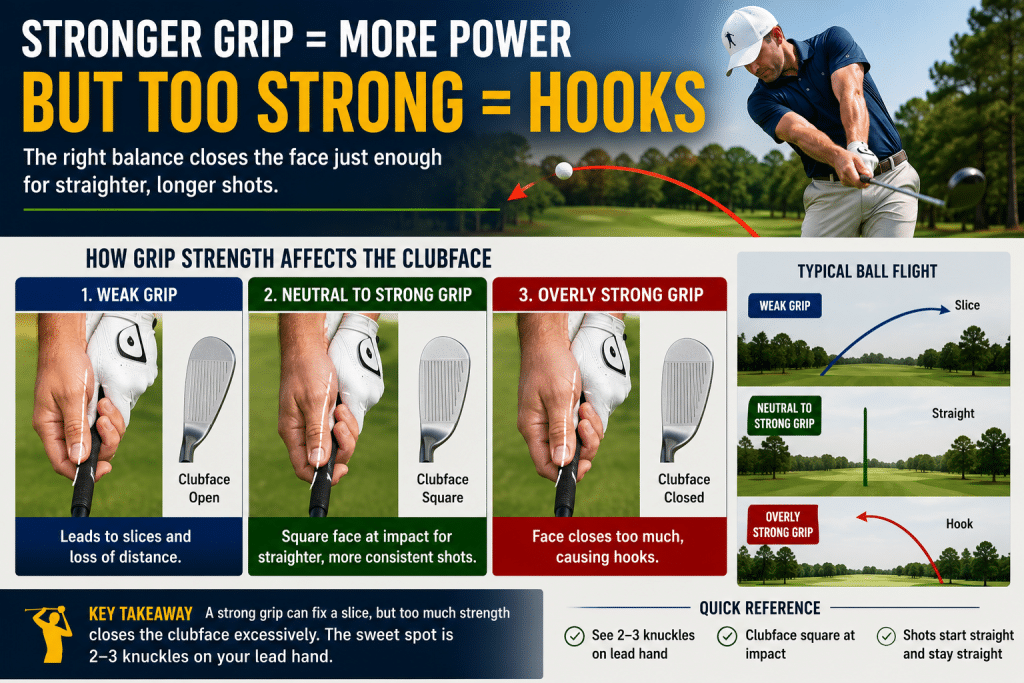
A stronger grip repositions your hands so the palms face more skyward at address. Since your right palm direction mirrors your clubface angle through impact, rotating the right hand underneath the handle means the face naturally wants to close as you release. With a neutral grip, a normal forearm rotation squares the face. With a strong grip and the same forearm rotation, the face closes well past square — producing the snap hook you’re now fighting.
The Difference Between a Strong Grip and an Overcorrected Grip
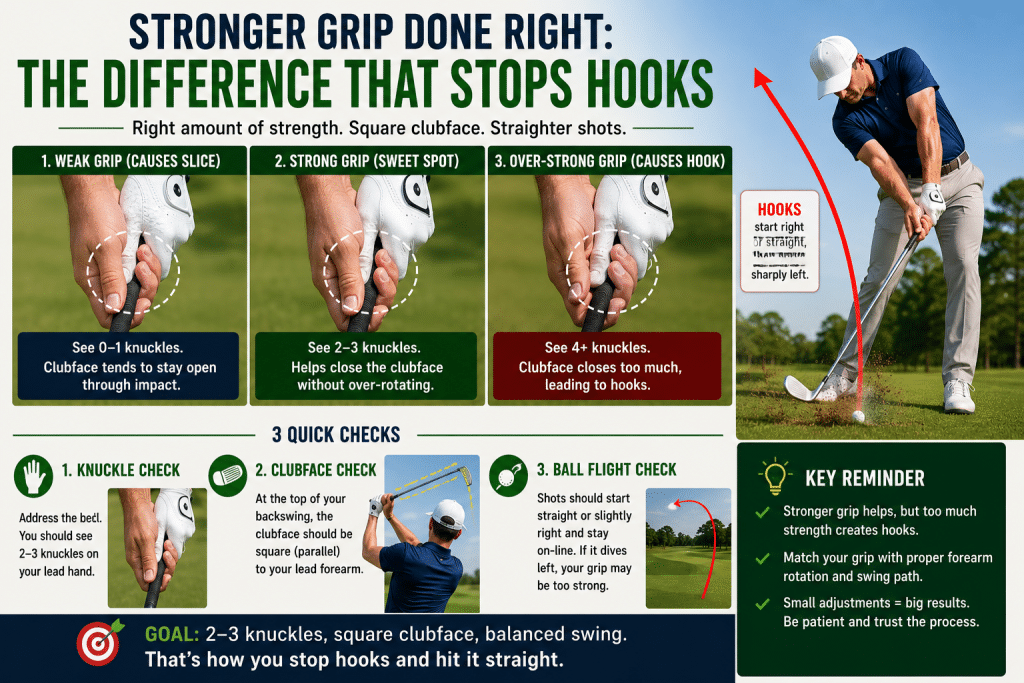
A strong grip means seeing two to three knuckles on your lead hand at address and having your trail hand positioned slightly under the handle. That’s functional and used by many tour players. An overcorrected grip pushes past that — four knuckles visible, trail hand fully under the shaft, and the V’s formed by both thumbs and forefingers pointing well outside the trail shoulder. At that point, the clubface is so pre-closed that squaring it at impact requires actively holding the face open, which is nearly impossible to do consistently under real swing speeds.
Why Your Brain Overcompensates When You Change Your Grip
Here’s something most instruction skips: your brain still remembers your old swing. When you change your grip, your nervous system tries to produce the same ball flight it’s used to — which means it unconsciously applies the same forearm rotation it always did.
With your old neutral grip, that rotation squared the face. With your new strong grip, that same rotation closes it too far. The result is a hook that feels like it came out of nowhere, even though your swing path looks identical on video. If you're struggling with a slice instead, you might want to check out this one-shot slice fix to improve your game.
How to Tell If Your Grip Is Too Strong
Before you start making swing changes, confirm that the grip is actually the problem. A closed swing path can also produce hooks, and fixing the wrong variable will waste weeks of practice time. These three checks isolate the grip as the culprit.
The Knuckle Check: How Many Should You See?
Stand at address and look straight down at your lead hand. A neutral grip shows two knuckles. A strong grip shows two to three. If you’re seeing four knuckles or the entire back of your glove, the grip is overcorrected. Simultaneously, check the V formed by your trail thumb and forefinger — it should point to your trail shoulder, not outside it. When both V’s point significantly right of the trail shoulder, you’ve crossed into overcorrection territory.
One quick secondary check: grip the club and hold it out in front of you at waist height. Let your arms relax naturally. If the clubface points toward the ground rather than vertical or slightly open, your grip is closing the face before the swing even starts. To ensure you're using the right grip, consider checking out the knuckle test.
Where Your Clubface Points at the Top of Your Backswing
At the top of a proper backswing, the clubface should be parallel to your lead forearm — sometimes called a “square” position at the top. With an overly strong grip, the face points more toward the sky (closed) at the top. You can check this with a mirror or camera positioned behind you. A closed face at the top gives the clubface a head start on closing further through impact, and even a modest forearm release sends the ball hard left.
Ball Flight Patterns That Confirm an Overcorrected Grip
Grip-related hooks have a specific shape: they start relatively straight or slightly right of target, then make a sharp left turn through the air. This is different from a swing-path hook, which typically starts left immediately. If your miss starts online or slightly right and then dives left, the face is closing through impact — a grip problem. If it starts left from the moment it leaves the clubface, the swing path is the more likely culprit and you need to check alignment and club path first before touching the grip.
| Hook Type | Starting Direction | Curve | Primary Cause |
|---|---|---|---|
| Grip-related hook | Straight or slightly right | Sharp left curve mid-flight | Overclosed face at impact |
| Path-related hook | Left of target immediately | Continues left or flattens | In-to-out path with closed face |
| Release hook | Straight start | Rolls left at landing | Excessive forearm rotation |
The Right Way to Set a Neutral-to-Strong Grip
The goal isn’t to weaken your grip back to where it was — it’s to find the sweet spot where the grip is strong enough to help without overclosing the face. Here’s exactly how to build that position from scratch.
- Place the handle diagonally across the fingers of your lead hand, not in the palm — this keeps grip pressure in the fingers where it belongs.
- Close your lead hand so exactly two to three knuckles are visible when you look straight down, with the V pointing to your trail shoulder.
- Place your trail hand so the lifeline covers your lead thumb and the trail palm faces the target — not skyward.
- Form the trail hand V so it also points to the trail shoulder, matching the lead hand angle.
- Check that the leading edge of the clubface is square to your target line before you lock in your grip — this is the step most people skip.
The most common error at this stage is gripping the club first and then rotating it to aim, which subtly changes the hand position relative to the face. Always aim the face first, then build the grip around it. If you're struggling with alignment, you might find these tips to fix a slice helpful.
One detail that separates functional strong grips from overcorrected ones is the right index finger. Positioning it in a slight “trigger finger” configuration — where it sits under the handle with a small gap between it and the middle finger — keeps the trail hand from over-rotating under the shaft. If the index finger wraps fully around the grip and closes the gap, the trail hand tends to slip into an overcorrected position without you noticing.
Grip Pressure: How Tight Is Too Tight
Grip pressure plays a bigger role in hooks than most golfers expect. Squeezing too hard through impact stiffens the wrists and forearms, which actually speeds up the rotation of the clubface through the hitting zone.
On a scale of one to ten, most tour players maintain a grip pressure of around four to six — firm enough to control the club, loose enough to let the wrists hinge and release naturally without snapping the face closed. If your forearms feel tense at address or your knuckles are whitening around the grip, you’re creating the exact tension that turns a strong grip into a snap hook.
Drills to Stop Hooking Without Losing Your Grip Strength Gains
Changing your grip without retraining your swing is only half the fix. Your muscle memory was built around your old grip, and it will fight you until the new movement patterns feel automatic. These two drills specifically target the connection between grip position and clubface control — without requiring you to weaken the grip you worked to build.
The Alignment Stick Drill to Train Clubface Awareness
Stick an alignment rod into the end of your grip so it extends back along your forearm during the swing. Take slow, deliberate half swings and watch where the rod points at the top of your backswing — it should roughly mirror the angle of your lead forearm, not point toward the sky. If the rod tilts skyward at the top, your face is closing early and your grip is likely overcorrected.
This drill builds the proprioceptive awareness that lets you feel clubface position without having to see it, which is exactly what you need to manage a strong grip under real swing conditions. Do this for ten to fifteen reps at the start of every practice session for two weeks and you’ll notice the feedback becoming instinctive.
Slow Motion Swings to Reset Muscle Memory
Hit shots at thirty percent speed with your adjusted grip, focusing entirely on where the face is pointing at impact — not on distance or ball flight. The goal is to groove the sensation of a square face at contact with the new hand position. Slow motion swings expose the exact moment the face overclosing happens, which at full speed is invisible even on camera. Three or four buckets of deliberate slow-motion swings will do more to reset your muscle memory than thirty buckets of full-speed range work where the old pattern keeps repeating itself.
Fixing Your Forearm Rotation to Match Your New Grip
Even a perfectly calibrated grip will produce hooks if your forearm rotation stays calibrated to your old neutral grip. This is the adjustment that most golfers miss entirely — and it’s why hooks often persist even after the grip is corrected.
Why Forearm Rotation Causes Hooks With a Strong Grip
With a neutral grip, the forearms need to rotate fully through impact to square the clubface. With a strong grip, the face arrives at square earlier in the downswing — so the same amount of forearm rotation that used to produce a straight shot now closes the face past square at impact.
Think of it this way: the strong grip gives the face a head start on closing, which means you need to apply less rotation through the ball to keep it square. Most golfers don’t reduce their forearm rotation after strengthening the grip, and the result is a face that’s several degrees closed at impact, producing that sharp left hook.
How to Reduce Forearm Roll Through Impact
The adjustment is subtle but specific. Through the impact zone, focus on keeping the back of your lead hand pointing more toward the target for slightly longer than feels natural. This delays the forearm rollover and gives the face time to square without overclosing. A good swing thought is to feel like the lead wrist stays flat or even slightly bowed through the hitting zone rather than cupping and rolling immediately after contact.
A simple drill to ingrain this feeling: place a golf glove or headcover under your trail armpit and hit punch shots with it tucked in place. This restricts the trail arm from fully extending and over-rotating through the ball, which is the physical motion that drives the forearm rollover. When the trail arm stays connected through impact, the clubface holds its angle longer and the ball flies much straighter. For more insights, check out this grip fix guide from Hank Haney.
The Feeling You Should Have Through the Ball
When the grip and forearm rotation are properly matched, the swing through impact feels almost like you’re holding the face open slightly compared to what you’re used to. That’s not actually what’s happening — the face is square — but because your old pattern involved so much more rotation, restraint feels like holding off. Trust that feeling. If the ball is flying straight or with a gentle draw rather than a snap hook, the mechanics are correct regardless of how different it feels from your old swing.
Setup Adjustments That Prevent the Hook
A stronger grip doesn’t just affect how you hold the club — it changes the optimal position for everything else at address. Stance width, alignment, and ball position all need minor recalibrations when you make a grip change, and skipping these adjustments is one of the main reasons hooks persist even after the grip and forearm rotation are corrected.
Most golfers treat setup as a fixed routine they run through automatically, which works fine when everything else stays constant. But grip changes shift the mechanics of impact enough that your old setup can actually fight your new grip. The good news is these adjustments are small — we’re talking inches and degrees, not a complete overhaul of how you stand to the ball. For more on grip adjustments, check out this grip compatibility guide.
The key principle here is that a stronger grip tends to encourage a slightly more in-to-out swing path, which compounds the hook when combined with a closed face. Small setup tweaks can neutralize that path tendency without requiring you to consciously manipulate the swing itself. Let the setup do the work so your swing can stay athletic and instinctive.
Stance Width and Alignment With a Stronger Grip
A common but overlooked issue is that golfers who hook with a strong grip are often inadvertently aligned slightly right of target — what instructors call a closed stance. A closed stance promotes an in-to-out swing path, and when that combines with a strong grip closing the face, the ball curves sharply left.
Check your alignment with an alignment rod on the ground and make sure your feet, hips, and shoulders are square or even fractionally open relative to your target line. This slight open tendency counteracts the in-to-out path that a strong grip naturally encourages.
Stance width matters too. An overly wide stance restricts hip rotation through impact, which forces the hands and forearms to do more work to square the face — and with a strong grip already pre-closing the face, more hand action means more hook. A stance roughly shoulder-width for irons and just outside shoulder-width for driver gives the hips enough freedom to rotate through impact and reduce the over-reliance on hand action. For more on improving your swing, check out this guide on how to fix a slice without changing your swing.
| Club | Recommended Stance Width | Ball Position | Alignment Adjustment |
|---|---|---|---|
| Driver | Just outside shoulder-width | Off lead heel | Fractionally open |
| Fairway Woods | Shoulder-width | One ball inside lead heel | Square to fractionally open |
| Mid Irons (5-7) | Shoulder-width | Center-forward | Square |
| Short Irons (8-PW) | Slightly narrower | Center | Square |
Pay special attention to your shoulder alignment specifically — it’s the most commonly misread part of setup. Many golfers check their feet but leave their trail shoulder dropped and pointed right, which closes the shoulder line and sends the club on an in-to-out path regardless of where the feet are pointing.
Ball Position Changes That Reduce Hook Spin
Ball position has a direct effect on where in the swing arc the clubface makes contact. When the ball is positioned too far back in the stance, impact happens earlier in the downswing — before the face has fully squared — which can produce pushes with a neutral grip, but with a strong grip it catches the face in transition and the ball flies low and left. Moving the ball slightly forward gives the face more time to reach square and allows the path to straighten out before contact. For more information on grip adjustments, you can read about Hank Haney's grip fix.
For the driver specifically, a ball position off the lead heel or even slightly ahead of it encourages a slightly ascending strike with an already-squaring face. This reduces hook spin compared to a ball position that’s too centered, which steepens the angle of attack and encourages the face to rotate through faster. With a strong grip, every degree of extra face rotation at impact costs you yards to the left.
The correction doesn’t need to be dramatic. Moving the ball one to two ball-widths forward from where you currently play it is often enough to see an immediate change in ball flight shape. Make this adjustment on the range first and hit ten to fifteen shots before drawing any conclusions — it takes a few swings to feel natural when you’ve played a centered ball position for years.
- Move the ball one to two ball-widths forward from your current position if you’re hooking consistently.
- For driver, play the ball off the inside of your lead heel as a baseline starting point.
- For irons, center-to-forward keeps the face from closing too early through the hitting zone.
- Avoid playing the ball behind center with a strong grip — this is the combination most likely to produce snap hooks.
- Recheck ball position every few weeks, as it tends to drift backward over time without you noticing.
How Long It Takes to Dial In a Stronger Grip
Expect the adjustment period to take two to four weeks of consistent, focused practice — not just hitting balls, but hitting balls with deliberate attention to grip position, forearm rotation, and setup. The first few sessions will likely feel awkward and the ball flight may actually get temporarily worse before it improves, which is completely normal and not a sign that the changes are wrong.
The reason it takes this long is that grip changes require rewriting motor patterns that were built over hundreds or thousands of repetitions. Your nervous system doesn’t update itself in one range session — it needs repeated, correct exposures to the new movement before it starts reproducing it automatically. Short, focused practice sessions of 45 to 60 minutes with intentional feedback are more effective than two-hour sessions where you slip back into old habits after the first twenty balls.
- Week 1: Focus exclusively on grip position and the knuckle check at address — don’t worry about results yet.
- Week 2: Add forearm rotation awareness using the tucked headcover drill during practice swings and half shots.
- Week 3: Incorporate setup adjustments — alignment, stance width, and ball position — and start tracking ball flight shape rather than just direction.
- Week 4: Graduate to full shots with full attention, trusting the new pattern and accepting occasional misses as part of the calibration process.
Most golfers see a significant reduction in hook frequency within the first two weeks, even before the pattern feels fully automatic. The snap hooks — the ones that go dramatically left — are usually the first to disappear. The gentler draws and occasional pull-hooks may linger into week three or four as the finer adjustments settle in.
The biggest mistake at this stage is abandoning the changes too early. If you hit three hooks in a row during week two and revert to your old grip, you reset the entire adaptation process. Stay committed to the adjusted grip even when it feels foreign, use the drills to course-correct when the hooks reappear, and trust that the discomfort is temporary while the improvement is permanent.
Frequently Asked Questions
These are the most common questions golfers ask when dealing with hooks that developed after strengthening their grip, answered directly based on the mechanics covered above.
Why Am I Hooking the Ball After Strengthening My Grip?
Strengthening your grip pre-closes the clubface relative to your swing path. If your forearm rotation, setup, and ball position haven’t been adjusted to match the new grip position, the face arrives at impact several degrees closed — which curves the ball left. The hook isn’t a sign the grip change was wrong; it’s a sign the rest of your setup hasn’t caught up to the grip yet.
Can I Keep a Strong Grip and Still Stop Hooking?
Yes — and you should, if the strong grip is helping you in other areas like eliminating your slice or generating more distance. The fix isn’t to weaken the grip back to neutral. It’s to reduce forearm rotation through impact, adjust your alignment to a fractionally open position, move the ball slightly forward in your stance, and calibrate your grip pressure down to a four to six out of ten. Many tour players use strong grips and hit controlled draws rather than hooks because the rest of their setup and rotation match the grip position.
How Many Knuckles Should I See on My Left Hand for a Neutral Grip?
Two knuckles visible on the lead hand is considered neutral. Two to three knuckles is a strong grip, which is functional for most players. Four or more knuckles visible indicates an overcorrected grip that will almost always produce hooks without significant compensations elsewhere in the swing.
Does Grip Pressure Affect Whether I Hook the Ball?
Grip pressure directly affects how quickly the clubface rotates through impact. Gripping too tightly creates tension in the forearms that accelerates face rotation, which compounds the closing effect of a strong grip. Maintaining a grip pressure of around four to six on a ten-point scale keeps the wrists supple enough to release naturally without snapping the face closed through the hitting zone.
How Do I Know If My Grip Is Too Strong or My Swing Path Is the Problem?
The ball flight tells you most of what you need to know. A grip-related hook starts straight or slightly right and then curves sharply left mid-flight. A path-related hook starts left immediately from the moment it leaves the clubface. If your ball is starting on or right of target before curving left, the grip and face are the primary issue.
You can also do a simple static check: take your address position and hold the club out in front of you at waist height with relaxed arms. If the leading edge points toward the ground rather than remaining vertical or slightly open, your grip is closing the face before the swing even starts — that’s a grip problem, not a path problem.