
Tiger Woods didn't become golf's greatest putter by accident. His approach to putting mechanics, combined with decades of deliberate practice, built a system that has held up across 15 major championships and 82 PGA Tour victories.
These five techniques can sharpen your putting and lower your scores.
RELATED Golf Putting Techniques: Tips and Drills
Why Tiger Woods' Putting Approach Works
Tiger's putting success comes from his commitment to fundamentals and repeatability.
During his prime years (1999-2008), he ranked in the top 10 in putting average seven times. He led the tour in putting average twice.
SAM PuttLab data has confirmed the precise mechanics behind his stroke during those peak years. His edge comes from a systematic approach to every part of the putting stroke.
RELATED Consistent & Accurate Golf Shot Tips
1. Perfect Your Putting Stance: The Foundation of Consistent Putts
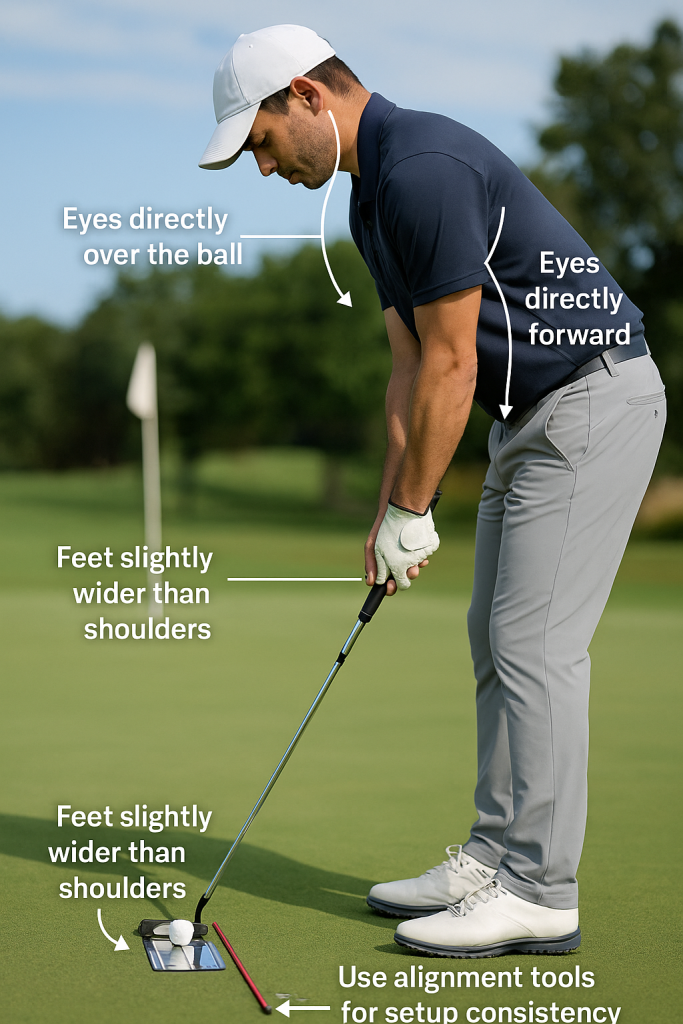
Your putting stance is the foundation of every successful putt. Tiger has always stressed that without proper posture and alignment, even the best stroke mechanics fall apart under pressure.
The Tiger Woods Stance Setup
Feet Position: Stand with your feet slightly wider than shoulder-width apart. This provides stability while allowing natural body movement during the stroke. Tiger positions his feet parallel to the target line so his body alignment supports the intended putt direction.
Eye Position Over the Ball: Drop a ball from between your eyes to test proper head position. The ball should land directly on or slightly behind your golf ball. This eye position gives you the clearest view of the putting line and helps eliminate perspective distortion that causes misaligned putts.
Shoulder Alignment: Your shoulders must be parallel to your target line. Tiger checks this by laying a club across his shoulders during practice. The club should point directly at his intended target. Misaligned shoulders are the #1 cause of pushes and pulls in putting.
Weight Distribution: Place 60% of your weight on your front foot. This forward press helps ensure a descending blow and promotes consistent ball-first contact, which is critical for speed control on varying green conditions.
A proper stance lets you use your larger muscle groups instead of relying on hand and wrist manipulation. Tiger credits this as essential for pressure putting.
2. Build Power and Control With the Back Leg Technique
Tiger's back leg positioning creates stability and power transfer that separates professional putting from amateur attempts. This technique requires specific practice, and it yields fast results.
The Back Leg Close Position
Keep your back leg positioned close to your body throughout the entire putting stroke. Here's why:
Power Generation: The close leg position allows for better weight transfer and creates a stable base for consistent power, especially on longer putts where distance control is critical.
Directional Control: Maintaining this position prevents lower body sway that throws off your putter path and face angle at impact.
Practice Drill for Back Leg Control
Tiger uses this technique to create a “Y-shaped motion” between his forearms and putter shaft. This positioning generates slight forward press and top spin on putts, making them hold their line and roll more consistently.
Pro Tip: Use a light, consistent grip pressure (3-4 on a scale of 10) when using this technique. Tiger stresses that grip tension must stay constant so you can feel the putter head weight properly, especially on fast greens.
RELATED Performance Golfs SQ Putter Alignment Tips & Consistent Putts Guide
3. Execute the Low and Wide Takeaway: Build Consistency
Tiger's putting stroke is known for its consistency. The low, wide takeaway is what creates repeatability under pressure.
The Mechanics of Low and Wide
Chest-Led Movement: Start the takeaway with your chest and core muscles, not your arms. This larger muscle group approach creates more consistent timing and reduces the small muscle variations that cause inconsistent contact.
Low Club Head Path: Keep the putter head as close to the ground as possible during the first 12 inches of your backswing. This promotes a stable arc and prevents the steep, jabbing motion that creates inconsistent roll.
Wide Arc Creation: Think of creating a wide arc rather than a narrow, wristy motion. Tiger visualizes pushing a beach ball underwater. The resistance helps him feel the proper wide, controlled movement.
Tiger's Two-Tee Drill
This drill grooves the proper takeaway while building confidence in your stroke path. Tiger credits this simple routine with helping him center his strikes consistently.
Distance Control Benefits: The low, wide takeaway naturally creates better distance control. The putter moves in a more consistent arc, making it easier to gauge how far back to take the club for different length putts.
RELATED Proper Golf Drop Tips & FAQ: Common Questions Answered
4. Maintain Proper Spine Angle: The Key to Consistent Contact
Spine angle maintenance is Tiger's most technical putting fundamental. It's also critical for building a repeatable stroke that performs under pressure.
Understanding Spine Angle in Putting
The Pendulum Principle: Tiger visualizes his putting stroke as a pendulum with his shoulders as the fulcrum. Maintaining consistent spine angle ensures the “pendulum” swings in the same plane every time, creating predictable results.
Setup Position: At address, tilt forward from your hips (not your waist) to create the proper spine angle. Your back should maintain its natural curve. Don't round it artificially or force it overly straight.
Angle Consistency: Throughout the entire stroke, your spine angle should stay constant. Any lifting or dipping changes the putter's attack angle and can cause thin or fat contact.
The Golf Ball Distance Check
Tiger uses this simple method to confirm proper spine angle:
Practice Drill: The Wall Exercise
Stand against a wall with your shoulders and head touching the surface:
Mental Strategy: Tiger uses the concept of “covering the golf ball” throughout his stroke. This mental image helps him maintain proper posture and keeps his chest position stable, preventing the common fault of standing up during the stroke.
RELATED Golf Fade Tips & Techniques: Improve Your Shot
5. Sharpen Your Visual Focus: Where and How to Look at the Ball
Tiger's ability to stay focused under pressure is legendary. His eye position strategy plays a huge role in his putting success.
The Quiet Eye Technique
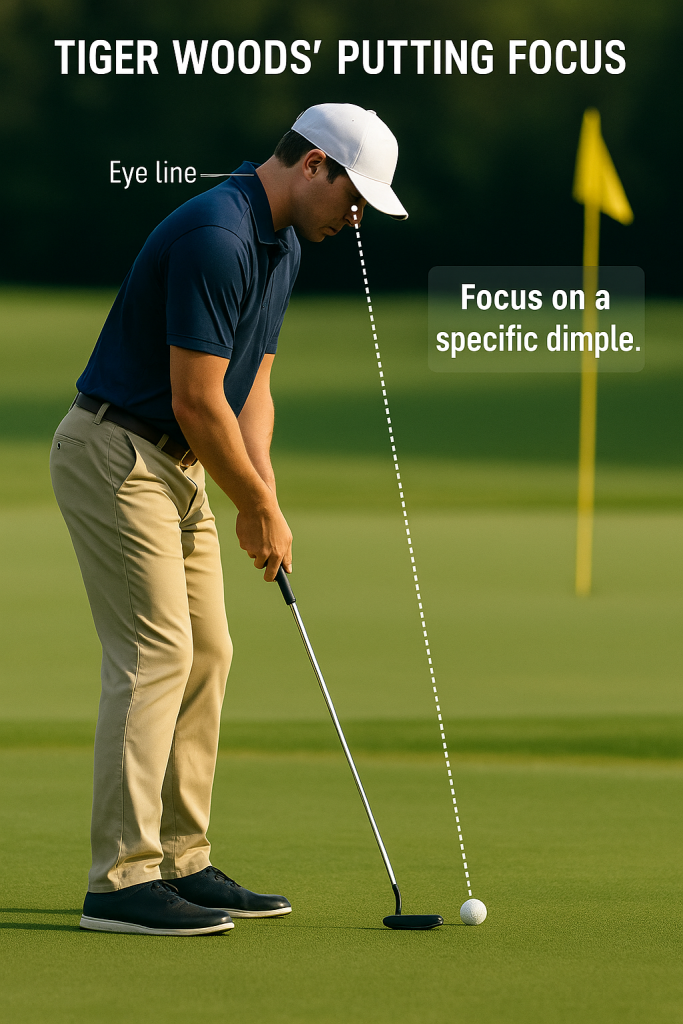
Tiger uses what sports vision experts call “Quiet Eye”: maintaining visual focus on a specific point for an extended period before and during the stroke.
Specific Focus Point: Rather than looking at the entire ball, Tiger focuses on a specific dimple on the back of the ball, where the putter will make contact. This precise focus point eliminates visual distraction and improves concentration.
Timing the Look: Tiger holds his focus on this specific dimple for at least 2-3 seconds before starting his stroke. He continues focusing on this spot until the ball is well on its way to the hole.
The Follow-Through Focus Method
For longer putts (15+ feet), Tiger uses a different approach:
This technique helps maintain body stability and prevents head movement that can pull putts offline.
Practice Drills for Visual Focus
Eyes Closed Distance Control:
Dimple Focus Drill:
The Gate Drill for Centering:
Tiger's signature centering drill uses two tees:
Advanced Visual Techniques
Peripheral Vision Control: While maintaining focus on your target dimple, stay aware of the hole in your peripheral vision. This helps with subconscious distance judgment while keeping primary focus where it belongs.
Pre-Shot Visual Routine: Tiger follows the same visual routine before every putt:
Implementation Strategy: Making These Techniques Your Own
Week 1-2: Foundation Building
Focus entirely on stance and setup. Spend 15 minutes daily on proper alignment and posture without worrying about stroke mechanics. Use a mirror to check your positions.
Week 3-4: Adding Movement
Add the back leg close technique and low, wide takeaway. Start with short putts (3-6 feet) to groove the motion before attempting longer distances.
Week 5-6: Visual Integration
Layer in the focus techniques while maintaining the physical fundamentals you've built. This is when most golfers see significant improvement in consistency.
Week 7+: Pressure Application
Practice these techniques in various conditions and during actual rounds. Tiger stresses that fundamentals must work under pressure to be truly valuable.
RELATED Master Your Golf Swing: Improvement Guide
The Mental Game Component
Tiger's putting success goes beyond the physical. He approaches each putt with absolute conviction in his technique and complete focus on process rather than outcome.
Confidence Through Preparation: Tiger's extensive practice of these fundamentals gives him deep confidence when facing crucial putts. He knows his technique will hold up because he's grooved it through thousands of repetitions.
Process Over Outcome: Rather than focusing on making the putt, Tiger focuses on executing perfect technique. This mental approach reduces pressure and lets his fundamentals shine through.
RELATED Golf Putting Techniques: Tips and Drills
Common Mistakes to Avoid
Trying to Fix Everything at Once: Tiger developed his putting over decades. Focus on one fundamental at a time. Get it right before moving to the next.
Neglecting Short Putts: Tiger spends as much time on 3-foot putts as 20-footers. Short putt confidence affects your entire approach to putting.
Inconsistent Practice: Sporadic practice won't create lasting improvement. Tiger advocates shorter, more frequent practice sessions over marathon putting sessions.
RELATED Consistent & Accurate Golf Shot Tips
Start Sinking More Putts Today
Tiger Woods' putting techniques have held up over decades because they're based on sound fundamentals that work under any conditions.
By focusing on proper stance, back leg control, low wide takeaway, spine angle maintenance, and visual focus, you're building the same foundation that helped Tiger become one of golf's greatest putters.
Improvement in putting comes from consistent application of correct fundamentals. Not from quick fixes or magic techniques.
Start with these five fundamentals. Practice them in order. Trust the process that has proven successful at the highest level of professional golf.
Take these Tiger Woods techniques to the putting green today and start building the foundation for lower scores and more confidence on the greens.
Your proper grip technique combined with these putting fundamentals will transform your short game and overall golf performance.