
You choose a golf swing trainer by working out which part of your swing is actually breaking down first, then buying a tool that addresses that specific thing — because most trainers are built to fix the arms, hands and clubface, and a lot of the faults golfers struggle with start further down, in the hips and legs.
That distinction is the whole point of this guide. If you buy a wrist-position trainer to fix a problem that's coming from your lower body, you'll use it for two weeks, see nothing change, and put it in the garage with the rest of them.
A note on where I'm coming from: I've played golf a long time and caddied for a while before that, so most of what's below comes from my own swing and from watching a lot of other people's up close. I haven't personally tested every trainer on the market, and I'm not going to pretend otherwise. What I can do is help you figure out what you're actually trying to fix, which is the part most buying guides skip.
What does a golf swing trainer actually do?
A swing trainer creates feedback — it makes you feel something, hear something, or physically prevents you from doing something, so your body learns a movement without you having to think your way through it mid-swing.
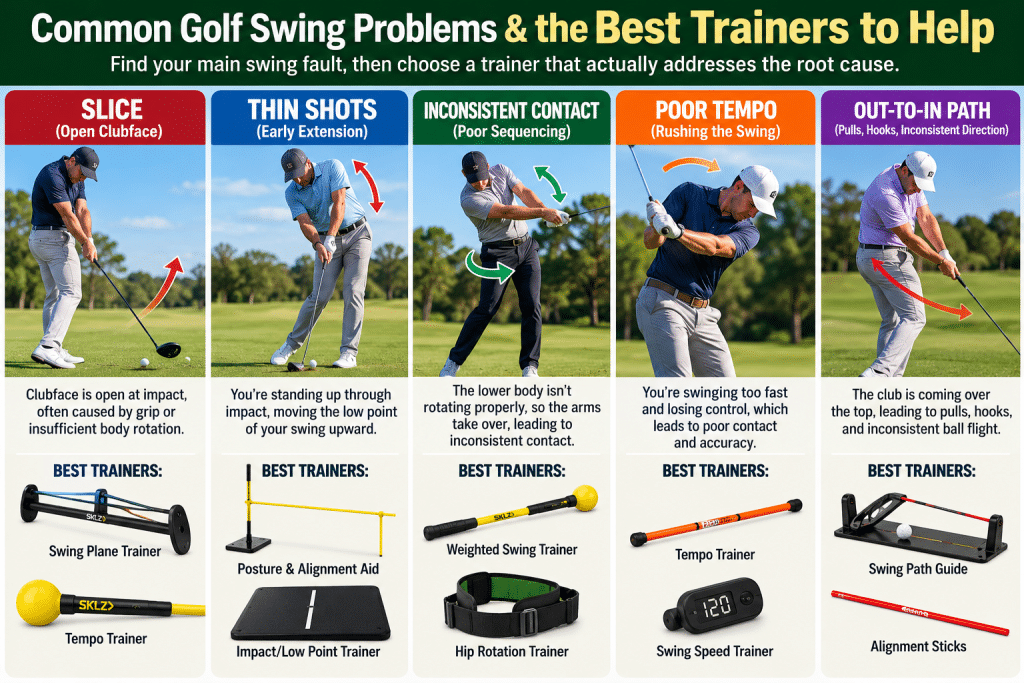
That's the honest description of the whole category. A tempo trainer is weighted so you can feel when you're rushing. An alignment aid shows you where you're aimed. A swing plane trainer physically blocks the club from travelling on a path it shouldn't. A speed trainer is light enough that swinging it fast teaches your body what fast feels like.
None of them fix your swing. They give your body information it isn't getting on its own. Whether that helps depends entirely on whether the information is about the thing that's actually wrong.
Why do so many swing faults start in the lower body?
Because the golf swing sequences from the ground up, and when the lower body stops doing its job, the arms and hands take over to compensate — and almost everything that then goes wrong shows up in the hands, which is where people assume the problem is.
This is the pattern I kept seeing when I caddied. Someone would hit a weak shot out to the right, look at their grip, and start fiddling with their hands. But watching from a few feet away, the thing that stood out was how little they were using their lower body. The hips barely turned. The legs were passive. Everything was arms and shoulders.
When the lower body doesn't rotate through, the arms have to supply the speed and the squaring of the face on their own, and they generally can't do both in the time available. So the face arrives open, or the hands flip to save it, or the whole thing bottoms out in the wrong place. It's the same root cause behind what's actually breaking down in your swing when the ball keeps leaking right.
I've got a version of it myself. I tend to pull up right before impact — standing up out of my posture, which is sometimes called early extension. My miss is thin contact. And the only thing that reliably helps me isn't a gadget: it's consciously turning my hips through the shot and making a deliberate effort to stay down until after the ball's gone. When I do those two things, the strike changes.
That's worth saying plainly, because it's the answer to a lot of what follows.
What causes thin shots, and can a trainer fix it?
Thin shots usually mean the low point of your swing has moved backwards or upwards, and the most common reason is that you're losing your posture through impact — coming up and out of the shot before the club gets to the ball.
If you're standing up through impact, the club rises with you. The bottom of the arc moves up. You catch the ball halfway up its side. It's not a contact problem so much as a posture problem that shows up as a contact problem, which means your setup and posture are where I'd look first.
Can a trainer help? Partially. There are alignment rods and posture aids that give you a physical reference for staying in your spine angle, and some people find them useful. But early extension is a sequencing and mobility issue as much as a feel issue — it's often tight hips or a body that's protecting itself — and no device makes your hips turn for you.
What's worked for me is boring and free: hip rotation as a conscious swing thought, and staying down through the ball. If you want to spend money on this fault, spend it on a lesson or a mobility routine before you spend it on a trainer.
What causes an open clubface at impact, and can a trainer fix it?
An open face at impact usually comes from either the grip or the sequence — the hands are set in a position that doesn't allow the face to square in time, or the body isn't rotating enough for the arms to catch up.
This is the one I saw most often caddying. Ball starting right, or starting left and curving hard right, and the golfer convinced the problem was somewhere in their takeaway.
Here's the split that matters for your buying decision. If your face is open because of your grip — hands too far under the club, a weak position, no real hinge — that's genuinely something a trainer can help with. Grip trainers and hinge aids put your hands in a position and hold them there until it feels normal. That's exactly the kind of narrow, physical, repeatable thing these tools are good at.
If your face is open because your lower body isn't turning and your arms are running out of time, a grip trainer won't touch it. You'll square the face in slow practice swings and lose it again the moment you swing at full speed, because the underlying sequence hasn't changed.
The quick test: make slow practice swings and check whether you can square the face easily. If you can, it's a sequencing problem, not a grip problem. If you can't square it even slowly, a grip aid might genuinely help.
Which swing faults do trainers actually help with?
Trainers work best on faults that are narrow, physical and repeatable — tempo, grip position, alignment, swing path and raw speed — and work worst on anything involving whole-body sequencing.
The ones with a decent track record:
Tempo. Weighted trainers give you a rhythm to feel. Tempo is a genuinely feel-based skill, and feel is what these tools are good at delivering.
Speed. Overspeed training — swinging progressively lighter clubs to teach your nervous system to move faster — has real research behind it and is probably the most evidence-backed category on the shelf.
Alignment. Rods and sticks aren't really trainers, they're measuring devices, and they're cheap and genuinely useful. If you're only buying one thing, buy these.
Grip position. Narrow, physical, easy to reinforce. Works if a grip is your actual problem.
Swing plane. Physical guides that stop the club going somewhere it shouldn't. Useful for an over-the-top move, less useful for anything else.
The ones I'd be cautious about are anything promising to fix your whole swing, anything requiring you to swing at half speed to use it, and anything that trains a feel you can't reproduce with a real club in your hands.

What should you look for when buying a swing trainer?
Look for something that targets one specific fault you've already diagnosed, that you can use with a normal swing at normal speed, and that you'll realistically pick up more than three times.
A few things worth weighing:
Can you use it at full speed? A tool you can only use in slow motion teaches you a movement you can't transfer to the course.
Does it work indoors? Winter in Wisconsin is long. A trainer that needs a range session is a trainer you'll use six times a year.
Is the feedback immediate? The value is in your body connecting an action to a result. Anything with a delay loses most of that.
Would you use it without the gadget? A lot of trainers reinforce a drill you could do with an alignment stick and a mirror. Worth asking before you spend.
When should you skip the trainer and take a lesson?
Skip the trainer when you can't confidently name the fault you're trying to fix, or when the fault involves how your body sequences the swing rather than where your hands sit.
I'd put my own early extension in that category, and I'd put most open-face problems there too. If your lower body isn't doing its job, you need someone watching you — in person or on video — to tell you what's happening, because it's almost impossible to feel it yourself while it's happening. A launch monitor will also measure what's happening if you'd rather see the numbers than take a lesson.
One lesson often costs about the same as two trainers, and it tells you which fault you actually have. Which, if you've read this far, you'll notice is the thing every decision in this guide depends on. It's also worth ruling out equipment first — whether your clubs actually fit you accounts for more bad shots than most golfers expect.
Most of the golfers I know who own swing trainers seem happy with them. I don't have a strong view on the category one way or the other. What I'd say is that the ones who got value out of theirs generally knew what they were fixing before they bought it.
What's in your garage?
Here's where I'd genuinely like to hear from you, because I've only got my own swing and what I saw caddying to go on.
Which swing trainer did you buy, and did it actually change anything? I'm especially interested in the ones that didn't work — the thing you used twice and then never picked up again. That's the more useful story and nobody ever tells it.
And if you've beaten early extension, I want to know how. Staying down and turning my hips is the best I've found and it's still a conscious effort every round. If something finally made it automatic for you, leave a comment below and tell me what it was. I'll read every one.
Frequently Asked Questions
Do golf swing trainers really work? Some do, for some faults. Trainers have a reasonable track record with tempo, speed, alignment, grip position and swing plane. They tend not to help with whole-body sequencing issues like early extension, because a device can't make your hips rotate for you.
What's the best swing trainer for a beginner? For most beginners, a set of alignment sticks is the highest-value purchase. They're inexpensive, they work indoors and outdoors, and poor alignment is behind a lot of faults that get misdiagnosed as swing problems. Sort out what you actually need in the bag before you spend on training aids.
Why do I hit thin shots? The most common cause is losing your posture through impact — standing up out of your spine angle so the bottom of your swing arc moves up. Turning your hips through the shot and consciously staying down until after contact is the fix that works for most people.
How do I stop my clubface from being open at impact? First work out whether it's a grip issue or a sequencing issue. Make slow practice swings: if you can square the face easily at slow speed, it's sequencing and you need body rotation, not a grip aid. If you can't square it even slowly, your grip is likely the problem and a grip trainer may help.
How long does it take to see results from a swing trainer? Most people who see a change report it within a few weeks of consistent use, but that depends heavily on whether the trainer matches the fault. A trainer aimed at the wrong problem won't produce results in any timeframe.