

Senior golfers represent one of the most active equipment research demographics in golf — and one of the most underserved when it comes to honest, age-specific buying guidance.
Most RS1 content is written for a generic adult male golfer in his thirties or forties with no mention of how the club's technology, feel profile, or adjustment demands interact with the specific physical and mechanical realities of golfers in their sixties, seventies, and beyond.
This guide fills that gap. We'll cover exactly how Forward Axis Weighting interacts with the most common putting tendencies senior golfers develop, which configuration makes the most sense for older players, how the adjustment period compares to what a younger golfer experiences, and the honest cases for and against the RS1 specifically for this demographic.
For the complete RS1 product overview including pricing and full configuration specs, see our main RS1 buying guide.
Why Senior Golfers Are Actually Ideal Candidates for the RS1
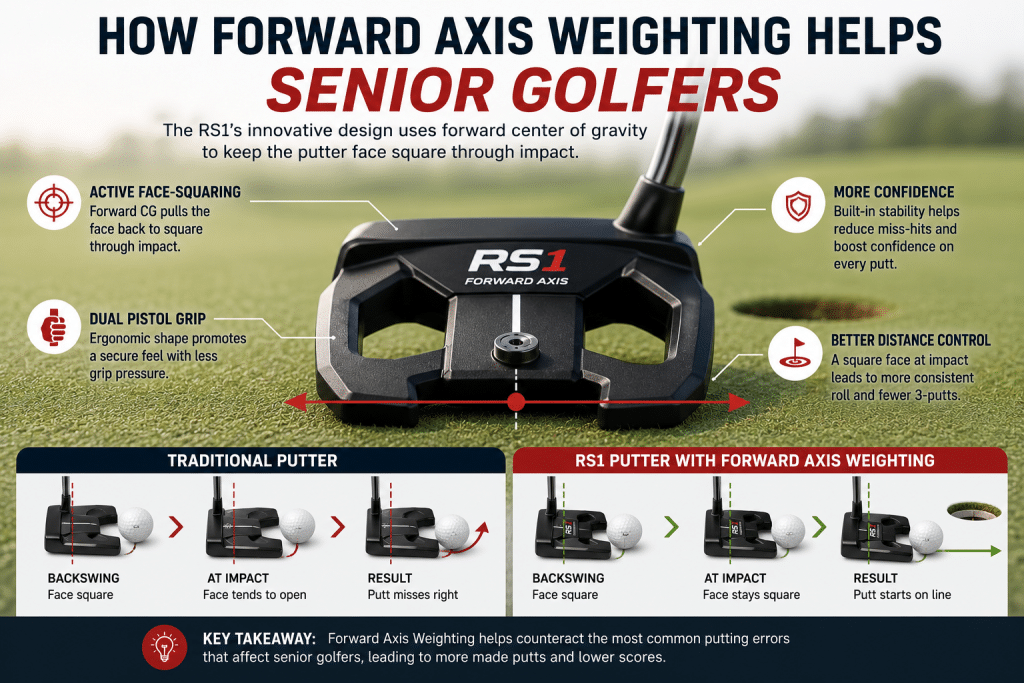
Here is a counterintuitive truth that the RS1's marketing materials don't make explicit: the physical changes that come with age — reduced grip strength, decreased wrist stability, higher grip pressure under stress, and a natural tendency toward a shorter, more compact stroke — align almost perfectly with the conditions under which the RS1's Forward Axis Weighting technology delivers its strongest benefit.
Let's walk through each of these specifically.
Grip Strength Decline and Its Effect on Face Control
As grip strength declines with age, many senior golfers unconsciously compensate by gripping the putter more tightly than they did in younger years. This is a natural response — the brain perceives a loss of control and instructs the hands to hold on harder.
The problem is that increased grip pressure directly increases wrist tension, which increases the tendency for the face to rotate open or closed through the stroke.
The RS1 addresses this cycle from two directions simultaneously. The Dual Pistol grip's ergonomic profile is specifically designed to maintain club security at lower grip pressure than a conventional round grip — the hand fits into the grip's contours rather than squeezing around a uniform surface.
And the Forward Axis Weighting creates an active gravitational correction that continues to pull the face toward square even when grip pressure increases under stress. The club is partially compensating for the very mechanical problem that grip pressure increase causes.
Wrist Stability and the Compact Senior Stroke
Many senior golfers naturally develop a shorter, more compact putting stroke over time — partly as a response to reduced flexibility, partly as an unconscious stabilization strategy. This shorter stroke arc is actually an advantage with the RS1, not a limitation.
As we explain in detail in our Forward Axis Weighting guide, the RS1's gravitational correction mechanism is most powerful on shorter, more compact strokes. On a brief backstroke, the forward-weighted head has the highest relative influence over face position at the bottom of the arc.
The shorter the stroke, the more the physics work in your favor. Senior golfers who have developed a compact, pendulum-style stroke are positioned to benefit from the RS1's technology more immediately than players with longer, more arc-driven strokes.
The Yip Factor
Putting yips — involuntary muscle spasms or jerking movements through the stroke — become more prevalent with age for a subset of golfers and can be career-defining problems for recreational players who love the game. They are most commonly triggered by anxiety over short putts, and they manifest primarily as sudden trail hand or wrist activation at impact.
The RS1 doesn't cure yips, and we want to be clear about that. But its design addresses two of the contributing factors: the Dual Pistol grip's ergonomic profile actively discourages wrist tension buildup, and the active face-squaring mechanism reduces the conscious steering and manipulating effort that often triggers yip responses under pressure.
Golfers who yip because they feel they must manually guide the face to the hole sometimes find that a club which actively assists face control reduces the psychological trigger for the yip response.
If yips are a significant issue, a cross-handed or claw grip style — both of which are fully accommodated by the Dual Pistol grip, as we cover in our grip compatibility guide — is worth exploring in combination with the RS1.
Which RS1 Configuration Is Best for Senior Golfers
Our recommendation for senior golfers is unambiguous: the RS1 Plus is the right starting point, and in many cases the Founder's Edition is worth the additional consideration.
Here is the specific reasoning for each configuration from a senior-focused perspective.
Why the RS1 Standard Is the Wrong Choice for Most Senior Golfers
The base RS1 Standard's steel shaft and steel face combination produces a bright, high-pitched sound at impact that reviewers consistently describe as a “ting” or “ping.” For many senior golfers, this acoustic profile creates two specific problems.
First, hearing sensitivity changes with age, and high-pitched impact sounds are disproportionately uncomfortable for golfers with any degree of age-related hearing sensitivity. A putter that produces a sharp, ringing sound at impact is not a comfortable playing experience for a demographic that often has some high-frequency hearing change.
Second, feel sensitivity matters more, not less, as golfers age and their stroke becomes more feel-dependent. A firm, harsh feedback profile reduces the tactile information available from each putt — information that experienced senior golfers use to calibrate distance and read green conditions. The Standard's acoustic profile works against this need.
Why the RS1 Plus Is the Right Choice
The Plus's graphite shaft transforms the acoustic and feel profile from bright and firm to muted and controlled — a deeper, more solid “tock” at impact that experienced golfers across all age groups respond to more positively. For senior golfers specifically, this feel improvement has additional practical significance beyond mere preference.
The graphite shaft's vibration dampening reduces the harshness of feedback transmitted to the hands on both center and off-center strikes. For golfers with any arthritis, reduced hand sensitivity, or joint tenderness in the fingers or wrists — all increasingly common concerns in the senior demographic — reduced vibration transmission on mishits is a genuine comfort consideration that compounds over an 18-hole round.
The polyurethane grip upgrade on the Plus also provides a slightly tackier surface texture than the Standard's rubber grip, which helps maintain secure contact at lower grip pressure — directly relevant for players managing grip strength changes.
When to Consider the Founder's Edition
The Founder's Edition takes the feel refinement further with a 303 stainless steel face — an alloy known for producing a softer, warmer feel at contact compared to standard steel — combined with a custom graphite shaft.
For senior golfers who have spent years with premium milled putters from Scotty Cameron, Odyssey, or similar manufacturers and have very refined feel expectations, the Founder's Edition closes the gap between the RS1's performance benefits and the premium tactile experience they're accustomed to.
Availability is the limiting factor — with only 500 units produced, Founder's Edition stock is extremely limited. See our full Founder's Edition review for current availability guidance.
The Adjustment Period for Senior Golfers: Honest Expectations
Our RS1 Adjustment Guide covers the standard three-session recalibration process in detail. For senior golfers specifically, there are two modifications to those expectations worth addressing directly.
The Recalibration May Take Slightly Longer
This isn't a criticism of senior golfers' adaptability — it's a straightforward consequence of having longer-established muscle memory. A golfer who has putted with the same style of putter for fifteen or twenty years has a deeply ingrained distance calibration that has had more time to solidify than a golfer who's been playing for five years.
Updating deeply ingrained motor patterns takes more repetition than updating recently acquired ones.
Most senior golfers should budget four to six dedicated practice sessions rather than three before taking the RS1 into competitive play. The short putt improvement will still be immediate — that benefit doesn't require recalibration. But lag putting distance control may take those additional sessions to fully solidify.
Arthritis and Practice Session Duration
For senior golfers managing arthritis or joint tenderness, the standard 45 to 60 minute practice session recommendation in our adjustment guide may need to be broken into shorter, more frequent sessions. Three 30-minute sessions spread over a week may accomplish the same recalibration as a single 60-minute session while being considerably more comfortable.
The recalibration process requires focused repetition rather than extended duration — it's the quality and specificity of the practice that matters, not the length of any individual session. Don't feel you need to push through physical discomfort to complete the adjustment; spread the sessions over a longer timeline if needed and the recalibration will still occur.
Putting Challenges Most Common in Senior Golfers — And How the RS1 Addresses Them
Consistently Missing Putts on the Same Side
Missing putts consistently to one side — right lip outs or left lip outs — is almost always a face angle problem rather than a read problem. This pattern becomes more pronounced with age as grip strength changes and wrist stability decreases, introducing systematic face rotation that wasn't present in younger years.
The RS1's active gravitational correction directly targets this systematic directional bias. If your face has developed a consistent tendency to arrive open or closed at impact — a tendency you may not even be consciously aware of — the Forward Axis Weighting works against that tendency on every single stroke.
Three-Putting from Mid-Range Distances
Senior golfers who three-putt frequently from 15 to 30 feet are typically losing the first putt to either a face angle error that sends the ball too far offline, or a distance control error that leaves an uncomfortable second putt.
The RS1 addresses the face angle component immediately. Distance control improvement comes after the adjustment period but is consistently reported as a secondary benefit once recalibration is complete.
Loss of Confidence on Short Putts
Decreased confidence on short putts under pressure is a near-universal experience for senior recreational golfers and is one of the most scoring-impactful putting problems in this demographic.
The RS1's face-squaring technology has its strongest effect precisely in the short putt range where confidence loss is most costly — delivering a more square face at impact on those 4 to 8 foot putts that determine whether you card a bogey or a double.
The psychological dimension matters here too. Knowing that the club is actively assisting face control can reduce the conscious steering and guiding effort that breaks down under pressure.
Many senior golfers report that the RS1 gives them permission to make a confident, committed stroke rather than a tentative, steering one — and that permission has its own performance value independent of the physics.
Physical Fit Considerations for Senior Golfers
Lie Angle and Posture
The RS1's 74-degree upright lie angle — approximately 4 degrees more upright than a standard putter — positions your eyes directly over the ball at address and encourages a straighter, more compact stroke arc.
For many senior golfers, this upright setup is actually more comfortable than a standard lie angle putter because it requires less forward bend from the hips and a more upright, relaxed posture at address.
Golfers with back issues or reduced hip flexibility often find the RS1's upright lie angle reduces the physical strain of the address position compared to a flatter putter that requires more forward tilt. This is a practical comfort benefit that goes largely unmentioned in standard RS1 reviews but matters meaningfully for the senior golfer demographic.
Putter Length
The RS1 ships in a standard 35-inch length in both right and left-handed configurations. For senior golfers whose posture has changed over time — whether through back issues, reduced height from spinal compression, or simply changed preferences — verifying that 35 inches is the correct length for your current setup is worth doing before committing.
A simple check: sole the putter at address in your natural putting stance. Your eyes should be directly over the ball and the toe of the putter should sit flat on the ground without the heel raised. If the heel is consistently raised or you find yourself reaching for the ball at address, a shorter length may be more appropriate.
Contact Performance Golf's customer service or speak with a local fitting professional for custom length guidance.
Left-Handed Availability
The RS1 is available in both right-handed and left-handed configurations at the standard 35-inch length — a practical note worth confirming since not all premium putter models offer left-handed options as standard.
What Senior Golfers Say About the RS1
Verified purchaser feedback from senior golfers across multiple review platforms reveals consistent patterns worth noting:
Most commonly reported improvements: Short putt conversion rate, reduced three-putts from mid-range distances, and overall putting confidence — particularly on putts inside 10 feet where the face-squaring technology has its strongest effect.
Most commonly noted adjustment: Lag putting distance on putts over 25 feet, consistent with the general adjustment experience but noted as taking slightly more time by older players with deeply established muscle memory from previous putters.
Most commonly cited concern before purchase: Whether the RS1's technology would be “too advanced” or difficult to adapt to at their age and skill level. The consistent feedback from actual senior purchasers is that this concern was unfounded — the adjustment was manageable and the short putt improvement arrived before the lag putt recalibration was complete.
The 365-Day Return Policy: Especially Relevant for Senior Golfers
The RS1's 365-day money-back guarantee is valuable for any buyer, but it's particularly relevant for senior golfers who may need more time than average to complete the adjustment period before fairly evaluating the putter's long-term fit.
A 30-day return window — standard at most golf retailers — is simply not enough time for a senior golfer to complete the adjustment process and then play enough rounds to fairly assess whether the RS1 fits their game.
The RS1's one-year window removes that time pressure entirely, allowing a genuine, unhurried evaluation that respects the reality of how long meaningful putting recalibration takes for an experienced player with deeply established habits.
For full details on how the return process works and whether it applies to purchases made through authorized retailers, see our subscription and returns guide.

Our Recommendation for Senior Golfers
The RS1 is one of the strongest equipment recommendations we make specifically for senior golfers — not despite their age-related physical changes, but because of them. The compact stroke, the grip pressure tendencies, the face rotation patterns that develop with changing hand strength — all of these align with the conditions under which Forward Axis Weighting delivers its most immediate and measurable benefit.
Buy the RS1 Plus as your default choice. The graphite shaft's acoustic and feel improvements are not optional refinements for senior golfers — they're meaningful practical upgrades given the acoustic sensitivity and feel-dependent putting style common in this demographic.
Consider the Founder's Edition if feel quality is a top priority and you can find one at or near retail pricing — the 303 stainless face takes the feel profile further in a direction senior golfers with premium putter experience will appreciate.
Give yourself four to six practice sessions before evaluating the lag putt distance control — longer than the standard recommendation but appropriate given the depth of muscle memory being updated.
Take full advantage of the 365-day return policy. It's there specifically for situations like this — a meaningful equipment change that requires real time to evaluate fairly.

Frequently Asked Questions
Is the RS1 putter too technologically advanced for senior recreational golfers? No. The Forward Axis Weighting technology operates passively through physics — it doesn't require the golfer to learn a new technique or make conscious adjustments to benefit from it. If anything, senior golfers with the putting tendencies common to this demographic are among the most likely to see immediate, measurable improvement.
Which RS1 configuration is best for a senior golfer? The RS1 Plus in almost all cases. The graphite shaft's acoustic dampening and reduced vibration transmission are particularly beneficial for senior golfers with hearing sensitivity or hand joint concerns. The Founder's Edition is worth considering if premium feel is a priority and availability allows.
How long will it take a senior golfer to adjust to the RS1? Budget four to six dedicated practice sessions rather than the standard three, to account for the additional depth of muscle memory being updated. Short putt improvement is typically immediate. Lag putt distance calibration takes the most time.
Is the RS1's upright 74-degree lie angle comfortable for senior golfers? For many senior golfers, yes — the upright lie angle actually requires less forward hip bend at address than a standard lie angle putter, which can be more comfortable for players with back issues or reduced flexibility.
Does the RS1 help with putting yips? The RS1 doesn't cure yips, but its design addresses two contributing factors — grip tension buildup and conscious face-steering effort — that can trigger the yip response in susceptible players. Combining the RS1 with a cross-handed or claw grip is worth exploring for golfers whose yips are trail-hand dominant.
Is the RS1 available for left-handed senior golfers? Yes. The RS1 is available in both right-handed and left-handed configurations at the standard 35-inch length.
Last updated June 2026.
Related Reading:
- Performance Golf RS1 Putter: Complete Review and Buying Guide
- RS1 vs RS1 Plus: Is the Graphite Shaft Worth the Upgrade?
- RS1 Putter Adjustment Guide: Dialing In Distance Control in 3 Sessions
- Cross-Handed and Claw Grip Compatibility Guide
- How Forward Axis Weighting Works: The Physics Behind the RS1
- RS1 Founder's Edition: Complete Review and Availability Guide
- Buying the RS1 Putter Without Subscription Headaches