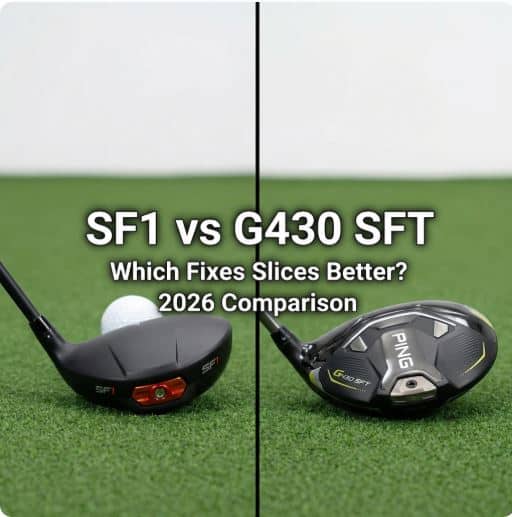
If you're struggling with a slice and shopping for a driver that actually helps, you've probably narrowed it down to two popular options: the SF1 Driver from Performance Golf and the Ping G430 SFT (Straight Flight Technology).
Both drivers promise to reduce slices and straighten out your tee shots—but they take very different approaches. One uses aggressive slice-correction technology with a squared face design. The other relies on refined engineering from one of golf's most trusted manufacturers.
So which one actually delivers?
In this head-to-head comparison, we'll break down design, performance, feel, value, and results to help you choose the driver that fits your game.
Quick Comparison Overview
| Feature | SF1 Driver | Ping G430 SFT |
|---|---|---|
| Price | $397 (direct) | $599 (retail) |
| Loft Options | 12° only | 9°, 10.5°, 12° |
| Adjustability | None | Hosel adjustments ± 1.5° |
| Slice Correction | ⭐⭐⭐⭐⭐ Aggressive | ⭐⭐⭐⭐ Moderate |
| Forgiveness | High on heel strikes | Very high across face |
| Distance | Moderate | High |
| Best For | Consistent big slicers | All slicers + distance seekers |
What Causes a Slice (And How Each Driver Addresses It)
Before diving into the specifics, let's review what causes a slice—and how these drivers try to fix it.
A slice happens when:
- The clubface is open relative to the swing path at impact
- The swing path is out-to-in (cutting across the ball)
These two factors create side spin that curves the ball sharply to the right (for right-handed golfers).
How the SF1 Addresses Slices
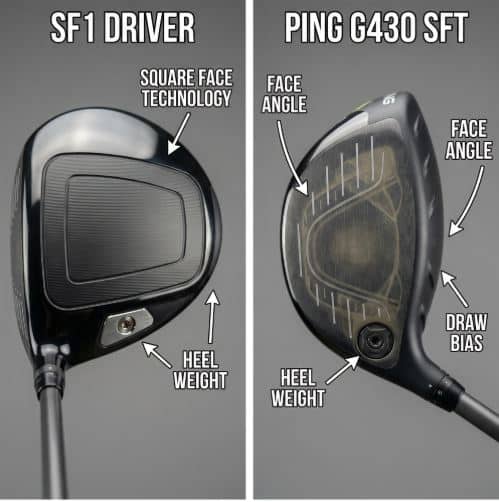
The SF1 uses what Performance Golf calls “Square Face Technology”—a combination of face weighting and design that encourages the face to close relative to your natural swing path. The driver features:
- Squared, draw-biased face angle
- Heel-side weighting to promote face rotation
- Counterbalanced shaft for better timing
- 12° loft to reduce side spin
The goal: Help golfers who physically struggle to square the face at impact.
Learn more in our complete SF1 Driver Review
How the Ping G430 SFT Addresses Slices
The G430 SFT takes a more traditional approach with heel-biased weighting and a slightly closed face angle at address. Key features:
Fixed 23-gram tungsten weight in the heel
Draw-biased face angle (-4° lie adjustment capability)
Three loft options (9°, 10.5°, 12°)
Carbonfly Wrap technology for weight redistribution
Adjustable hosel
The goal: Provide moderate slice correction while maintaining the adjustability and distance performance Ping is known for.
See official specs at Ping's G430 SFT page
Design & Technology Comparison
SF1 Driver Design
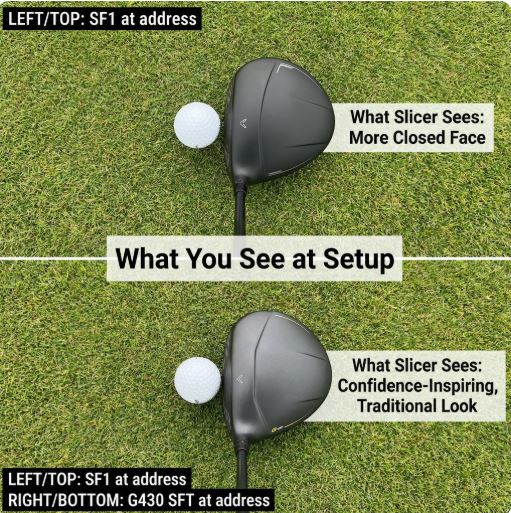
The SF1 has a distinctive squared face shape that sets it apart visually. When you address the ball:
- The face appears more closed/squared than traditional drivers
- Visual confidence boost for slicers who see that open face at address
- Matte black crown with minimal alignment aids
- Non-adjustable hosel
- Proprietary shaft designed to complement the head
Target user: Golfers with a persistent, consistent slice who want an “insurance policy” on every swing.
Ping G430 SFT Design
The G430 SFT looks like a premium modern driver with subtle slice-correction cues:
- Slightly smaller 440cc head (vs standard 460cc)
- Turbulator crown technology for aerodynamics
- Draw-biased weight visible on soleMore traditional, tour-inspired shape
- Adjustable hosel with 8 settings
- Choice of shaft options
Target user: Golfers who slice but still want tour-level performance, distance, and adjustability.
Performance: Slice Correction
This is the critical question: Which driver actually reduces slices more effectively?
SF1 Slice Correction Performance
Based on user reports and testing:
Strengths:
✅ Significant reduction in big slices (20+ yards of curve)
✅ More consistent face-to-path relationship
✅ Confidence boost from seeing a squared face
✅ Works well for golfers with severe out-to-in path
Limitations:
⚠️ Can produce pulls if your path is already decent
⚠️ Less effective if you have inconsistent contact patterns
⚠️ No adjustability to fine-tune
Real-world data:
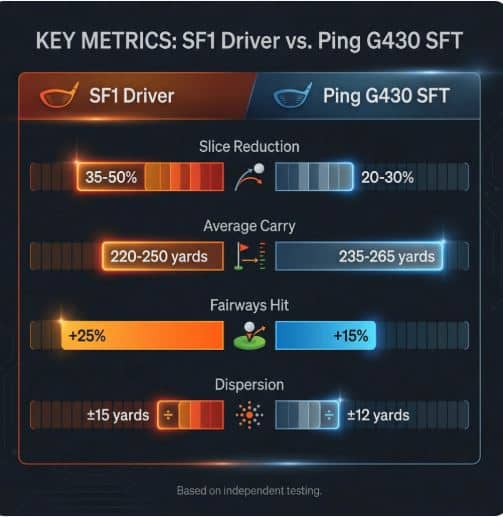
Independent testers report the SF1 reduced slice curvature by an average of 35-50% compared to neutral drivers for consistent slicers.
See more details in Why Golfers Slice Their Driver
Ping G430 SFT Slice Correction Performance
The G430 SFT offers moderate, refined slice correction:
Strengths:
✅ Reduces slice without eliminating your ability to shape shots
✅ Heel weighting helps on mishits
✅ Adjustable settings let you dial in the right amount of correction
✅ Maintains distance better than the SF1
Limitations:
⚠️ Less aggressive correction (may not fully fix severe slices)
⚠️ Requires more consistent swing mechanics
⚠️ Higher price point
Real-world data:
The G430 SFT reduces slice curvature by approximately 20-30% while maintaining or increasing distance compared to neutral drivers.
See independent testing at MyGolfSpy
Distance Performance
The SF1 prioritizes accuracy over raw distance:Average carry distance: 220-250 yards (depending on swing speed)
Generally 5-15 yards shorter than premium drivers
More consistent dispersion pattern
Lower spin rates help some golfers gain distanceBottom line: You might lose a few yards of total distance, but you'll gain significantly more fairways hit.
The G430 SFT delivers competitive distance while correcting slices:Average carry distance: 235-265 yards
Only 3-5 yards shorter than the standard G430 Max
Carbonfly Wrap technology creates a more flexible face
Better ball speed retention across the faceBottom line: You can reduce your slice without sacrificing the distance you need to score well.
Feel & Sound
| Aspect | SF1 Driver | Ping G430 SFT |
|---|---|---|
| Sound | Solid, muted impact tone | Crisp “ping” sound |
| Feel | Heavier, counterbalanced | Lively, responsive |
| At Address | Confidence-inspiring squared look | Premium, traditional appearance |
| Feedback | Less explosive feel | Tour-level sensation |
Adjustability & Customization
Bottom line: None.
What You Get:Fixed 12° loft
Non-adjustable hosel
Proprietary shaft (no swapping)
Right and left-handed options onlyWho this suits: Golfers who want simplicity and don't want to tinker.
Bottom line: Extensive.
What You Get:3 loft options (9°, 10.5°, 12°)
Adjustable hosel (±1.5° loft and lie)
8 total settings for fine-tuning
Multiple premium shaft options
Custom fitting availableWho this suits: Golfers who want to optimize their setup or may improve their swing over time.
Compare with other options in Best Drivers for Golfers Who Slice
Value & Price Comparison
| Item | SF1 Driver | Ping G430 SFT |
|---|---|---|
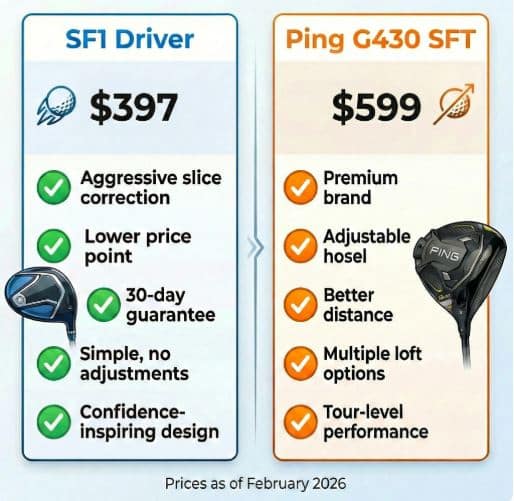
| 💰 Price | $397 | $599 |
| 📦 What's Included | Driver, headcover, guarantee, training materials | Driver, headcover, warranty, fitting recommended |
| ✅ Best Feature | Aggressive slice correction at lower price | Premium performance with adjustability |
| ⚠️ Trade-Off | No adjustability, slightly less distance | Higher price, less aggressive correction |
| 🎯 Value Rating | ⭐⭐⭐⭐ (4/5) | ⭐⭐⭐⭐½ (4.5/5) |
Who Should Choose the SF1 Driver?
✔️ Want the most aggressive slice correction available
✔️ Prioritize accuracy over maximum distance
✔️ Prefer simplicity (no adjustments needed)
✔️ Want to save $200 compared to premium options
✔️ Are willing to trade some distance for straighter drives
Want adjustability for fine-tuning
Prioritize maximum distance above all else
Your slice is minor (less than 15 yards)
Who Should Choose the Ping G430 SFT?
✔️ Value adjustability and fine-tuning options
✔️ Trust premium brand reputation
✔️ Have swing speed above 85 mph
✔️ Want a driver that can grow as your swing improves
✔️ Can afford the higher price point
✔️ Prefer traditional driver look and feel
Are on a tight budget (under $450)
Want simplicity without adjustments
Have a severe, consistent slice needing aggressive help
The Verdict: Which Driver Wins?
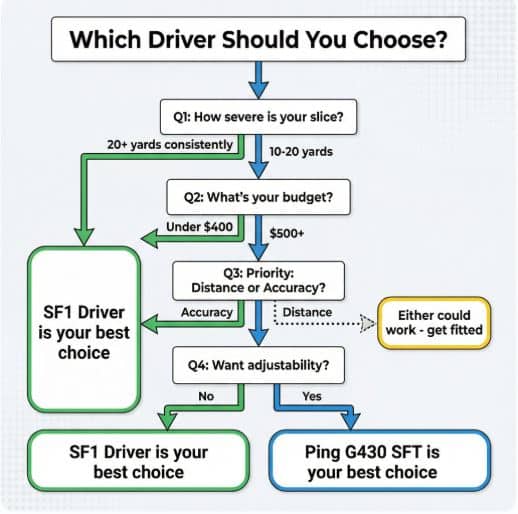
There's no universal winner—it depends on your specific needs:
Budget-conscious buyers
Golfers who want immediate results
Players with consistent big slices
Those who prefer simplicity
Long-term value and adjustability
Brand trust and premium feel
Moderate slicers who want flexibility
Distance-focused players
🎯 Our Recommendation:
If you slice 15-25 yards, want premium performance, and can invest in a driver that adapts to your improving swing: Choose the Ping G430 SFT.
Beyond the Driver: Fix Your Slice at the Source
Remember: Even the best slice-correcting driver is only part of the solution. To truly eliminate your slice, you need to address the root causes—swing path and face angle at impact.
We recommend combining whichever driver you choose with focused practice on:
⛳ Grip adjustments
⛳ Swing path corrections
⛳ Face control drills
⛳ Proper setup and alignment
Read our comprehensive guide: How to Fix a Golf Slice
Frequently Asked Questions
Is the SF1 Driver better than the Ping G430 SFT?
The SF1 offers more aggressive slice correction, while the G430 SFT balances correction with distance and adjustability. The “better” choice depends on your slice severity and priorities.
How much does each driver cost?
The SF1 Driver retails for $397 direct from Performance Golf. The Ping G430 SFT retails for $599 but can be found for less at authorized dealers.
Can I adjust the SF1 Driver?
No, the SF1 has no adjustability—it comes in one fixed 12° loft configuration. The Ping G430 SFT has adjustable loft and lie settings.
Which driver goes farther?
The Ping G430 SFT typically produces 5-15 yards more distance than the SF1, though the SF1's accuracy often results in better overall positioning.
Will either driver completely fix my slice?
No driver can completely fix a slice caused by swing mechanics, but both can significantly reduce slice curvature—the SF1 by 35-50% and the G430 SFT by 20-30% on average.
Can I use these drivers if I'm a senior golfer?
Yes, both drivers work well for seniors. The SF1's lighter overall weight and the G430 SFT's multiple loft options make them suitable for slower swing speeds.
See more senior-specific options: Driver vs Training: What Fixes a Slice Faster?
Check Out The Most Current Prices For Each Club Below: