If you’ve ever stood on the tee box feeling confident—only to watch your driver peel off to the right—while your iron shots fly relatively straight, you’re not alone. This is one of the most common and frustrating experiences in golf, especially among senior golfers and mid- to high-handicappers.
The good news? There’s a clear explanation for why this happens, and once you understand it, fixing the problem becomes far more manageable.

The Short Answer
Most golfers slice their driver but hit irons straight because the driver magnifies swing and setup mistakes that irons naturally hide. The longer shaft, lower loft, and wider clubface of a driver make it far more sensitive to face angle and swing path at impact.

Irons, on the other hand, are shorter, more forgiving in terms of face control, and easier to square consistently.
To understand the mechanics behind why this happens so often, we break it down in detail in our guide explaining why golfers slice their driver.
Why Drivers Are Harder to Control Than Irons
1. Longer Shaft = More Room for Error
A driver is typically 2–4 inches longer than your irons. That extra length increases clubhead speed—but it also increases timing difficulty.
Even a small delay in face rotation can leave the clubface open at impact, which is the primary cause of a slice.
Irons, with their shorter shafts, are easier to control and naturally return closer to square.
2. Lower Loft Exposes Face Angle Problems
Drivers have very little loft compared to irons. That means the ball’s initial direction is determined almost entirely by clubface angle, not swing path.
With irons:
-
Loft helps straighten ball flight
-
Slightly open faces still produce playable shots
With drivers:
-
An open face creates side spin
-
The ball curves dramatically to the right
This is why many golfers feel like their driver “betrays” them.
3. Different Swing Intent (Without Realizing It)
Many golfers subconsciously swing differently with a driver.
Common driver-only tendencies:
-
Trying to “hit up” on the ball
-
Overswinging for distance
-
Starting the downswing with the shoulders
-
Tension in the hands and arms
All of these promote an out-to-in swing path, which—combined with an open face—produces a slice.
Iron swings are usually more compact, controlled, and balanced.
Setup Differences That Cause Driver Slices
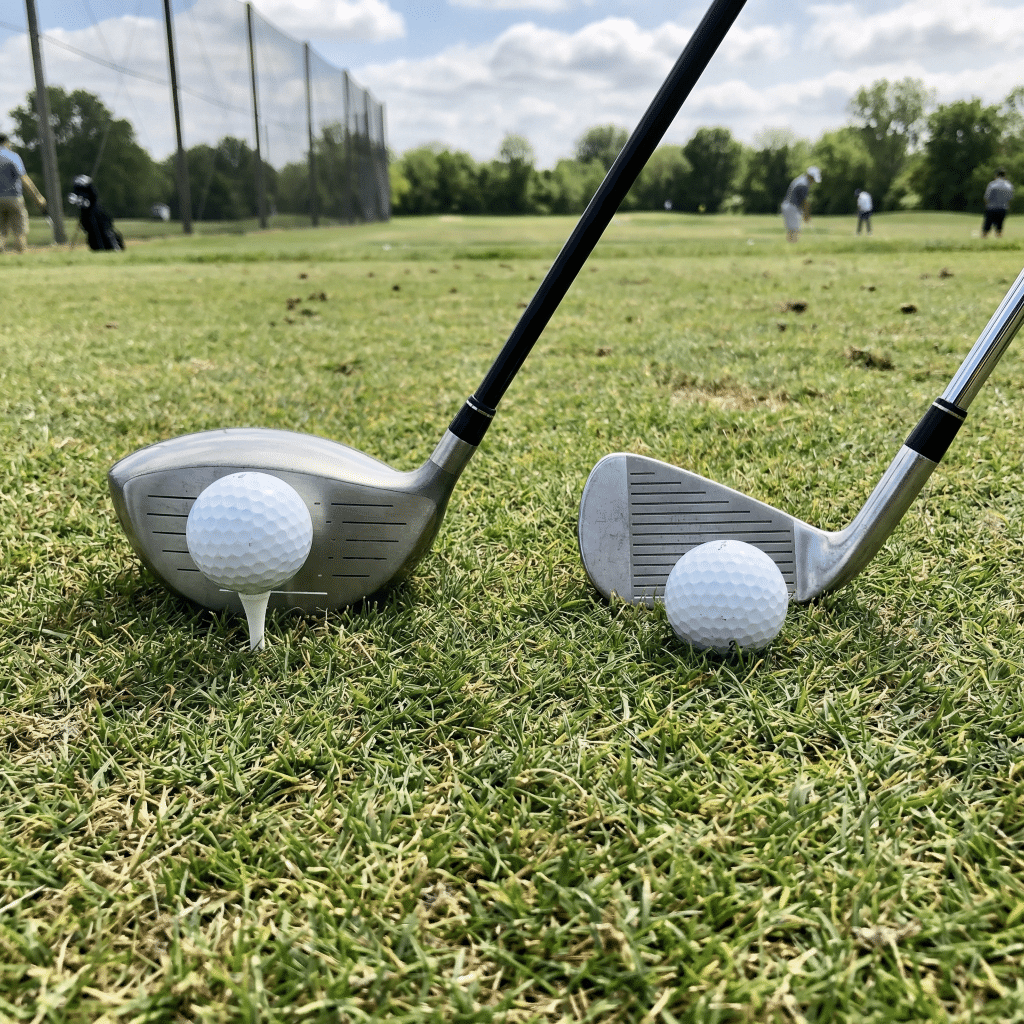
Ball Position
With irons, the ball is usually centered or slightly forward.
With a driver, it’s placed much farther forward—near the lead heel.
If your alignment isn’t adjusted correctly:
-
The clubface arrives open
-
The swing path moves across the ball
This alone explains why many golfers slice drivers but stripe irons.
If you want to correct these setup issues step by step, this guide on how to fix a golf slice walks through simple adjustments that can make an immediate difference.
Tee Height and Attack Angle
Teeing the ball high encourages golfers to:
-
Tilt the shoulders excessively
-
Drop the trail shoulder too much
-
Swing across the ball
Irons are hit off the ground, which naturally promotes better sequencing and contact.
Why This Is Especially Common for Seniors
As golfers age, a few physical changes can make the driver even harder to control:
-
Reduced wrist flexibility
-
Slightly slower swing speed
-
Less rotation through impact
These factors make it harder to square a low-lofted clubface consistently.
That’s why many seniors benefit from:
-
Equipment designed to help square the face
-
Slightly higher lofted drivers
-
More forgiving driver designs
We cover driver designs that help reduce face-angle errors and improve consistency in our guide to the best drivers for seniors who slice.
The Equipment Factor
While technique is always the foundation, drivers are not created equal.
Some drivers are designed to:
-
Reduce side spin
-
Promote a square face at impact
-
Increase forgiveness on off-center hits
This doesn’t “fix” a swing—but it can dramatically reduce how severe a slice becomes, especially when paired with better setup and awareness.
Quick Self-Check: Why Your Driver Slices but Irons Don’t
Ask yourself:
-
Do I swing harder with the driver?
-
Is my ball position much farther forward?
-
Do I feel rushed at the top of my driver swing?
-
Does my driver face look open at address?
If you answered yes to even one of these, you’ve identified a likely cause.
The Takeaway
You’re not broken—and your swing isn’t as far off as it feels.
Most golfers slice their driver but hit irons straight because:
-
Drivers amplify face angle errors
-
Longer shafts challenge timing
-
Lower loft punishes small mistakes
-
Setup differences change swing mechanics
Once you understand this, you can make smarter decisions—about practice, setup, and equipment—and finally start hitting more confident tee shots.